
Based on coverage from CBC, Global News, The Globe and Mail, The Epoch Times, and Toronto Star.
Parti Québécois Leader Paul St-Pierre Plamondon says he suspects the federal government may be spying on his party, even though he acknowledges he has no proof and says the PQ lacks the means to verify it.
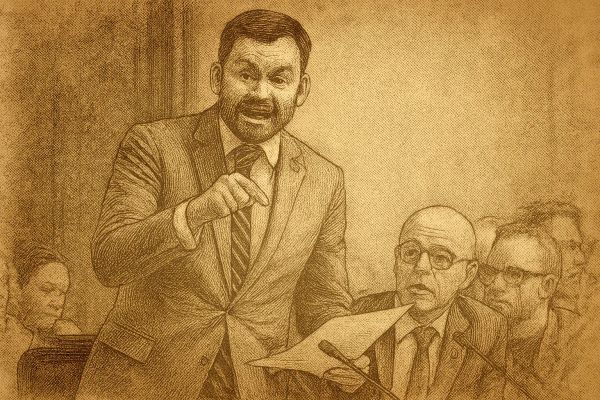
Speaking at a news conference at the Quebec legislature this week, St-Pierre Plamondon leaned on history as his main rationale, arguing that surveillance of the PQ and its key figures has been a recurring theme over decades. With the PQ leading in polling ahead of Quebec’s October general election and promising a sovereignty referendum by 2030 if it forms government, the timing has added fuel to an already touchy national unity debate.
Paul St-Pierre Plamondon raises Ottawa spying fears
St-Pierre Plamondon told reporters he’s acting on the assumption Ottawa could be listening, and pointed to how much easier it is to eavesdrop now that everyone carries a smartphone.
He described practical steps the party is taking during sensitive meetings: phones go into signal-blocking pouches and are kept out of the room. He framed the precautions as basic caution rather than paranoia, saying the party has a “duty to be cautious” given past experience.
At the same time, he conceded the central weakness of the claim: he cannot present evidence of current federal surveillance, and says the PQ doesn’t have the capacity to investigate on its own. One report also says he claimed to have “information” related to alleged spying, while still admitting he could not prove it.
Quebec election polls put PQ ahead
The comments land as the PQ is riding real momentum. Poll aggregator Qc125 suggests the party would win about 64 seats, enough for a slim majority, if Quebecers voted today.
That matters because the PQ has promised a sovereignty referendum by 2030 if it forms government. With only months to go before the October election, even vague allegations about federal interference can quickly become part of the campaign storyline, whether or not they’re backed up by proof.
History of RCMP and CSE surveillance in Quebec
On the history, St-Pierre Plamondon has some ground to stand on. Multiple reports point to well-documented examples of federal attention on the PQ in earlier decades.
One of the freshest reminders is the recent death of Claude Morin, a key figure in the PQ’s 1976 election win who was later revealed to have been a paid informant for the RCMP. St-Pierre Plamondon referenced the “shadows” around Morin’s legacy while paying tribute.
There are other examples cited from the 1970s through the 1990s: a public inquiry later detailed a 1973 RCMP break-in at a computer company to steal an electronic PQ membership list. Reporting has also described past monitoring of separatist politicians by the Communications Security Establishment in the 1980s, and Radio-Canada reporting from 1994 that CSE kept files on leading PQ members.
What’s far less clear, based on the coverage here, is whether anything like that is happening now.
Quebec and federal reactions to the allegation
Quebec’s public security minister, Ian Lafrenière, said he was surprised by the PQ leader’s remarks and voiced doubt. “I’m not saying it’s impossible. I really doubt it,” he said, adding the PQ’s positions and strategy are already well known. He also suggested foreign interference is a bigger worry.
Other sovereigntist voices weren’t rushing to agree, either. Québec solidaire spokesperson Ruba Ghazal said she isn’t worried about being spied on by Ottawa, despite leading a sovereigntist party.
On the federal side, the RCMP did not immediately comment in the reporting provided, and Prime Minister’s Quebec lieutenant Joël Lightbound declined to comment.
Security experts say federal spying is unlikely today
Canadian intelligence and national security experts quoted in the coverage say modern-day surveillance of a provincial political party is highly unlikely.
Wesley Wark, a senior fellow at the Centre for International Governance Innovation, called it “preposterous” to assume the PQ would be spied on today, pointing to tighter rules after the creation of CSIS in 1984, when the RCMP’s intelligence role was replaced. He argued that the legal categories CSIS investigates (such as espionage, sabotage, foreign interference, terrorism, and subversion) wouldn’t fit the PQ.
At the same time, Citizen Lab research fellow Bill Robinson said it’s still sensible for political parties to treat surveillance as a real-world risk and to keep phones out of meetings. His twist: if someone is listening, he suggested it’s more likely to be foreign governments than Ottawa.
For now, the PQ leader says the precautions stay, and the allegation, evidence or not, is now part of the political weather heading into October.
Support Independent Canadian News Analysis
The Canada Report is supported by readers like you. If this article helped you understand what’s happening, you can support our work with a one-time tip.
Support The Canada Report