
| Sourced from 6 independent sources · no points in dispute |
CBC, paNOW, Prince Albert Daily Herald, 98 COOL, CKOM, and Global News
Every key fact in this report is confirmed by more than one independent source.
8 key facts · 8 corroborated · none disputed
This summary is compiled from the independent sources listed above.
A new Saskatchewan wildfire agreement begins with a blunt premise from Prince Albert Grand Council Grand Chief Brian Hardlotte: “At the end of the day, a wildfire doesn’t care whose jurisdiction it’s in.”
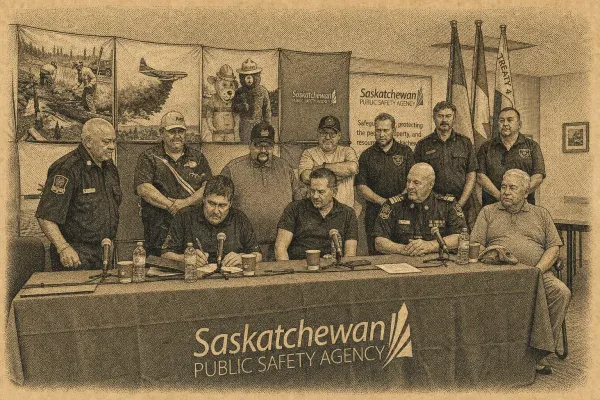
The Saskatchewan Public Safety Agency, Prince Albert Grand Council and Meadow Lake Tribal Council have signed a memorandum of understanding to formalize collaboration on wildfire management, with the goal of strengthening wildfire preparedness, prevention, response and recovery across Saskatchewan. The agreement follows a 2025 wildfire season that prompted reviews, concerns and calls to fix preparedness gaps.
A More Structured Wildfire Partnership
The MOU creates a more structured approach to collaboration among SPSA, PAGC and MLTC leaders around wildfire seasons. Improved communication and coordination are central goals.
SPSA president and fire commissioner Marlo Pritchard said one expected outcome is “enhanced communication,” adding that improvement will be ongoing.
“That will be probably a never-ending cycle of improvements, because we know communication was one of the first things that broke down last year,” Pritchard said.
The agreement also brings Indigenous Services Canada and the Canadian Forest Service into relevant wildfire-management discussions, adding federal participation to the table as priorities and recommendations are discussed.
Pritchard said the agreement reflects a commitment to work alongside First Nations leadership “to strengthen wildfire preparedness, improve response efforts and support long-term community resilience.”
Local Knowledge At The Table
A key piece of the MOU is the First Nations Wildfire Strategy Working Group, which will provide a forum to share local and traditional knowledge, community experience and lessons learned from previous wildfire events.
Hardlotte said that knowledge needs to be part of planning before emergencies unfold.
“First Nations have generations of knowledge about our lands, our forests and the communities we are working to protect,” he said. “That knowledge needs to be part of wildfire planning from the beginning, not only when an emergency is already underway.”
He also framed the agreement as a way to move beyond talk.
“We want recommendations to lead to action, and I’m also glad to see our federal partners involved,” Hardlotte said. “When a fire threatens a First Nation, our people want to know there’s a plan.”
Faster Initial Attacks Near Communities
For Meadow Lake Tribal Council communities, one practical focus is using community-based crews for faster initial attacks on small fires near communities.
MLTC Chief Jeremy Norman said the goal is quicker action when a possible fire is spotted close to home.
“You see a lightning strike or you see something smoldering near your community, we’re open to attack it right away before it gets too big,” Norman said.
He said being able to send crews early, while a fire is still small, “could be a game-changer.”
“We’re working together to find a better way to fight fire, find a better way to utilize our people to work together,” Norman said. “So, I feel we’re on the right step.”
Fixing Gaps Before Fire Season
The MOU was signed in the shadow of Saskatchewan’s 2025 wildfire season, which triggered reviews, public concerns and demands for improvements in preparedness. Leaders involved in the agreement are positioning it as a way to build relationships before the next emergency, rather than trying to create coordination while communities are already under threat.
Hardlotte said past wildfire seasons showed the need to know “how we’re going to work together before our communities are under threat.”
The agreement does not erase the risks facing communities, but it does set out a clearer process for SPSA, PAGC and MLTC to keep talking around wildfire seasons, bring First Nations knowledge into planning and involve federal partners in relevant discussions.
For Norman, the emphasis is on making sure local capacity is not left waiting when smoke appears.
“We feel that our crews are capable of more,” he said.
Reader-funded. No ads. No paywall.
The Canada Report is independent, reader-funded Canadian news — no advertisers, nothing behind a paywall, kept free for everyone. If you value it, you can help keep it that way.
Support The Canada Report →Source 1 | Source 2 | Source 3 | Source 4 | Source 5 | Source 6