
| Sourced from 5 independent sources · no points in dispute |
CBC, Castanet, Lake Country Calendar, Canadian Defence Review, and KelownaNow
Every key fact in this report is confirmed by more than one independent source.
7 key facts · 7 corroborated · none disputed
Allegations described here are not proven in court unless stated.
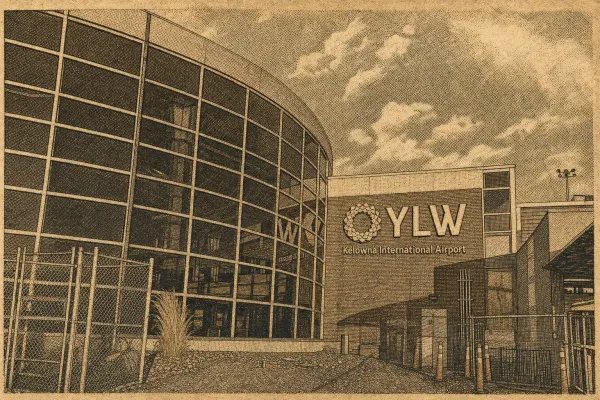
Kelowna International Airport is preparing to open up more than 165 acres of employment and industrial land on its east side, backed by a federal commitment of up to $22.4 million.
The money, announced by Kelowna MP and Secretary of State for Defence Procurement Stephen Fuhr, will support the YLW Economic Enabling Infrastructure Project through the Build Communities Strong Fund. The work is designed to tackle a basic but consequential obstacle: the lack of utility servicing needed for development.
Servicing Kelowna Airport’s East Lands
The project will add water, sewer, electrical and communications infrastructure to the airport lands. Those services are intended to remove barriers that have limited development and prepare the site for future aerospace, aviation, logistics, advanced manufacturing, technology and training facilities.
The Kelowna project follows a similar pattern seen in the Canada Report’s coverage of Winnipeg Airport Lands Development Secures $32M Funding from Federal and Provincial Governments, where public investment was used to unlock airport-adjacent industrial land for future growth. That broader context helps frame the latest funding as part of a wider push to turn underused airport property into serviced sites for aviation and logistics development.
“This investment removes the infrastructure barriers and creates serviced airport, industrial land,” Fuhr said at a news conference. “We are strengthening the local economy, creating opportunities for skilled training jobs, and opening the door to Canada’s aerospace industry to grow right here at home.”
The initial phase is expected to service about 90 acres of development-ready land. Major construction is set to begin in spring 2027, with the overall project expected to be complete in 2028.
For Phillip Elchitz, YLW’s director of operations and innovation, the utility work carries a larger ambition.
“Today is more than just infrastructure. Today is unlocking possibilities,” Elchitz said. “We see airports as economic engines, places where innovation happens, where investment is attracted, where industry grows, where people build careers, and where communities create the conditions for long term prosperity.”
A $58.8-Million Infrastructure Project
The federal contribution is part of a $58.8-million project to develop the airport’s east lands. The remaining $36.4 million will be financed through the Municipal Finance Authority.
The investment is focused on the practical work that can make industrial development possible: connecting land to the systems businesses need to build and operate. Once that work is underway, airport officials expect the newly serviced area to support private-sector activity connected to aviation and other industries.
Fuhr described the funding as an opportunity to unlock airport lands, draw new investment and aerospace companies, and create skilled Canadian jobs in the Okanagan.
Aerospace Companies Show Interest
Several aviation and aerospace businesses have already shown interest in the land. De Havilland Canada, Wildcat Helicopters and FireSwarm Solutions have expressed interest or signed letters of intent to use the newly serviced space.
Elchitz said the airport is already working through potential parcels for the companies. “We have a pretty good idea of where De Havilland is going to go and where FireSwarm is going to go and where Wildcat is going to go,” he said.
De Havilland Canada board co-chair Sherry Brydson called the opportunity full of potential. “There’s endless possibilities,” she said, adding that the company has been seeking a warm Canadian location for aircraft finishing work.
Wildcat Helicopters sees the airport lands as a chance to expand. Brett Michaud said the company is running out of space at its West Kelowna location and could benefit from access to YLW’s runway and landing infrastructure.
Wildfire Drone Technology in the Mix
FireSwarm Solutions, which is developing autonomous firefighting drones for wildfire suppression, is also among the prospective users of the land.
Its CEO, Alex Deslauriers, said co-locating drone technology with established aerospace companies could be a strong fit. “Having this drone innovation hub co-located at an airport alongside De Havilland and Wildcat Helicopters is a perfect mix,” he said.
The airport project does not itself build aircraft, helicopters or drones. Its purpose is more foundational: to put the water, sewer, electrical and communications systems in place for businesses that may build the next phase of Kelowna’s aerospace and industrial footprint.
Reader-funded. No ads. No paywall.
The Canada Report is independent, reader-funded Canadian news — no advertisers, nothing behind a paywall, kept free for everyone. If you value it, you can help keep it that way.
Support The Canada Report →Source 1 | Source 2 | Source 3 | Source 4 | Source 5
Sign up for The Canada Report
Your modern digest of Canadian news. Friendly, clear, and in your inbox.
No spam. Unsubscribe anytime.