
| Sourced from 5 independent sources · 1 point in dispute |
paNOW, SaltWire, Daily Herald Tribune, Canadian Lawyer, and Rebel News
Sources agree on most key facts but differ on 1 point.
10 key facts · 10 corroborated · 1 disputed
Where sources differ
The size of the enhanced or shelter assistance Lowe sought
Daily Herald Tribune: Lowe applied to move from $380 per month in essentials assistance to the enhanced rate of $974 per month.
Canadian Lawyer: Lowe applied to increase his rate from $380 per month under the essentials tier to $974 per month under the enhanced tier.
Rebel News: Lowe was receiving $380 per month plus a $92 allowance and was denied an additional $974 in shelter assistance.
Allegations described here are not proven in court unless stated.
Bradley Lowe’s tent was not just a possession. For the Nova Scotia Court of Appeal, it was accommodation under income-assistance rules.
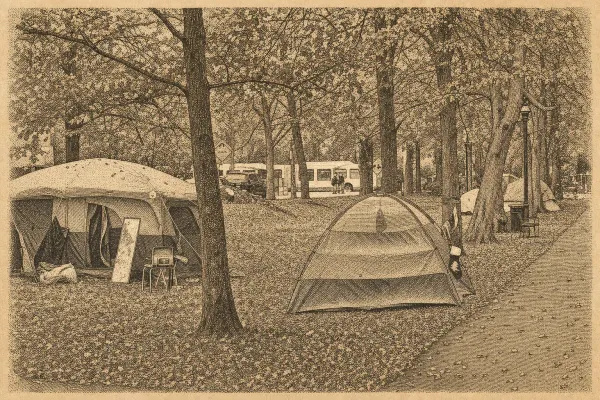
Lowe was living in a tent he owned in Halifax’s Victoria Park and receiving $380 a month in basic income assistance when he sought higher benefits in 2023. He asked for the enhanced rate on the basis that he had a disability and owned his tent as his accommodation. He died before the case ended, but the legal challenge continued on his behalf.
A denial based on shelter type
The Department of Community Services denied Lowe’s application because it classified him as unhoused and found he did not meet the accommodation requirement.
That decision survived the first stages of appeal. The Assistance Appeal Board upheld the denial. The Supreme Court of Nova Scotia later found the board’s decision unreasonable, but still held that Lowe did not qualify for the enhanced rate.
The Court of Appeal has now set aside the board’s decision, ruled that Lowe’s tent qualified as accommodation under the regulations, and concluded that he was entitled to the higher assistance he had been denied.
Court reads accommodation broadly
At the centre of the case was a simple but consequential question: can a tent count as accommodation for someone seeking income assistance?
The Court of Appeal said yes.
The court reasoned that accommodation has a broad meaning that includes a tent used as a primary shelter. It also found that Nova Scotia’s income-assistance law is meant to help people in need without restricting assistance by shelter type.
“The court found that the hearing judge erred in interpreting the Regulations, as the term ‘accommodation’ should include the applicant’s tent,” Chief Justice Michael J. Wood wrote in the decision, according to the source reporting.
The ruling changes the way the rules apply to people in similar circumstances. It sets a precedent for other Nova Scotians living in tents who are eligible for income assistance to seek higher benefits.
A precedent for tent residents
Vince Calderhead, quoted in the source reporting, framed the decision as a reminder that income assistance is a legal entitlement, not a favour.
“Social assistance isn’t a charitable thing. It’s an entitlement, and the law,” Calderhead said.
He said the ruling does not mean everyone living in a tent automatically qualifies for the enhanced rate. But for people who are otherwise eligible for income assistance and meet the relevant criteria, the shelter they use cannot be the reason they are turned away.
According to Calderhead, Lowe’s case was not only about his own circumstances. He said Lowe wanted to challenge what he saw as broader injustice facing people living without conventional housing.
“He came forward and said, ‘Look, we’re treated terribly in terms of the amount of money we’re receiving from government,’” Calderhead said.
Women’s safety before the court
The Elizabeth Fry Society of Mainland Nova Scotia intervened in the case to emphasize that income-assistance rules can worsen the safety risks and economic hardship faced by women living in tents.
Emma Halpern, the society’s executive director, called the ruling a win that recognizes the humanity of vulnerable people.
“I feel like this is a win for all Canadians in that I really, deeply believe that we are only as healthy as our most vulnerable people,” Halpern said.
The Court of Appeal also rejected the province’s argument that increased assistance could encourage women fleeing abuse to choose tent encampments over transition houses.
Halpern said she was pleased to see that argument fail.
“I’ve never heard of anyone deciding they want to live permanently in a tent so they can get an extra couple hundred bucks a month,” she said.
She also described the practical hardship faced by people trying to survive outdoors. “You have to live somewhere, and there’s nowhere that’s cheap to live,” Halpern said.
A case carried after death
Lowe did not live to see the final result. But the case continued after his death, and the Court of Appeal’s ruling now reaches beyond his own application.
His family kept the challenge alive. Jackie Lowe said she hoped the decision would help others.
“I am so pleased with the outcome, and my hope is that the decision will help others in the future,” she said. “Bradley was a father, son and brother. He was loved and is missed every day.”
Reader-funded. No ads. No paywall.
The Canada Report is independent, reader-funded Canadian news — no advertisers, nothing behind a paywall, kept free for everyone. If you value it, you can help keep it that way.
Support The Canada Report →