


Heads up: some of the links in this post are affiliate links. That means if you click and purchase, we may get a commission. It's how we keep this site running without cluttering it with ads.
At 7 a.m., a family in an Ontario townhouse starts the car in its attached garage while the gas furnace and fireplace are running inside. That is exactly the kind of ordinary household moment a carbon monoxide alarm is meant to guard against. CO risk is not confined to one season: it follows fuel-burning appliances, attached garages, fireplaces, generators and backup heat—at home, in a cottage or in an RV.
For most households, our top pick is the Kidde C3010D Worry-Free Carbon Monoxide Alarm. A sealed 10-year battery and a digital display mean you install it, test it, and forget it until it tells you it is done. Protection starts around $31 if you just need an alarm in one more room, but the right choice depends on where it will sit, how it is powered and how many alarms your layout needs. Our curated picks, based on specifications, prices and user ratings, are laid out in the comparison table below.
Quick Overview: Our Top Picks
| Product | Best For | Why We Love It | Price |
|---|---|---|---|
| Best overall | Sealed 10-year battery and a digital CO readout — nothing to maintain until the unit expires. | $61.00 CAD | |
| Best budget | UL-listed battery alarm with a seven-year end-of-life warning, for rooms with no outlet nearby. | $31.15 CAD | |
| Best plug-in | Plugs into any non-switched outlet and keeps working on AA backup through a power cut. | $35.58 CAD | |
| Best for outages | Adds a sealed 10-year lithium backup and a digital display to the plug-in format. | $73.92 CAD | |
| Best portable | Pocket meter with audible and visual alerts for rentals, hotel rooms and RVs — alongside your fixed alarms, not instead of them. | $34.99 CAD |
Kidde C3010D
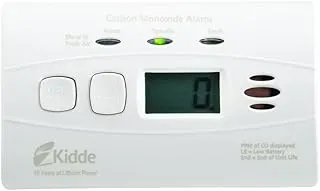
At $61, the Kidde C3010D buys the two upgrades that matter most for low-maintenance protection: a sealed 10-year battery and a digital display. Its electrochemical sensor and audible alarm make it a practical standalone carbon monoxide detector for homes, apartments, cottages or RVs where fuel-burning appliances, attached garages or backup heating create year-round risk. The listed 87,600-hour battery life matches the 10-year design, so there are no routine battery swaps to remember and no battery door for anyone to raid. The display's most useful trick is peak-level memory: it shows the highest CO concentration measured since the last reset, so you can tell whether something happened while the house was empty rather than only being warned while you are standing in front of it. Its 4.7-star average from 1,223 customers is the strongest backing of any alarm here, and Amazon lists it as a Choice pick in the category. It costs more than entry-level battery alarms, but the display and sealed power make the premium sensible for a main-floor or bedroom-hallway alarm.
Pros
- Sealed 10-year battery eliminates routine battery replacement
- Digital display with peak-level memory shows the highest reading since reset
- Strong 4.7-star rating from 1,223 customers
Cons
- Higher upfront cost than basic battery-powered CO alarms
- The whole unit has to be replaced at 10 years — the battery is not serviceable
Kidde Nighthawk
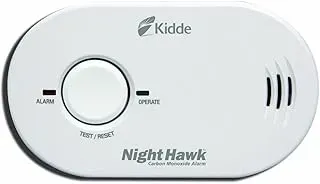
The Kidde Nighthawk is the one to buy when you simply need another alarm on another floor and there is no outlet where it should go. It is a straightforward standalone CO alarm running on three AA batteries, included in the box, with an electrochemical sensor and a test-reset button. Two things the spec sheet does tell you, and both matter: it meets Underwriters Laboratories requirements, and it gives a seven-year end-of-life warning rather than the ten years you get from a sealed unit. That shorter service life is the real trade for the lower price — not the battery changes, which are a minor chore by comparison. At $31.15 it is the cheapest fixed alarm in this guide, and its 4.6-star average from 335 ratings is solid for a model that has been on the market for years. The outlet-free design also gives Canadian households more freedom to position an alarm where the manufacturer's instructions and local requirements say it belongs, rather than beside a receptacle.
Pros
- Cheapest fixed alarm here, with three AA batteries in the box
- UL listed, with a dedicated electrochemical CO sensor
- Battery power avoids dependence on a nearby outlet
Cons
- Seven-year service life, three years shorter than the sealed picks
- No digital display, so you get an alarm rather than a reading
Kidde Plug-In CO Alarm
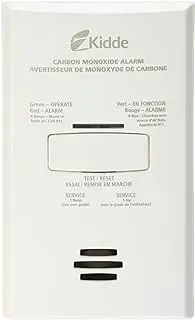
For a home, apartment, cottage or RV with an accessible outlet near the intended alarm location, the Kidde 900-0263CO-CA suits shoppers who prefer plug-in convenience. Its electrochemical sensor triggers an audible alarm, and two AA backup batteries keep it alive through the kind of winter outage that also has people running a generator or firing up backup heat. There is a tamper-resist mode that puts the unit into constant alarm if it is unplugged or works loose from the outlet, a low-battery hush that silences the chirp for twelve hours so you are not changing batteries at 2 a.m., and a ten-year end-of-life chirp when the alarm itself needs replacing. It measures 4 by 7.2 by 11.9 cm and weighs 272 g, so it is a compact standalone CO alarm rather than a smoke-and-CO combo unit. At about $36 — currently the second-cheapest pick here — its 4.7-star rating from 2,127 customers gives it the largest review base in this guide.
Pros
- Two AA backup batteries keep it running through a power cut
- Tamper-resist mode and a twelve-hour low-battery hush
- 4.7 stars from 2,127 customers, the largest review base here
Cons
- Requires an available electrical outlet at the alarm location
- Standalone CO alarm, not smoke-and-CO protection
Kidde Plug-In with Sealed Backup
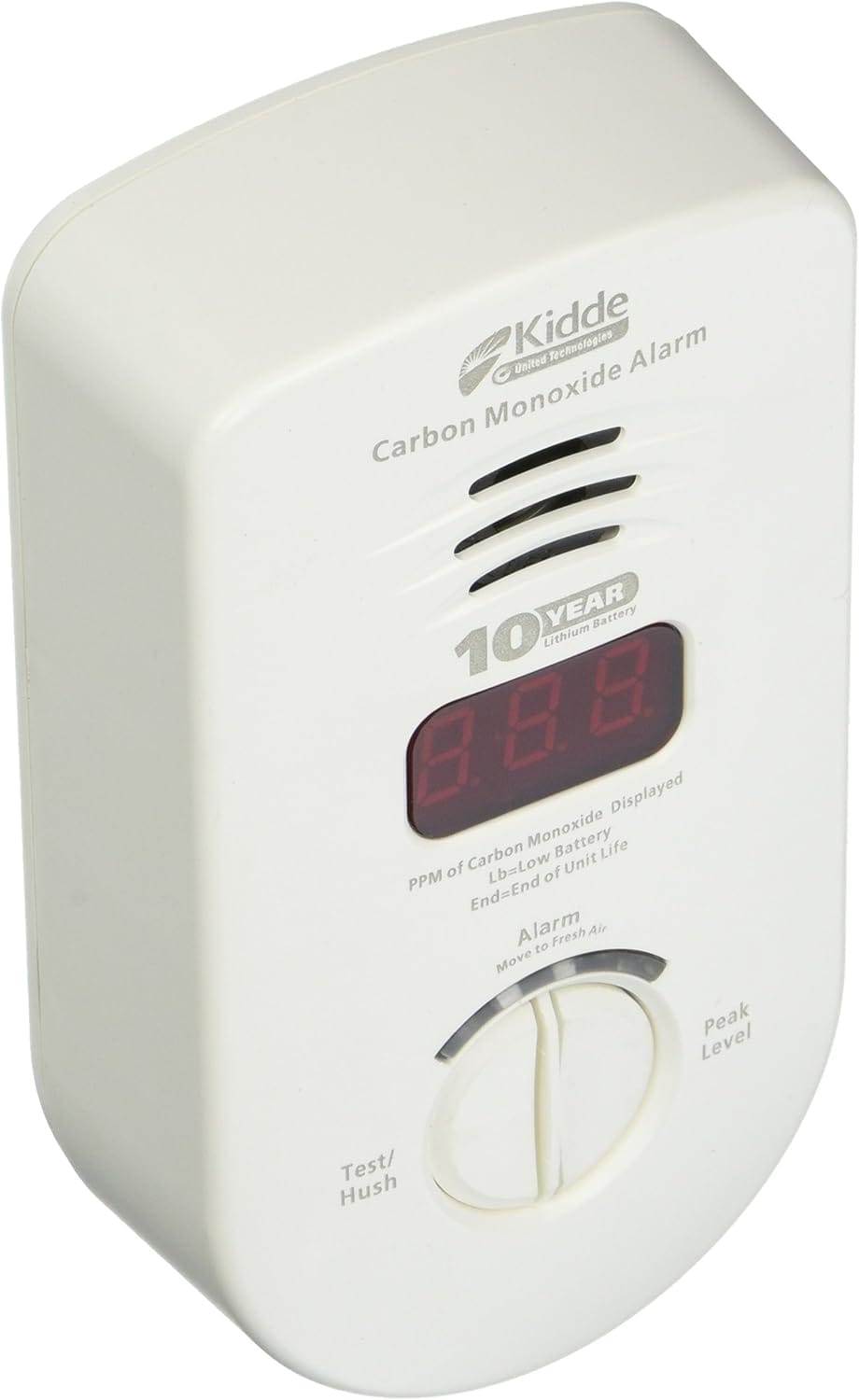
If you like the convenience of a plug-in but not the idea of AA cells as your backstop, the Kidde 21026350 is the version to buy. It combines an outlet-powered alarm with a sealed 10-year lithium backup and a digital display, so it keeps monitoring through an outage and there is no battery door to open — or to leave open. At $73.92 it is the most expensive pick here, and its 4.8-star average across 65 ratings is the highest, with Amazon's Choice in the carbon monoxide category. The sealed backup is the whole argument: a plug-in alarm with dead backup batteries is just a plug-in alarm, and an outage is precisely when portable generators, camp stoves and backup heat come out across the neighbourhood. Worth noting before you buy — Amazon lists only a 30-day warranty on this particular listing, which is short next to the ten-year terms on the other Kidde alarms here.
Pros
- Plug-in convenience with a sealed 10-year lithium backup
- Digital display alongside the audible alarm
- Highest-rated pick here at 4.8 stars
Cons
- Roughly double the price of the standard plug-in alarm
- Amazon lists only a 30-day warranty on this listing
TopTes CT-300
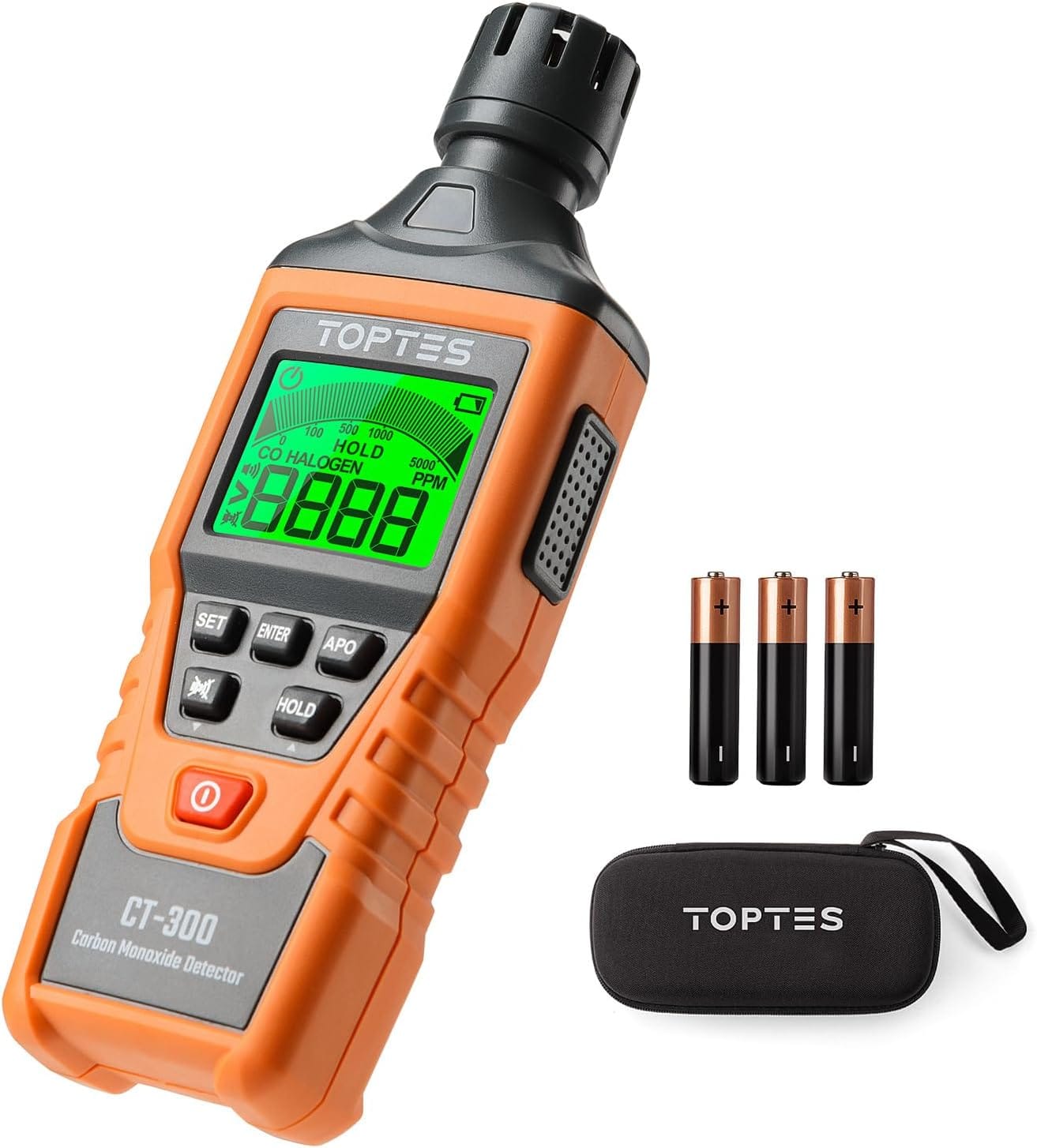
A portable meter is not a substitute for a fixed alarm, and this pick is not an argument that it is. It is for the situations Canadian households actually run into: a rented cabin with an unfamiliar propane heater, a hotel room, a fifth-wheel, a garage workshop. The TopTes CT-300 reads 0 to 5000 ppm on a backlit screen and alerts with both sound and a colour change, runs about 40 hours on the three AAA batteries it ships with, and comes in a hard case. At $34.99, with a 4.3-star average across 532 ratings and Amazon's Choice in the carbon monoxide category, it is a considerably better-documented option than most pocket meters on Amazon.ca. Bring it where fixed alarms do not exist — and if you are cooking on a camp stove, keep it outside regardless of what any meter says. Our camping stove picks for Canada cover the ventilation side of that in more detail.
Pros
- Audible and visual alarms plus a backlit 0–5000 ppm readout
- Hard case and three AAA batteries included
- Amazon's Choice in Carbon Monoxide Detectors, 4.3 stars from 532 ratings
Cons
- No certification listed — treat it as a monitor, not a life-safety alarm
- About 40 hours of runtime, so it needs battery attention on longer trips
Standalone Carbon Monoxide Alarms vs Smoke-and-CO Combo Detectors: Which Do You Need?
Standalone carbon monoxide alarms are the straightforward choice when smoke coverage is already handled or when you need CO protection in a specific spot, such as near a sleeping area, furnace room or attached garage entry. They also let you choose power that suits the location: battery models work where no outlet is nearby, while a plug-in carbon monoxide detector is convenient in a visible outlet location. The Kidde Nighthawk shows how affordable that basic coverage can be, at $31.15.
A smoke-and-CO combo detector can reduce the number of devices on the ceiling and may make sense during a broader smoke-alarm update. It is often the better fit for homes replacing several aging alarms at once. Still, a combo unit is not automatically the best choice for every location; placement needs for smoke and CO can differ. Before replacing anything, confirm what protection is already in place and check provincial, municipal, landlord or condominium requirements — a detached Alberta home with an attached garage may need coverage in different areas than a compact Montréal apartment. For cottages, apartments and RVs, a dedicated CO alarm can be simpler to place and replace without disturbing the smoke-alarm setup.
What Does Spending More on a Carbon Monoxide Detector Buy You?
The floor for a fixed alarm here is $31.15, and the Kidde Nighthawk at that price is genuinely enough if you want a conventional battery-powered alarm and are prepared to replace it at its seven-year end-of-life date. Around $35 the picture gets more interesting than the small price gap suggests: the Kidde plug-in at $35.58 adds AA backup power and a tamper-resist mode for barely more money, while the TopTes CT-300 at $34.99 does a completely different job — rentals, hotel rooms and RVs where no fixed alarm exists at all.
The clearest upgrade is convenience. Our top pick, the Kidde C3010D, costs $61 and combines a 10-year sealed battery with a digital display and peak-level memory. Its 4.7-star rating from 1,223 reviews makes the added cost easier to justify for a main home alarm that should need no attention across its service life. Spending $73.92 on the Kidde 21026350 buys the plug-in format with a sealed 10-year lithium backup instead of AA cells, which is the version worth having if outages are common where you live. Before paying more, compare end-of-life dates and warranty terms directly — a higher price does not automatically mean longer coverage, and the gap between a seven-year and a ten-year alarm is three years of protection you either have or you do not.
Power, Placement and Display Features That Matter More Than Fancy Extras
Battery, Plug-In or a Sealed 10-Year Supply
Power source shapes the ownership experience more than any other spec. A replaceable-battery model such as the Kidde Nighthawk costs $31.15, runs on three AA cells and uses an electrochemical sensor, making it a straightforward option for spaces without a convenient outlet. A plug-in carbon monoxide detector, such as Kidde's 900-0263CO-CA at $35.58, suits a location with a reliable outlet and keeps working on AA backup when the power drops. If you want the plug-in format without backup batteries to think about, the Kidde 21026350 at $73.92 seals a 10-year lithium cell inside. And for the least routine attention of all, the C3010D has a sealed battery rated for 87,600 hours — 10 years — at $61. The honest summary: pick the power style you will actually maintain, because an alarm with a flat battery protects nobody.
Placement, Quantity and a Testing Habit
One alarm rarely covers an entire multi-level home. Plan around sleeping areas, each level, and locations affected by attached garages or fuel-burning appliances, following the manufacturer's instructions and local requirements. A bungalow in Saskatchewan with a gas furnace has different coverage needs from a two-storey Ontario home with a basement fireplace and garage. Keep alarms where they can be heard by sleeping occupants, and give cooking appliances a few metres of clearance so ordinary kitchen fumes do not set off nuisance alarms. Generators deserve their own mention: they are one of the biggest CO sources in a Canadian winter, they come out exactly when the power is down, and they belong well away from the house and never in a garage — our guide to home backup and portable generators covers safe placement in more detail. Test alarms according to their instructions, replace batteries in the models that need them, and remember that a detector is not a substitute for maintaining furnaces, fireplaces, chimneys and vehicle exhaust systems. The best carbon monoxide detector is the one installed in the right spot and still working.
Digital Readings and Portable Monitoring
An audible warning is essential, but a digital display adds context by showing a CO reading rather than only signalling an alarm — and, on the C3010D, the highest reading since the last reset. That peak-level memory is the practical advantage: it can tell you something happened while the house was empty. Portable devices serve a different role again. The TopTes CT-300 costs $34.99, reads 0 to 5000 ppm on a backlit screen and alerts with both sound and colour, which makes it useful for a rented cabin, a hotel room or an RV. Treat it as portable monitoring rather than a replacement for properly placed home alarms — it is not certified for that job, and nothing about a pocket meter changes what the wall of your house needs.
Comparing Retail Listings Without Chasing the Wrong Bargain
When checking a carbon monoxide detector at Costco, Home Depot or Walmart, compare the exact model number, power type and included display instead of relying on a product photo or retailer category. Stock varies by region, especially in smaller northern communities and coastal markets. Above all, confirm the alarm carries a CSA or ULC certification mark. That is the check that matters in Canada — an electrochemical sensor is table stakes, and a sensor spec on a listing tells you nothing about whether the finished device was tested against the Canadian standard. Uncertified pocket meters are useful as extra eyes; they are not what a fire inspector, an insurer or a landlord is looking for on the wall. A low sticker price may be worthwhile for a basic battery model, but account for the end-of-life date you are buying into.
Frequently Asked Questions
What is the best carbon monoxide detector for most Canadian homes?
The Kidde C3010D Worry-Free Carbon Monoxide Alarm is our top all-around pick, based on its 4.7-star rating from 1,223 customers, its 10-year sealed battery and its digital display. At $61 it costs more than basic alarms, but it avoids routine battery replacement for its entire service life, and its peak-level memory shows the highest CO reading since the last reset. The standalone format suits homes that need CO coverage without replacing existing smoke alarms. Install it according to the manual and your local requirements.
What should I do if my carbon monoxide alarm goes off?
Get everyone outside to fresh air first, including pets, and call 911 or your local fire department from outside. Do not open windows and go back to bed, and do not go hunting for the source yourself — CO is invisible and odourless, and the early symptoms of exposure (headache, nausea, confusion) are the same ones that make people decide it is probably nothing. Stay out until responders tell you the building is clear, then have the furnace, fireplace or appliance inspected before it is used again. One thing worth learning in advance: four beeps in a repeating pattern is a real CO alarm, while a single chirp every minute or so is a low battery or an end-of-life warning. They mean very different things at 3 a.m.
Where should I place CO alarms in a Canadian home, apartment, cottage or RV?
Put an alarm on every level of the dwelling and outside sleeping areas, following the manufacturer's distance and mounting instructions. Give particular attention to rooms near fuel-burning appliances, an attached garage, a fireplace, a wood stove or a backup heater — while keeping a few metres of clearance from cooking appliances, since ordinary kitchen fumes can cause nuisance alarms. CO risk in Canada is year-round; it is tied to combustion sources, not winter alone. For cottages and RVs, confirm the alarm is rated for the space and the temperature range it will sit in.
Should I buy a battery, plug-in or 10-year sealed carbon monoxide detector?
Choose a battery model where an outlet is unavailable or where flexible placement matters. A plug-in carbon monoxide detector such as the Kidde 900-0263CO-CA is convenient near a suitable outlet, and its AA backup keeps it working during a power cut. A sealed 10-year alarm removes battery changes altogether and is a strong fit for hard-to-reach spots. Whichever you pick, placement should be driven by the manufacturer's instructions and your local requirements rather than by where the power happens to be, and the full unit gets replaced at its stated end-of-life date.
Can a portable carbon monoxide detector replace a fixed alarm?
No. A portable carbon monoxide detector is a travel and spot-monitoring companion, not the life-safety alarm for a home. The TopTes CT-300 gives you a 0–5000 ppm reading with audible and visual alerts in a pocket-sized case, which is genuinely useful in a rental cabin, a hotel room or an RV. Keep certified alarms permanently installed in sleeping and living areas, then use portable monitoring for the temporary settings where none exist. Never rely on a handheld device while sleeping unless its instructions specifically support that use.
Which Carbon Monoxide Detector Is the Right Fit for Your Canadian Home?
For most Canadian households, the Kidde C3010D is the sensible pick. At $61, its 10-year sealed battery removes the routine battery-change chore, while the digital display and peak-level memory give you a reading when you want more than an alarm sound. It suits a main living area, a hallway near bedrooms, a cottage or a rental unit where low-maintenance protection matters and battery changes are easy to forget.
There are good reasons to spend less or choose a different format. The Kidde Nighthawk, at $31.15 and UL listed, is a practical battery-powered choice for adding coverage to another floor or a spot without a nearby outlet, provided you diary its seven-year replacement date. If you want a plug-in for a regularly used room, the Kidde 900-0263CO-CA costs $35.58 with AA backup, and the Kidde 21026350 at $73.92 seals that backup in for a decade. For trips, the TopTes CT-300 covers the rooms your own alarms cannot.
Before buying, count the levels in your home and identify every fuel-burning appliance, the attached garage and any backup heat source. Install alarms according to the manufacturer's instructions and local requirements, confirm each one carries a CSA or ULC mark, test them regularly, and replace them at their end-of-life date rather than waiting for them to fail quietly. Choose the power style you will actually maintain, then place enough alarms to protect the spaces people sleep and live in.
Our recommendations are curated from listed specifications, prices, ratings and product features rather than in-house testing.