

Heads up: some of the links in this post are affiliate links. That means if you click and purchase, we may get a commission. It’s how we keep this site running without cluttering it with ads.
Canadian homes see an average of 2–3 power outages a year, and when an ice storm hits Ottawa, a windstorm darkens Calgary, or a nor’easter rolls over the Atlantic coast, a portable generator is what keeps the sump pump running, the fridge cold, medical devices powered, and your family comfortable until the grid comes back. The same unit pulls double duty the rest of the year at the cottage, the job site, or a backyard gathering.
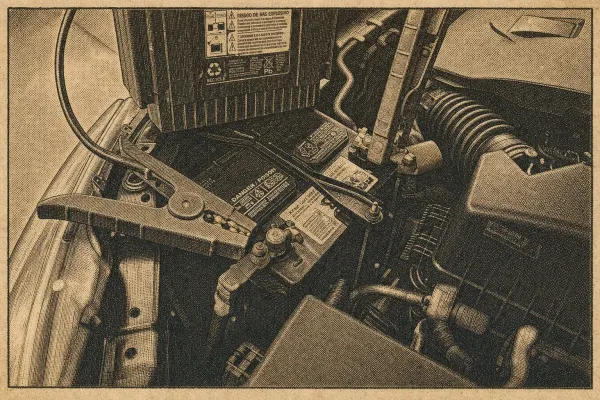
This guide rounds up five portable generators that stand out for Canadian life and emergencies: quiet inverter models for tight neighbourhoods and campgrounds, a dual-fuel unit for cold-weather flexibility, and a battery/solar station that’s safe for indoor condo use. Picks are based on specs, price, and user reviews on Amazon.ca — we’ll help you match wattage and features to your home, whether you’re powering essentials through a blackout or heading off-grid for the weekend. A proper car emergency kit is worth pairing with backup power if winter driving is part of your routine.
Quick Overview: Our Top Picks
| Product | Best For | Why We Love It | Price |
|---|---|---|---|
| Best overall home backup | Amazon’s Choice with clean 4000W inverter power, smart gauge, and eco mode for effortless outage management. | $518.99 CAD | |
| Condo and apartment dwellers | Silent, fume-free backup for essentials; fast recharging and optional solar keep you powered indoors. | $209.00 CAD | |
| Best budget pick for essentials | Ultra-quiet, lightweight, and clean enough for laptops and CPAPs while keeping lights and a fridge running. | $419.00 CAD | |
| Safety-focused families | CO sensor, LED light, weatherproof cover, and quiet 4000W output deliver safer overnight backup. | $539.00 CAD | |
| Dual-fuel flexibility in the cold | Runs on gas or propane with electric start and clean inverter power — built for long Canadian winters. | $1559.64 CAD |
Aceup Energy 4000 Watt Portable Inverter Generator 149cc, Gas Powered Generator Quiet for Home, RV-Ready, EPA Compliant
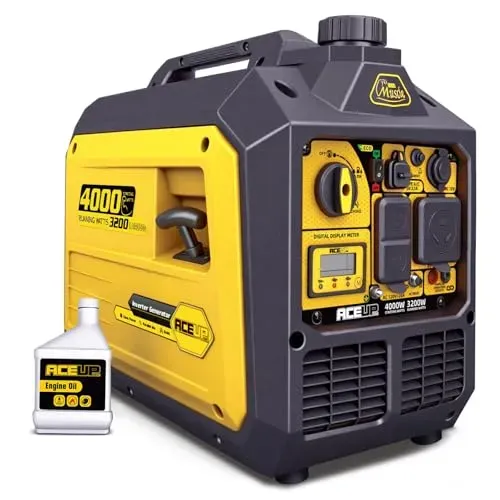
Our top overall pick, the Aceup Energy 4000W is an Amazon’s Choice inverter that balances quiet operation with enough muscle to carry a Canadian home through an outage. Its 149cc 4‑stroke OHV engine delivers 4000 peak watts and 3200 running watts — enough for essentials like a fridge, sump pump, router, lights and a TV in most homes. The fuel tank gives up to five hours of run time at half load, and Eco mode helps stretch fuel during longer winter outages. Noise is rated around 60 dB at 23 feet (7 metres) under a 25% load, so it’s neighbour‑friendly for urban backyards and campgrounds. You get clean inverter power with THD under 1.5%, ideal for laptops and phones, plus a 30A RV TT‑30R, 20A household outlet, 12V car charger, and USB‑A/USB‑C. It’s also parallel‑ready if you ever need to double your capacity. With a 4.5-star rating across roughly 250 reviews, it’s one of the best inverter generators in Canada for everyday home backup.
Pros
- Amazon’s Choice with a strong balance of power and portability
- Quiet inverter operation, suitable for urban neighbourhoods and campgrounds
- Very clean power, safe for sensitive electronics and appliances
- RV‑ready 30A TT‑30R plus USB‑A and USB‑C ports
- Parallel‑ready design for future expansion if needed
Cons
- Run time only about five hours at half load
- No electric start, recoil only
Jackery Portable Power Station Explorer 300, 292Wh Backup LiFePO4 Battery, 110V/300W Pure Sine Wave AC Outlet, Solar Generator for Outdoors Camping Travel Hunting Blackout (Solar Panel Optional)
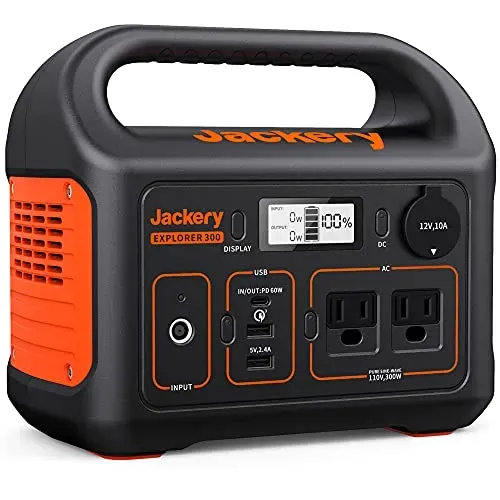
The Jackery Explorer 300 is a compact battery power station that’s ideal as a quiet, fume-free backup during shorter power outages — and the only pick here that’s safe to run indoors, making it our top choice for condos and apartments. With a 292Wh battery and 300W pure sine wave inverter (surge 500W), it’s designed to safely run laptops, Wi‑Fi routers, phones, CPAPs, small TVs, and similar essentials. Weighing about 3.2 kg with a built‑in carry handle, it’s easy to move around the house or stash in your vehicle for camping. You get two 110V AC outlets, a 60W USB‑C PD port, fast USB‑A, standard USB‑A, and a 12V car port, so it can handle up to six devices at once. Paired with a Jackery SolarSaga 100 panel (optional), the integrated MPPT controller maximizes solar input across changing light conditions. It’s the #1 best seller in Amazon.ca’s Outdoor Generators category, with a 4.6-star rating across more than 10,000 reviews — the most proven option on this list.
Pros
- Clean, silent battery backup – no gas, fumes, or maintenance
- Safe for indoor and balcony use in condos and apartments
- Very portable at about 3.2 kg with carry handle
- Fast recharge to 80% in about two hours
- Multiple ports, including 60W USB‑C for modern laptops
Cons
- 292Wh capacity too small for fridges or sump pumps
- Solar panel sold separately, adds to total system cost
ERAYAK 2400W Portable Inverter Generator for Home Use, Super Quiet Small Generator for Camping Outdoor Emergency Power Backup, Gas Powered Engine, EPA, ECO Mode
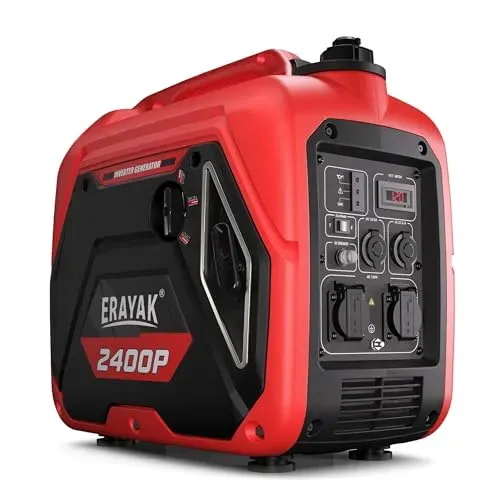
The ERAYAK 2400W is our budget pick if you want a quiet generator for power outages without going to a huge, heavy unit. With 2400W peak and 1800W running watts, it’s powerful enough to keep essentials going in a Canadian home—think fridge, router, a few lights, maybe a CPAP—while staying compact at just 47.8 × 29.8 × 46.0 cm and only 42 lbs (19.1 kg). The inverter design and low THD (under 1.2%) make it safe for sensitive electronics during winter storms or summer brownouts. Noise is a standout: as low as 52.5 dB at 7 metres with Eco Mode, making it neighbour‑friendly in tight suburban lots or campgrounds. With two AC outlets, two USB ports, and a DC output, it doubles nicely as an emergency backup and a quiet camping companion. It’s an Amazon’s Choice pick with a 4.3-star rating across 600+ reviews.
Pros
- Very quiet operation, suitable for dense neighbourhoods and campgrounds
- Clean inverter power is safe for laptops and medical devices
- Lightweight and compact design is easy to move and store
- Lowest price among the gas units here
Cons
- 1800 running watts limits how many essentials run at once
- No electric start, recoil only
PROYAMA 4000W Portable Gas Inverter Generator, CO Sensor, Digital Interface, RV - Ready, LED Light, ECO - Mode, Parallel Capable, Low Oil Shutoff, Super Quiet and Lightweight with Weatherproof Cover
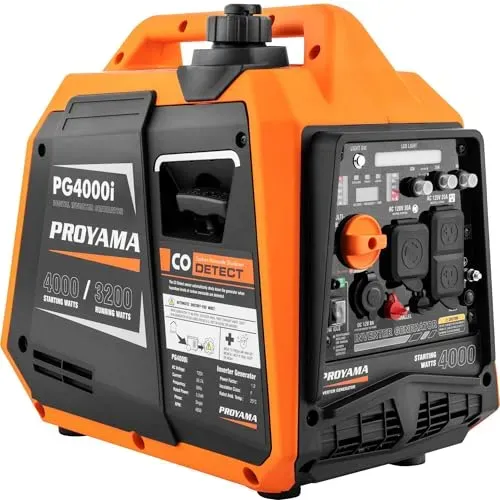
If you want a quiet generator with extra safety features built in, this PROYAMA 4000W inverter is a strong option. It’s rated at 4,000W peak and 3,200W running, plenty for essentials like your fridge, sump pump, a few lights, Wi‑Fi and phone charging during a storm. At only 47 lb (21.3 kg) with a top handle, it’s much easier to move between the garage, cabin or RV than many traditional units in this size range. Noise is around 62 dB at 7 metres with no load, roughly normal conversation level — nice for tight suburban lots or quiet campgrounds. The digital control centre with CO sensor, low‑oil and overload shutoff adds a layer of safety Canadian families will appreciate when the generator is running overnight in cold, dark conditions, and it ships with a weatherproof cover. It carries an Amazon’s Choice badge and a 4.3-star rating.
Pros
- CO sensor and auto‑shutoff add real safety for overnight use
- Ultra‑quiet operation, neighbour‑friendly for suburban or cottage use
- Lightweight 47 lb design is easy to carry and store
- Built‑in LED light and included weatherproof cover
Cons
- Five‑hour runtime at 50% load may require refuelling overnight
- Gas-only, no dual-fuel option
Champion Power Equipment 3400-Watt Dual Fuel RV Ready Portable Inverter Generator with Electric Start
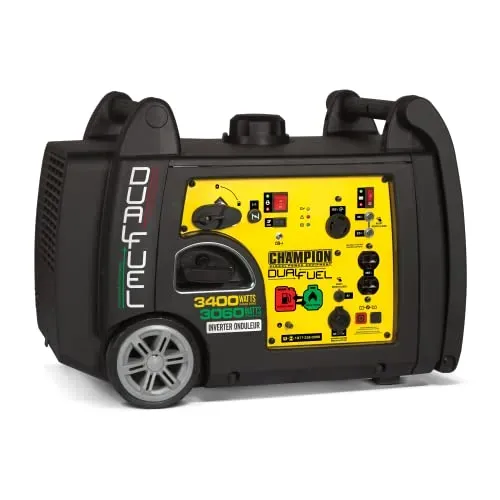
If fuel flexibility is your priority, the Champion 3400-Watt Dual Fuel runs on gasoline or propane — a real advantage in Canada, where propane stores longer and is easier to keep on hand for a Prairie blizzard or an Ontario ice storm. With 3400 starting watts and 3100 running watts, it’s well-sized for essential home loads, an RV, or a jobsite. At only 59 dBA from 23 ft (7 metres), it’s noticeably quieter than conventional open-frame units. The integrated handle and Quick Touch Panel keep it manageable and simple to operate, electric start makes cold mornings easier, and clean power (less than 3% THD) is safe for laptops, TVs, and modern furnaces. It’s the priciest pick here and carries a smaller review count, so it’s best for buyers who specifically want dual fuel and electric start.
Pros
- Dual fuel flexibility with gasoline or propane
- Electric start and simple Quick Touch control panel
- Very quiet 59 dBA operation compared to standard generators
- Clean inverter power is safe for sensitive electronics and furnaces
Cons
- Most expensive option on this list
- Heavy at roughly 96 lb; not for frequent manual lifting
Portable Generators vs Standby Generators: Which Do You Need?
When you’re comparing a portable generator for power outages with a permanent standby generator, it really comes down to budget, convenience, and how often the lights go out where you live. Portable units are far cheaper up front and flexible — you can wheel one out for camping, a cottage weekend, or to power fixed home equipment during a storm. They’re ideal if outages are occasional and you’re comfortable running extension cords or a manual transfer switch.
Standby generators (permanently installed, automatic systems) cost several times more once you factor in the unit, natural gas/propane hookup, and electrician labour. But they turn on automatically, can power your whole house, and handle harsh Canadian winters without you needing to step outside in a blizzard. For most Canadians, a good portable generator is the better value as emergency backup. A standby system makes sense if you have frequent, long outages, critical medical equipment, or a rural property where power reliability is a serious concern.
Budget vs Premium: What’s the Difference?
Budget portable generators in Canada typically run about $400–$600. At this level you can find a capable inverter for occasional use, but you’ll often sacrifice runtime, extra outlets, or electric start — and warranties tend to be shorter (often 1–2 years). The ERAYAK 2400W and Aceup Energy 4000W both sit near this range and still deliver clean inverter power, which matters during a -25°C snap in Winnipeg or Edmonton.
Premium models, usually $1,200 and up, cost more but add dual fuel, electric start, larger fuel tanks, and engines built for long runs and repeated storms. Many include 3-year warranties and better dealer support in Canada — the Champion 3400W Dual Fuel is a good example. If you live in an outage-prone area, rely on a well pump, or want something you can trust for 10+ years, paying more is often worth it. If outages are rare and brief, a solid budget unit can still be the best portable generator for your home without overspending.
How to Choose a Portable Generator for Canadian Conditions
Choosing the right portable generator means matching power to purpose—emergency backup, remote work sites, or off-grid adventures. Think about how you’ll actually use it: keeping essentials running during outages (furnace, sump pump, fridge), powering tools at a job site, or running a cottage weekend?
The best generators for Canadian conditions start reliably in cold weather, deliver enough wattage for your needs, run quietly in residential areas, and offer fuel flexibility for extended use. You’re really choosing reliability, independence, and preparedness in one investment.
Key Features to Look For
Power Output and Wattage Planning
Start by matching the generator’s power output to your actual home needs. For most detached homes, look for 4,500–7,500 running watts to cover a gas furnace, fridge, sump pump, a few lights, and electronics. Smaller spaces, like condos or cabins with fewer loads, can often get by with 2,000–3,000 watts. Check both starting (surge) watts and running watts, especially for well pumps, fridges, and freezers, which draw more power at startup. If you live in an area with frequent winter outages, lean toward a slightly larger unit so you’re not constantly juggling what’s plugged in.
Cold-Weather Starting and Engine Reliability
Canadian winters are tough on small engines. In places where temperatures routinely drop below -15 °C (Ottawa Valley, interior B.C., much of the Prairies), look for generators with proven cold-weather performance. Features like electric start with a battery and the right cold-weather oil grade can make a huge difference when you’re trying to start an emergency backup generator at -25 °C. A reliable 4-stroke engine with low-oil shutdown and a good reputation for longevity will matter far more in Year 5 of ownership than minor spec differences.
Fuel Type, Run Time, and Efficiency
For most Canadian households, gasoline models are the most common, but dual-fuel units (gas and propane) are worth a close look. Gas is easy to find but can be tricky to store safely in larger quantities; propane stores longer and is great for cottages in Muskoka or the Laurentians where outages may last all weekend. Check run time at 25% and 50% load; in a winter storm in Nova Scotia or New Brunswick, a generator that runs 10–12 hours on a tank at moderate load means fewer cold trips outside. Inverter models are more fuel-efficient and ideal if you mainly need power for electronics, Wi‑Fi, and a few appliances.
Noise Level and Neighbour-Friendly Operation
Noise matters, especially in dense urban and suburban areas like the GTA, Vancouver, Calgary, and Montreal. Traditional open-frame generators can easily hit 72–80 dB at 7 metres, which gets old fast during an overnight outage. Inverter generators are typically much quieter (often in the 52–60 dB range at 25% load) and are the better choice where you want to keep the peace with neighbours. Look for clear decibel ratings from the manufacturer and eco or “idle-down” modes that reduce noise when demand is low. For smaller homes and townhouses, a quieter inverter model is usually the most comfortable for long-term use.
Safety, Outlets, and Home Integration
Safety and connectivity are critical when choosing a generator for power outages. Look for models with built-in GFCI-protected outlets, covered receptacles to keep out snow and sleet, and CO detection or automatic CO shutoff—a big plus in tightly built Canadian homes. If you plan to power hardwired circuits like a furnace or well pump, make sure the generator is compatible with a manual transfer switch or inlet box installed by an electrician. Look for 30A or 50A locking outlets for easier connection. In coastal regions like Vancouver Island or St. John’s, choose units with corrosion-resistant components and robust frames so they can handle damp, salty air over the long term. For a complete picture of what to keep ready, our guide to the best emergency kits for Canadian power outages covers the supplies that pair with backup power.
Frequently Asked Questions
Q: How do I choose the right size portable generator for home power outages in Canada?
Start by listing the essentials you want to run: fridge (600–800W running, 1,200–1,500W surge), gas furnace blower (400–800W), sump pump (600–1,000W), Wi‑Fi, lights, and maybe a TV. Most Canadian homes doing “essentials only” are well served by 2,000–4,000W inverter models such as the ERAYAK 2400W for smaller loads or the Aceup Energy 4000W for a fuller essentials list. Always check starting (surge) watts, not just running watts—pumps and compressors spike well above their running draw for a second or two—and keep at least 20% headroom so the generator isn’t maxed out.
Q: How much does it cost to run a portable generator during a winter power outage in Canada?
Cost depends on fuel type, load, and fuel prices in your province. Gas inverter generators like the Aceup Energy 4000W typically burn around 0.5–1.5 litres of gasoline per hour depending on ECO mode and load. At $1.60/L (a typical winter price in many parts of Ontario or BC), that’s roughly $0.80–$2.40 per hour. Battery-based options such as the Jackery Explorer 300 cost only what you pay for grid charging (a few cents per kWh) but provide much shorter runtimes, making them better for brief outages or as a complement to a gas generator rather than the primary source for multi‑day winter events.
Q: Is it worth spending more on premium inverter generators for home backup use?
For most Canadian households, yes—especially in dense neighbourhoods or condos/townhomes where noise and clean power matter. Inverter models like the Aceup Energy 4000W and PROYAMA 4000W provide quieter operation (often under 65 dB in ECO mode) and stable power for sensitive electronics, modems, and high‑efficiency furnaces. That’s crucial during winter outages when you’ll run them for many hours. Cheaper non‑inverter units can be louder and harder on electronics. Premium features like electric start and dual fuel (Champion 3400W Dual Fuel) add convenience during fuel shortages. Over 10+ years of occasional outage use, the extra upfront cost often pays off in comfort, fuel savings, and reduced risk to laptops, smart TVs, and home networking gear.
Q: Can I safely use these portable generators with my furnace, fridge, and electronics?
Yes, but you must size and connect them correctly. Inverter generators like the Aceup Energy 4000W and PROYAMA 4000W produce clean sine‑wave power suitable for modern furnaces, fridges, and electronics. Many Canadians use a 4,000W‑class unit to run a gas furnace blower, refrigerator, Wi‑Fi router, and some lights together. For best safety and code compliance, have a licensed electrician install a transfer switch or inlet, especially in Ontario, Quebec, and BC where utilities are strict about backfeed. Never backfeed through a dryer outlet. For smaller, plug‑in backup (Wi‑Fi, laptops, phones, medical devices), the Jackery Explorer 300 is ideal and completely silent. Always check each appliance’s starting wattage and stay under the generator’s rated and peak outputs.
Q: Will these portable generators work with sump pumps and well pumps?
Yes, but pumps have high startup (surge) wattage. Many 1/2 HP sump pumps need 1,500–2,000W for a second or two at startup. A modest inverter like the ERAYAK 2400W can often handle a single sump plus a few lights. For larger homes with multiple sump pumps or a deep‑well pump, choose at least a 4,000W inverter such as the Aceup Energy 4000W or PROYAMA 4000W. Rural properties with big well pumps, electric water heaters, or large farm loads may need to step up to a larger dual-fuel unit. If you’re unsure, test running your pump(s) under supervision or consult an electrician with your pump nameplate data to confirm appropriate sizing.
Q: What type of portable generator is best for BC, Prairie, Ontario, and Atlantic climates?
Climate affects cold starts, corrosion, and runtime needs. In rainy coastal BC and Atlantic Canada, choose inverter units with good covers and corrosion‑resistant finishes—the PROYAMA 4000W (with weatherproof cover) and Champion 3400W Dual Fuel are good fits. In the Prairies and Northern Ontario, where winter outages can be long and extremely cold (–30°C or below), prioritize electric start and dual‑fuel options (the Champion 3400W) so you’re not fully dependent on gasoline deliveries. For urban Ontario and Quebec neighbourhoods, quiet inverters like the ERAYAK 2400W or Aceup Energy 4000W reduce noise complaints. The Jackery Explorer 300 suits condo or apartment dwellers who can’t run gas units on balconies but still want limited, silent backup during short outages.
Q: What maintenance do portable home generators need for reliable performance?
Basic maintenance is similar across gas models like the Aceup Energy 4000W, ERAYAK 2400W, and PROYAMA 4000W. Change oil after the break‑in period (often 5–10 hours) and then every 50–100 hours or annually. Use the oil grade recommended for cold weather if you expect –20°C or lower. Keep air filters clean and replace spark plugs as specified in the manual. Run the generator at least once a month for 10–20 minutes with a small load—especially important in humid coastal regions and very cold Prairie climates. Store with treated fuel or drain the carburetor for long periods. For the Jackery Explorer 300, simply recharge every 3–6 months and avoid leaving it fully empty or in very hot vehicles.
Final Thoughts: Choosing the Right Generator for Canadian Living
Choosing the best portable generator for Canadian power outages comes down to matching capacity, noise levels, and fuel type to how and where you’ll actually use it. For most households, the Aceup Energy 4000 Watt Portable Inverter is our top pick: it’s an Amazon’s Choice unit with clean inverter power, enough output for essential loads, and quiet operation that suits suburban homes and condos in cities like Vancouver where noise and power quality both matter. It’ll keep your fridge, sump pump, a few lights, and key electronics running through winter storms in places like rural Ontario or along the Atlantic coast.
For condo dwellers, renters, or anyone who wants a simpler, fume-free backup, the Jackery Explorer 300 Power Station is a great option for short outages, work-from-home setups, and emergency phone or CPAP use, particularly in apartments where running a gas generator isn’t practical. If your priority is fuel flexibility for long, cold outages, the Champion 3400W Dual Fuel lets you switch between gas and propane with electric start.
Before you decide, make a list of the appliances you absolutely need during an outage, check their wattage, and compare that to each generator’s rated and surge output. Factor in where you’ll store the unit, how you’ll run it safely outdoors, and whether you need something that can handle deep-freeze Prairie winters or milder coastal conditions. Then choose the model that best fits your home, budget, and comfort level—ideally before the next storm is in the forecast.