
Sourced from 4 independent sources · no points in disputeHow we sourced thisABC7, News.Az, Readers, and CityNews Montreal
Every key fact in this report is confirmed by more than one independent source.
8 key facts · 8 corroborated · none disputed
This summary is compiled from the independent sources listed above.
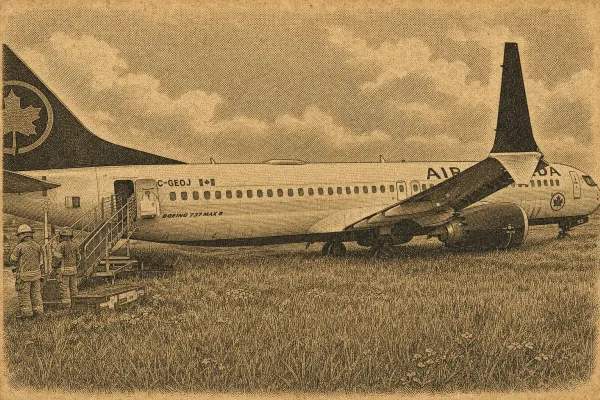
The safest outcome can still leave people shaken. Air Canada Flight AC774, arriving from Los Angeles, ended up in a grassy area after landing at Montréal-Trudeau International Airport while heavy rain was falling at the airport.
The flight was carrying 156 passengers and six crew members. All passengers and crew got off safely, and no injuries were reported. But the incident led to a tense aftermath: passengers remained on the aircraft for about three hours before leaving it, and a runway was temporarily closed.
A safe exit, after a long wait
For those on board, the landing was not the end of the ordeal. The aircraft was already off the paved surface, in the grass, but passengers still waited for about three hours before they were able to get off.
That detail has become one of the central concerns around the incident, even as investigators work to determine why the aircraft ended up where it did. No injuries were reported, but the length of time passengers spent inside the aircraft has drawn sharp criticism from at least one aviation expert.
McGill aviation lecturer John Gradek said the delay was far too long.
“To have passengers sit on the airplane for three hours is not what I would call prompt evacuation,” Gradek said. “To me, looking at it, it’s dangerously slow.”
Heavy rain at the airport
Heavy rain was falling at Montréal-Trudeau when the incident occurred. What role, if any, the weather played has not been determined.
That distinction matters. The rain was part of the conditions at the airport, but the cause of the excursion remains under investigation by the Transportation Safety Board of Canada and Air Canada.
The incident temporarily closed a runway, adding to the disruption at the airport while the aircraft remained in the grassy area.
Expert questions response time
Gradek’s concern focused less on what caused the aircraft to leave the paved area and more on what happened afterward. He said passengers should not have been kept aboard for so long once the aircraft was immobilized.
“We design airplanes for quick evacuations,” he said.
Gradek acknowledged that key details are still unknown. But he argued that, when an aircraft has ended up off the paved surface, safety planning should favour getting people off sooner rather than leaving them exposed to unknown risks.
“I don’t know what happened,” Gradek said. “But I’d rather err on the side of caution and not take any unnecessary risk.”
His criticism adds a second layer to the official review. Investigators will need to determine what caused the excursion. But the response timeline, including the three-hour wait before passengers left the aircraft, is also facing scrutiny.
Investigators look for the cause
The Transportation Safety Board of Canada and Air Canada are investigating what caused the excursion.
For now, the confirmed outcome is clear: 156 passengers and six crew members were aboard Air Canada Flight AC774 from Los Angeles, the aircraft ended up in a grassy area after landing at Montréal-Trudeau, no injuries were reported, and everyone got off safely.
The unresolved question is why the aircraft left the paved area in the first place. Until the investigations are complete, the heavy rain, the runway closure and the long wait on board remain pieces of a larger sequence that investigators are now working to explain.
Reader-funded. No ads. No paywall.
The Canada Report is independent, reader-funded Canadian news — no advertisers, nothing behind a paywall, kept free for everyone. If you value it, you can help keep it that way.
Support The Canada Report →