

Heads up: some of the links in this post are affiliate links. That means if you click and purchase, we may get a commission. It’s how we keep this site running without cluttering it with ads.
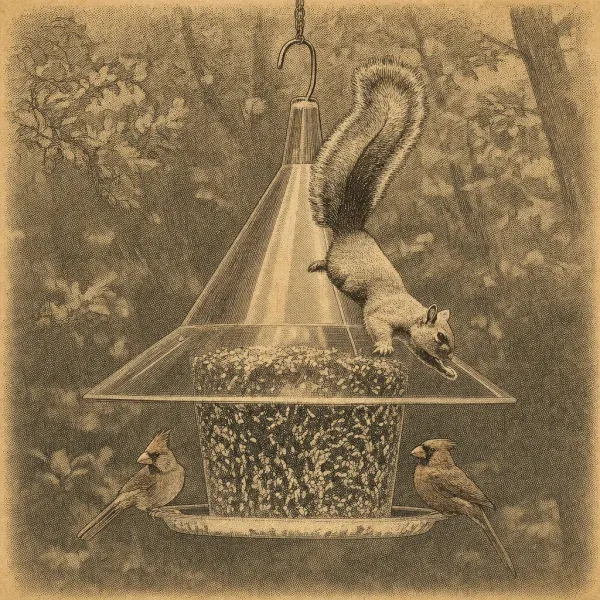
You top up the feeder before work. By lunch it’s been “audited” by a grey squirrel with the confidence of a condo board — the tube gouged, the ports jammed, a fan of sunflower chips sprayed across the lawn like confetti. It happens on a Toronto deck in July as readily as on a Prairie fence line in January, and the squirrels do not get less determined in between. Either way, your chickadees, nuthatches, finches — and the odd cardinal — show up to an empty diner.
We’ve rounded up seven feeders that keep seed where it belongs: the ones that shut down under squirrel weight, resist chewing, shed weather, and still refill easily with gloves on. Our best overall pick is the Brome Squirrel Buster Plus (3 qt / 5.1 lb) — a $149.95 CAD feeder built by Brome Bird Care of Knowlton, Québec, who have been making Squirrel Buster feeders since 1998, rated 4.8 stars across more than 10,000 Amazon.ca reviews. If you want to watch the results up close, pair it with our best birdwatching binoculars. Otherwise, scroll straight to the comparison table — then stick around for the placement rules, which matter more than the feeder you buy.
Quick Overview: Our Top Picks
| Product | Best For | Why We Love It | Price |
|---|---|---|---|
| High-traffic backyards | Big capacity and reliable squirrel lockout keep busy feeders running smoothly. | $149.95 CAD | |
| Sunflower-seed lovers | Chew-proof build and smooth refill design make daily feeding easy and clean. | $57.95 CAD | |
| Condo balconies | Compact, tough, and dependable—perfect when space is tight but squirrels aren’t. | $44.95 CAD | |
| First-time bird feeders | Low-cost, weight-activated cage shuts squirrels down without any extra fuss. | $27.98 CAD | |
| Gift-worthy garden decor | Cute metal design adds charm while still keeping seed protected outdoors. | $34.99 CAD | |
| Cardinal-friendly perching | Sturdy tube and responsive perch system help birds eat while squirrels slip off. | $44.99 CAD | |
| Mixed backyard flocks | Mesh feeding style attracts more species while weight-activated perches deter thieves. | $41.99 CAD |
Brome Squirrel Buster Plus
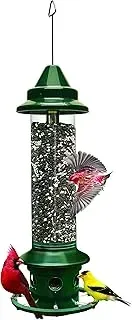
If you’re tired of squirrels raiding your feeder the minute you top it up, the Brome Squirrel Buster Plus is the premium, “set it and forget it” option that earns its reputation. It’s a tall, slim feeder (15.24 x 15.24 x 71.12 cm) with six feeding ports and a cardinal perch ring, so it suits the mix of backyard birds many Canadians want to see through fall and winter. The 3-quart / 5.1 lb seed capacity is a big deal when cold snaps and shorter daylight make birds visit more often—fewer refills means less time outside in wind and snow. At just under 1 kg (997.9 g), it’s manageable to take down for cleaning, and it’s backed by a lifetime limited warranty. It’s pricey at $149.95 CAD, but the 4.8★ average across 10,000 reviews is hard to argue with.
Pros
- 4.8★ rating backed by 10,000 reviews
- Large 5.1 lb capacity for winter-long feeding
- Cardinal perch ring plus six feeding ports
Cons
- Premium price compared with simpler squirrel-resistant feeders
- Tall design can be awkward to store between seasons
Brome Squirrel Buster Standard
The Squirrel Buster Standard is the Brome to buy when you want the same weight-activated shroud without the $150 price tag. It’s a compact green feeder (12.7 x 12.7 x 33.66 cm, 725.75 g) with four metal perches and a 1.3 lb seed capacity — enough for a steady trickle of chickadees and finches, though you’ll refill more often at peak times. Every part a squirrel can reach is moulded from Brome’s chew-proof RoxResin, and the whole feeder comes apart by hand, no tools, for cleaning. At 4.6★ across more than 11,500 reviews it’s the best rated squirrel-proof bird feeder in its price range, covered by the same hassle-free warranty out of Knowlton, Québec.
Pros
- 4.6★ rating with 11,500 reviews
- Chew-proof design helps stop squirrel damage
- Easy to fill and clean
Cons
- 1.3 lb capacity needs frequent winter refills
- Only four perches for busier feeding times
Brome Squirrel Buster Mini
Balcony feeders live or die on size, and the Squirrel Buster Mini is the smallest Brome that still runs the full weight-activated mechanism. It’s compact (10.49 x 10.49 x 31.45 cm) and light (454 g), so it hangs from a deck hook or a branch without a heavy bracket. It holds 1 lb of seed, which suits general daily feeding, though you’ll refill more often during cold snaps when birds burn through calories fast. Brome backs it with a 24-month warranty covering material and manufacturing defects and squirrel damage — reassuring if you’ve watched a squirrel chew through a “squirrel-proof” claim before. At 4.5★ across more than 6,000 reviews, it’s a well-established option for keeping seed in the feeder rather than on the ground.
Pros
- Compact size fits balconies, decks, and small hooks
- 4.5★ rating from 6,000 reviews
- 24-month warranty includes squirrel damage coverage
Cons
- 1 lb capacity means frequent refills in winter
- Lightweight build may sway more in strong winds
Perky-Pet Squirrel-Be-Gone Feeder
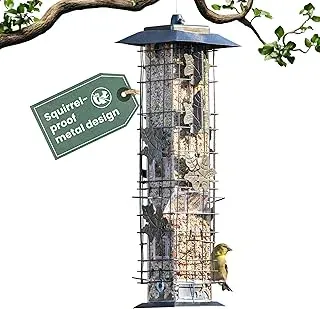
At $27.98 CAD, the Perky-Pet Squirrel-Be-Gone (Model 336) is the cheapest genuine squirrel deterrent in this guide — and by far the most popular, with more than 19,000 Amazon.ca ratings. It ships with a hanging wire, so it goes straight onto a deck hook, a balcony rail arm, or a tree branch when you don’t have room for a pole-and-baffle setup. The mechanism is worth understanding, because it’s often described wrong: this isn’t weight-activated perches, it’s a weight-activated cage. When a squirrel climbs on, the all-metal cage is pulled down over the six feeding ports and blocks access. The powder-coated metal body holds 2 lb of mixed, black-oil sunflower, or safflower seed, and at 20.07 x 17.7 x 48.46 cm and roughly 450 g it’s easy to take down for refills. The 4.0★ average is the lowest here and the warranty is only 30 days — but for under thirty dollars, it works.
Pros
- Cheapest real squirrel deterrent here at $27.98 CAD
- All-metal, powder-coated cage over six feeding ports
- More than 19,000 Amazon.ca ratings at 4.0 stars
Cons
- 30-day warranty is short for year-round outdoor use
- Lowest average rating of the seven picks
LBTING Cat Bird Feeder
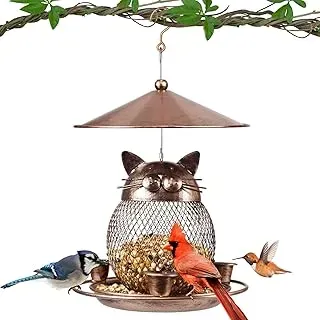
Not every feeder has to look like lab equipment. The LBTING cat-shaped hanging feeder is the decorative pick here at $34.99 CAD, and it works differently from everything else on this list: instead of a weight-activated shroud, it uses an adjustable baffle that shakes when a squirrel tries to climb onto it. That makes it a softer deterrent than the Brome or GAINSEN designs — treat it as squirrel-resistant, not squirrel-proof. It’s heavy-duty metal (572 g), holds 2 lb of seed, and at 18.8 x 18.8 x 19.81 cm it suits a small yard or a deck where a full pole system won’t fit. The wide refill top and included brush make cleaning straightforward. It rates 4.2★ across 776 reviews — the lowest of the metal feeders here, which tracks with the gentler mechanism.
Pros
- Heavy-duty metal build with a genuinely attractive design
- Wide refill top and included cleaning brush
- Built-in adjustable baffle rather than a bolt-on accessory
Cons
- Baffle mechanism is squirrel-resistant, not squirrel-proof
- Lowest rating here at 4.2 stars
GAINSEN Weight-Activated Tube Feeder
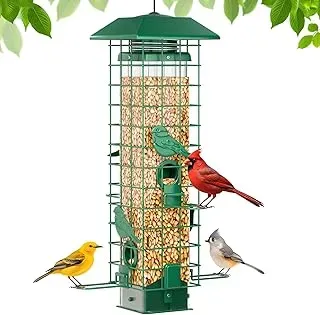
The GAINSEN metal tube feeder is the middle ground: weight-activated like the Bromes, all-metal like the budget picks, and $44.99 CAD. When a heavier visitor climbs on, a spring mechanism closes the feeding ports — the same principle as the Squirrel Buster, executed more simply. It’s compact enough for tighter spaces but still sized for regular backyard use at 12.95 x 12.95 x 40.13 cm and 800 g. The 3 lb capacity and four ports keep a few birds moving through without constant refills. It rates 4.3★ across 687 reviews, and it’s rust- and weather-resistant, which matters more on a wet coast than in a dry Prairie winter.
Pros
- Weight-activated design helps reduce squirrel access
- 3 lb capacity suits everyday, winter-friendly feeding
- Metal build feels sturdier than basic plastic tubes
Cons
- Smaller capacity than premium, winter-long feeders
- Only four ports can get busy at peak times
THKFUL Mesh Metal Feeder
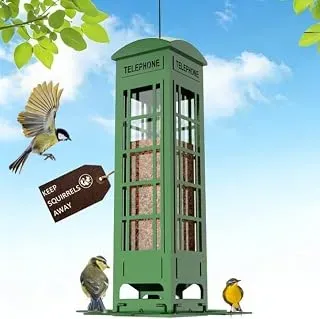
Mesh feeders pull in a wider mix of birds than tubes do — woodpeckers, blue jays, and cardinals will all work a grid that a narrow port shuts out — and the THKFUL is the mesh pick here at $41.99 CAD. It’s heavy-duty metal with weight-activated perches on a spring, closing the feeding grid when a squirrel hops on. The 3 lb capacity means fewer trips outside, and at 10.49 x 8 x 40.01 cm it’s tall and slim enough for a deck or balcony where a bird feeder pole isn’t an option. It rates 4.3★ across 580 reviews.
Pros
- Weight-activated perches help discourage squirrels
- 3 lb seed capacity suits day-to-day feeding
- Includes hook for straightforward hanging installs
Cons
- Mesh feeders can be messier with some seed types
- Hanging setups still need careful spacing from railings
Weight-Activated Feeders vs Baffle-and-Pole Setups: Which Do You Need?
If your core problem is squirrels emptying the seed, weight-activated feeders (like our top pick, the Brome Squirrel Buster Plus) are the most “set it and forget it” option: a squirrel’s weight shuts the ports, so the seed stays for chickadees, finches, nuthatches, and cardinals. They earn their keep year-round — through the late spring and summer stretch when squirrel pressure is highest, and again in the -20°C Prairie cold snaps and wet Ontario freeze/thaw cycles when you’d rather not be outside topping up twice a day. The trade-off is price. These sit at the premium end of the category.
A pole-and-baffle setup — a smooth metal pole squirrels can’t grip, plus a wide squirrel baffle mounted so its top sits at least 1.5 m up — is cheaper and can be just as effective. But it only works if the spacing works, and that’s where most people fail. On balconies and decks, where you simply cannot get seven feet of clearance from the nearest railing, weight-activated models win by default: they don’t depend on geometry you don’t have.
How to Keep Squirrels Off a Bird Feeder: The 5-7-9 Rule
Most squirrel problems are placement problems. Before you spend $150, try moving the feeder. Experienced birders use a guideline called the 5-7-9 rule, and it maps directly onto what a grey squirrel can physically do:
- 5 feet (1.5 m) off the ground. A squirrel can jump roughly five feet straight up from a standing start.
- 7 feet (2.1 m) from the nearest launch point. Fences, deck railings, tree trunks, sheds — and in February, snowbanks. Seven feet is about the limit of a horizontal leap.
- 9 feet (2.7 m) below any overhanging branch. Squirrels will happily drop onto a feeder from above, and nine feet is far enough to make them think twice.
If you’re running a pole, mount the baffle so its top sits at least 1.5 m off the ground, or the squirrel simply jumps over it. Smooth metal poles work; wood and textured composite do not. And if you buy the Squirrel Buster Plus, Brome specifies 18 inches (47 cm) of clearance on every side for the shroud to close properly — don’t tuck it against a wall.
Treat this as a first line of defence, not a guarantee. Red squirrels are lighter and more persistent than greys, flying squirrels ignore the rule entirely, and a mature oak next door raises everyone’s ceiling. But on most Canadian lots it costs nothing to try, and it makes every feeder on this list work better.
Where 5-7-9 breaks down is exactly where a lot of Canadians feed birds: a condo balcony in Vancouver, a narrow deck in Halifax, a townhouse yard in Calgary. You will never get seven feet of clearance from a balcony railing. That is precisely the case for a weight-activated feeder — it stops caring how close the railing is.
Budget vs Premium: What's the Difference?
Budget “squirrel-resistant” feeders (roughly $28–$70 CAD) work if your squirrel pressure is mild or you’re willing to troubleshoot placement. What you give up is capacity, weather sealing, and smooth cold-weather operation: more refills, more clogs from damp seed, and more time outside when it’s windy, icy, and dark by 4:30 p.m. Some budget models rely on cages or spinning deterrents that stop larger squirrels but can be awkward for bigger birds, or jam with snow and ice.
Premium options ($100–$149.95 CAD) buy reliability and a lower total cost of ownership: sturdier parts, better closing mechanisms, and fewer chewed ports. The Brome Squirrel Buster Plus stands out as the best rated squirrel-proof bird feeder here, at 4.8 stars across more than 10,000 reviews, with a 5.1 lb capacity that pays off whenever refills are inconvenient. If you feed heavily and the squirrel pressure is real, the extra upfront cost is offset by seed you don’t lose and feeders you don’t replace. If you feed casually, a well-placed budget feeder plus a good baffle is enough.
Squirrel Buster Plus vs Standard vs Mini: Which Brome?
Three of the seven picks here are Bromes, and they all run the same patented mechanism: a squirrel’s weight pulls a shroud down over the seed ports, denying access without harming the animal. The difference is size, capacity, and warranty.
- Squirrel Buster Plus — $149.95 CAD, 5.1 lb, six ports, cardinal perch ring, lifetime limited warranty. Buy this if you have a real yard, real squirrel pressure, and you want cardinals. The capacity is the point: fewer refills, which matters most in January.
- Squirrel Buster Standard — $57.95 CAD, 1.3 lb, four metal perches, hassle-free warranty. The value pick. Same mechanism, roughly a third of the price, four times the refills. For most Canadian backyards this is the right answer.
- Squirrel Buster Mini — $44.95 CAD, 1 lb, four metal perches, 24-month warranty that covers squirrel damage. The balcony pick. Light enough for a rail hook, small enough not to dominate a compact deck.
If you’re torn between the Plus and the Standard, the honest test is how often you’re willing to go outside. The Plus holds about four times as much seed for two and a half times the price. If you’d refill weekly either way, take the Standard and put the difference toward a pole and a baffle.
How to Choose the Best Squirrel-Proof Bird Feeder for Canadian Conditions
In Canada a good squirrel-resistant feeder has two jobs, and they arrive in different seasons. Through late spring and summer, squirrel pressure is at its highest and the feeder simply has to hold the line. In winter, it has to keep working through freeze/thaw cycles and blowing snow while birds depend on it for consistent calories. Start by deciding where you’ll install it — hanging on a balcony hook, or on a pole in the yard — then match the squirrel-stopping method to your local pressure: urban raccoons in Southern Ontario, bold greys on the Prairies, red squirrels and persistent coastal rain in B.C. Then prioritise capacity, weather protection, and easy cleaning so seed doesn’t clump or go stale when temperatures swing from around -20°C to +5°C.
Key Features to Look For
Weight-Activated Shutoffs vs. Chew-Proof Barriers
The most reliable squirrel-stopping designs tend to fall into two camps: weight-activated feeders that close ports when a heavier animal climbs on, and physical barriers that prevent access (like cages, domes, or “baffle-style” setups). Weight-activated models are great if you want a clean look and easy access for chickadees, nuthatches, finches, and cardinals—especially when paired with a cardinal-friendly perch ring (a standout reason the Brome 1024 Squirrel Buster Plus is a favourite premium pick). Chew-proof designs matter in places where squirrels gnaw plastic in winter. Look for metal components at stress points (ports, perches, hangers) and clear adjustment options so smaller birds aren’t accidentally blocked.
Seed Capacity and Weather Protection
Capacity is about more than convenience. In summer it means you’re not refilling a raided feeder every second day; in winter it means less time outside in wind and snow, and birds stay on a steady routine through short daylight hours. In colder regions like Winnipeg, Edmonton, or the Laurentians, a larger hopper (several pounds of seed) is a practical advantage, especially for black-oil sunflower seed that disappears fast in January. Also consider how well the feeder shelters seed from moisture: a wide, well-fitted roof, internal drainage, and a seed tube that limits wind-driven snow help prevent freezing and clogs. If you regularly get wet coastal winters in Vancouver or Halifax, moisture control is just as important as volume.
Materials and Hardware That Survive Canadian Weather
Canadian weather exposes weaknesses quickly. Repeated freeze/thaw—common in Southern Ontario, the Okanagan, and parts of Nova Scotia—can cause cheaper plastics to become brittle and crack, especially around threads and hanging points. Prioritize UV-stabilized, thick plastics (if used at all), powder-coated metal, and stainless or rust-resistant hardware. Hinges, springs, and closing mechanisms should feel solid and should still move smoothly after an icy night around -15°C. If you’re hanging the feeder, check the hanger and top loop: these take the most stress when the feeder is full, swinging in wind, or bumped by a determined squirrel. For pole setups, look for sturdy collars and connections that won’t loosen with vibration and temperature changes.
Bird-Friendly Feeding and Easy Cleaning
Squirrel protection shouldn’t come at the expense of the birds you’re trying to attract. Look for comfortable perches and well-spaced ports that suit common Canadian backyard visitors—cardinals need more room than finches, and larger perches help in cold snaps when birds conserve energy. Cleaning matters more in winter than many people expect: small thaws around 0°C can introduce moisture that turns seed dusty or mouldy inside a tube. Choose a feeder that comes apart without tools, with parts you can rinse and dry quickly indoors. Keeping seed fresh reduces waste and discourages rodents. For a complete winter station, many Canadians pair a reliable feeder with a heated bird bath so birds have dependable water even when everything else is frozen.
If the feeder is part of a wider yard project, a pole planted in a bed keeps it well away from fences and other launch points — our guide to the best raised garden beds in Canada covers options that work on decks and balconies too.
Frequently Asked Questions
Q: How do I squirrel-proof a bird feeder setup in Canada without constantly refilling it?
Placement first: hang the feeder about 1.5 m (5 ft) off the ground, at least 2.1 m (7 ft) horizontally from anything a squirrel can launch from, and 2.7 m (9 ft) below any overhanging branch. That’s the 5-7-9 rule, and it costs nothing. Add a baffle on pole setups, mounted so its top sits at least 1.5 m up. Then choose a weight-activated feeder that closes when a squirrel lands — that combination is the most reliable “set it and forget it” approach for yards, decks, and balconies.
Q: What’s the best rated squirrel-proof bird feeder for feeding through a Canadian winter?
The top overall choice is the Brome 1024 Squirrel Buster Plus (3 qt/5.1 lb). Its strong rating and large capacity matter in winter, when shorter days and stormy stretches mean birds rely on consistent food and you’ll refill less often. The weight-activated mechanism helps stop squirrels without complicated add-ons, and the capacity is a big advantage when freeze/thaw weather makes frequent refills and cleaning more annoying.
Q: Should I choose a weight-activated feeder or a chew-proof metal design?
They solve different problems. Weight-activated feeders shut access when a heavier animal lands, which stops squirrels stealing seed — the right answer when your complaint is “they empty it.” Chew-proof construction matters when squirrels are physically destroying the feeder: gnawed ports, claw-scored tubes, torn hangers. You don’t have to choose between them. Brome’s Squirrel Buster line is both, with every squirrel-facing part moulded from chew-proof RoxResin, which is why the Plus and the Standard sit at the top of this guide. An all-metal feeder like the GAINSEN tube is the cheaper route to chew resistance if you don’t need the shroud.
Q: Should I use a bird feeder pole or hang the feeder on my balcony?
For pole installs, use a smooth metal pole plus a wide baffle whose top sits at least 1.5 m off the ground, and site it 2.1 m from fences, trunks, and branches — spacing is what prevents the jump. On a balcony you can’t win on spacing, so win on mechanism: hang a weight-activated feeder from a sturdy hook and accept that the railing is close. Also consider size. Large capacity means fewer refills, but make sure the feeder won’t swing into a wall in wind or block a walkway on a small deck.
Q: How do I clean and maintain a bird feeder for winter so seed doesn’t clog or spoil?
In Canadian freeze/thaw cycles, moisture is the enemy: wet seed clumps, freezes, and can block ports. Keep the feeder sheltered from driving snow and wind, refill smaller amounts more often, and dump old seed before topping up. Clean every 1–2 weeks (more during mild, wet spells) with warm soapy water, rinse well, and fully dry before refilling. Choose designs that disassemble easily to prevent hidden mould.
Final Thoughts: Making the Right Choice for Canadian Conditions
Keeping seed in the feeder is less about fancy features than about three things: a mechanism that actually stops squirrels, enough capacity that you’re not refilling constantly, and placement that doesn’t hand them a runway.
For most households, the Brome 1024 Squirrel Buster Plus (6"x6"x28") is the best all-around choice. Its weight-activated design reliably shuts access when squirrels try to feed, and the 5.1 lb capacity is ideal for serious, cold-weather feeding when refills are harder (and daylight is shorter). The cardinal perch ring and six ports also make it friendly for the songbirds Canadians actually want at the feeder, even during windy Prairie cold snaps.
If you like the Brome system but don’t need the largest hopper, the Squirrel Buster Standard Squirrel-Proof is a strong mid-range option that still focuses on squirrel resistance and everyday usability. For smaller spaces—like a condo balcony or a compact deck—the Squirrel Buster Mini Squirrel-Proof Bird Feeder makes sense, especially when you’re prioritizing lighter weight and easier handling over maximum capacity.
Before you buy, decide on hanging vs. pole placement, then plan your spacing with the 5-7-9 rule: five feet up, seven feet from the nearest launch point, nine feet below any branch. Use a proper baffle if you’re installing on a pole, and aim for easy cleaning access.
Pick the feeder that fits your space, set it up thoughtfully this week, and enjoy a yard that’s busy with birds — not squirrels — right through the year.