
| Sourced from 4 independent sources · no points in dispute |
Juno News, The Manatee, Winnipeg Free Press, and County Market
Most key facts are confirmed by more than one independent source; a few details come from a single outlet.
11 key facts · 7 corroborated · none disputed
This summary is compiled from the independent sources listed above.
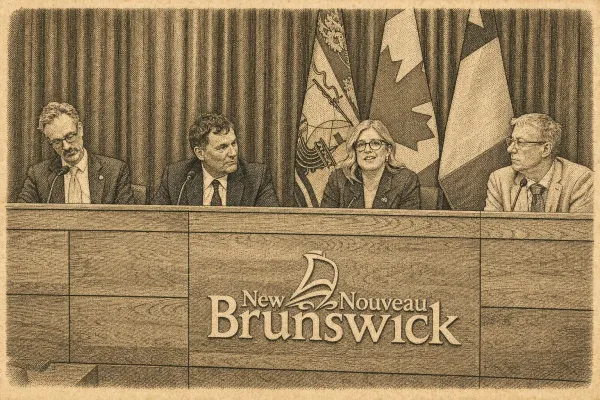
Premier Susan Holt has put New Brunswick’s fracking debate back on the provincial agenda, launching a review of the long-standing moratorium on hydraulic fracturing that has blocked new fracking for more than a decade.
Holt linked the move to escalating trade tensions with the United States and the need to build a stronger, more stable provincial economy. But she stressed the review is not an immediate approval for companies to start drilling.
A review, not a green light
“This is, in fact, the start of a conversation,” Holt told reporters.
“This is not a green light to start getting drills in the ground. This is a deliberate five-month-long dialogue with many partners in our province and with you as New Brunswickers to determine if this is something we want to move forward with together.”
Juno News reported the review is scheduled to run for five months.
The government plans to consult First Nations communities, local governments, industry stakeholders, experts and members of the public as it reopens a debate that has sat largely frozen under the moratorium.
Holt and Natural Resources Minister John Herron said natural gas extraction would not proceed unless the government is satisfied it can be done safely and without adverse environmental effects.
Herron said, “the government would not allow natural gas extraction to proceed if it doesn’t have assurances it would be safe,” according to source reporting.
Economy drives renewed debate
Holt framed the review as part of a broader search for economic stability as Canada’s trade relationship with the United States becomes more strained.
“We are looking at all the options that can bring economic stability and independence to our province, so that entrepreneurs can invest in growing their businesses, and so that they can create good-paying jobs for New Brunswickers,” Holt said.
The scale of the possible resource is a major reason the issue keeps returning. Estimates put New Brunswick’s natural gas resources in the tens of trillions of cubic feet.
That potential now sits beside Holt’s repeated warning that the review should not be read as approval. The premier’s message was clear: the province is asking whether development should proceed, not announcing that it will.
Safety, evidence and consultation
The government’s review will also look at natural gas extraction already operating in a small part of New Brunswick under a 2019 exemption to the moratorium, according to the Winnipeg Free Press.
That existing activity is expected to form part of the evidence the province considers as it weighs whether the moratorium should remain, change or be lifted.
County Market reported that Mi’gmawe’l Tplu’taqnn Inc. said Mi’kmaq representatives will participate in the review while maintaining that formal consultation is required if development proceeds.
“We know this is an extremely important issue for many of our community members,” MTI said in a statement quoted in source reporting.
The organization said participation in review tables does not replace the need for the Government of New Brunswick to consult if it decides to move ahead with natural gas development.
Support and opposition emerge
The review has already drawn clear political and industry reactions. County Market reported criticism from Green Party politicians and support from the Atlantica Centre for Energy.
Green Party Leader David Coon condemned Holt’s move, saying he was “extremely disappointed” in the premier.
“It is dangerous what she’s contemplating doing here,” Coon said, arguing the province should be moving away from fossil fuels rather than considering expanded natural gas development.
The Atlantica Centre for Energy welcomed the review as a responsible step.
“Before decisions can be made about the future of natural gas development, we need a shared understanding of the facts,” Michelle Robichaud, the centre’s president, said in a statement quoted in source reporting. “That requires good science, credible economic and technical analysis, meaningful public discussion and, fundamentally, the leadership and active participation of First Nations throughout the process.”
For now, Holt’s government is trying to hold two messages at once: New Brunswick is revisiting a major economic question, and no drilling decision has been made. The review reopens the door, but Holt says it does not push anyone through it.
Reader-funded. No ads. No paywall.
The Canada Report is independent, reader-funded Canadian news — no advertisers, nothing behind a paywall, kept free for everyone. If you value it, you can help keep it that way.
Support The Canada Report →