
Sourced from 5 news outlets · most facts from statements · no points in dispute. How we sourced this
Alberta’s government has tabled Bill 33, legislation that would prohibit the use of diversity, equity and inclusion criteria in public-sector hiring and promotion decisions and ban most mandatory DEI training.
Key facts
- Bill 33 amends the Alberta Human Rights Act to prohibit provincial bodies from using programs, policies or activities under section 10.1 in hiring or promotion decisions.
- The restrictions would apply to public bodies including provincial government departments/public agencies, Crown-controlled organizations, post-secondary institutions, school boards and municipalities, and officials said some nonprofits receiving provincial grants could be covered depending on regulations.
- Justice Minister Mickey Amery said mandatory workplace training would be limited to ideologically neutral, job-related content, and DEI training would be prohibited unless reasonably necessary for employees to perform their duties.
- The government said provincial government employees are already hired on merit and that details of exceptions would be set out in regulations.
Read the original document: Government of Canada, linked by Culture Alberta.
Tabled Oct. 27, the bill would amend the Alberta Human Rights Act and extend across a broad range of public institutions, placing Alberta’s approach to hiring and workplace training at the centre of a sharp political dispute.
Hiring and promotion restrictions
Bill 33 would bar provincial bodies from using programs, policies or activities under section 10.1 of the Alberta Human Rights Act when making hiring or promotion decisions.
The restriction would apply to provincial government departments and public agencies, Crown-controlled organizations, post-secondary institutions, school boards and municipalities. Officials have also said some non-profits receiving provincial grants could be covered, depending on future regulations.
A protected characteristic could still be considered where it is genuinely required to perform a job.
Training must be job-related
The bill would also limit mandatory workplace training to content that is ideologically neutral and related to employees’ duties. Mandatory DEI training would be prohibited unless it is reasonably necessary for workers to perform their jobs.
Justice Minister Mickey Amery said public-sector jobs should go to the best-qualified candidate and that required training should focus on the work employees must do.
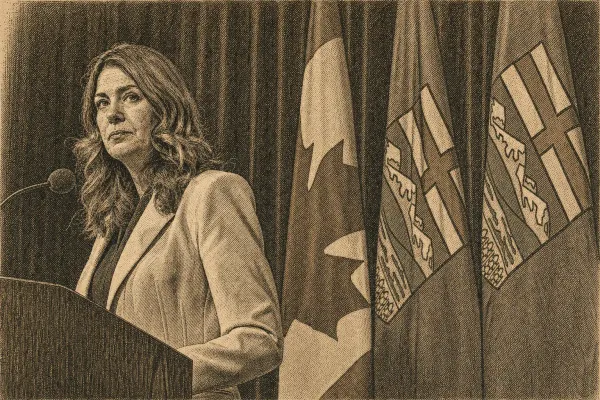
Premier Danielle Smith framed the changes as a fairness measure. “Hiring decisions should be about who is best qualified for the job,” Smith said, adding that the changes would ensure “fairness is at the heart of hiring.”
The government has said provincial government employees are already hired on merit. Details of the bill’s exceptions are to be set out in regulations.
Opposition criticism of Bill 33
NDP Leader Naheed Nenshi accused the government of using “merit” as coded language against diversity initiatives.
Sandra Azocar, president of the Alberta Union of Provincial Employees, called the bill a “thinly veiled” act of institutionalized racism. She argued that government hiring already selects qualified candidates.
According to The Canadian Press, NDP MLA Kathleen Ganley said her party had not heard concerns about DEI hiring practices and called it inappropriate to link the issue to other provisions in the bill.
Deepfake penalties also proposed
Bill 33 also includes stronger penalties and civil options related to the non-consensual distribution of digitally altered intimate images, including deepfakes.
The proposed provincial offence carries a maximum penalty of a $10,000 fine, up to two years in jail, or both. The bill would also expand civil options connected to such material.
The Calgary Herald reported that the deepfake-related penalties would begin in spring 2027 if Bill 33 passes.
What we don't know yet
- The government has not said how many public bodies use demographic preferences in hiring today or how often.
- The full scope of who is covered and what exceptions apply is not yet known because key details are set to be defined in regulations.
- The legislation does not specify what types of training could qualify for the stated exception related to cultural, political, social or historical matters.
How outlets covered it
- The Globe and Mail (The Woodbridge Company) — “Alberta tables bill to prevent DEI hiring in public sector”, Oct. 28, 2026. By Jack Farrell. Quoted Premier Danielle Smith; Opposition NDP member Kathleen Ganley.
- The Epoch Times — “Alberta Government Tables Bill to Ban DEI Hiring Policies in Public Sector”, Oct. 28, 2026. By Paul Rowan Brian. Quoted Premier Danielle Smith; Alberta NDP Leader Naheed Nenshi; AUPE president Sandra Azocar. Not in the other reports here: the federal Employment Equity Act's requirements for regulated employers.
- Culture Alberta — “Danielle Smith Moves to Ban DEI Hiring Across Alberta’s Public Sector Under Bill 33, Including Cities and Universities”, Oct. 28, 2026. By Shannon Williams. Quoted Premier Danielle Smith. Not in the other reports here: Donald Trump's 2025 executive order on federal DEI offices and programs; the University of Alberta's March 2026 recruitment-policy revision.
- The Canadian Press (carried by Airdrie City View, St. Albert Gazette and Winnipeg Free Press) — “Alberta government tables bill to end public sector hiring policies based on DEI”, Oct. 27, 2026. Led with Alberta's move to end public-sector DEI hiring practices. Quoted Premier Danielle Smith; Opposition NDP member Kathleen Ganley.
- Rebel News — “Alberta bill would ban DEI in public-sector hiring and training”, Oct. 27, 2026. Quoted Premier Danielle Smith; Justice Minister Mickey Amery. Not in the other reports here: the removal of justice-minister authority over Alberta Law Foundation matters; King's Counsel eligibility treatment of parental and other leave.
- Calgary Herald (Postmedia) — “Alberta to remove DEI hiring practices, strengthens protections against deepfake distribution”, Oct. 27, 2026. By Cindy Tran. Not in the other reports here: a spring 2027 start for penalties for deepfake distribution.
Reader-funded. No ads. No paywall.
The Canada Report is independent, reader-funded Canadian news — no advertisers, nothing behind a paywall, kept free for everyone. If you value it, you can help keep it that way.
Support The Canada Report →How we sourced this story
| Most key facts come from statements by Alberta government, Danielle Smith and Mickey Amery, as reported by 5 news outlets. Outlets repeating the same statements do not confirm them independently. |
12 key facts · 0 independently corroborated · 12 from statements or releases · none disputed
Why some reports were counted once
The Globe and Mail, Airdrie City View, St. Albert Gazette, and Winnipeg Free Press — the same Canadian Press report, counted once.
Allegations described here are not proven in court unless stated.
How we put this together: we compare reporting from the outlets above, draft with the help of AI tools, and an editor checks every story before it's published. Our methodology.