
Government Files is The Canada Report's public-records analysis series examining government documents obtained through Canada's Access to Information (ATI) and provincial Freedom of Information (FOI) laws. These transparency laws allow members of the public to request internal government records from federal and provincial institutions. This article reviews documents released through those processes and summarizes what the records contain and what they show. While we strive for accuracy, this article represents an analysis and interpretation of the source material. For complete accuracy and full context, readers should review the original documents, which are available in full below.
Full Document
The complete document is available for download below:
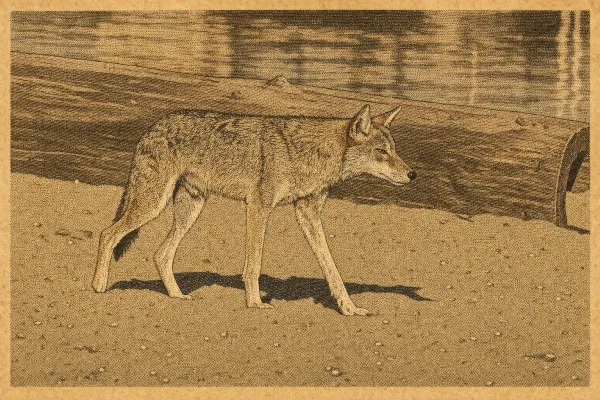
The Province of British Columbia spent $147,078.49 managing coyotes in Vancouver's Stanley Park, according to financial records released under the province's Freedom of Information law. The bulk of that total — $96,839.26 — went to operational contract fees, with the balance covering salaries, benefits, travel, laboratory testing, and a long tail of field supplies purchased on government credit cards.
The records were released by the Ministry of Water, Land and Resource Stewardship in response to a request for financial summaries, briefings, and itemized breakdowns of total expenditures associated with the removal of coyotes from Stanley Park, covering the period from January 2020 through December 2023. The documents consist of contractor invoices, laboratory billing statements, and an internal expenditure summary organized by cost category.
What the Documents Show
The single largest expense was a contract with the British Columbia Conservation Foundation, a Surrey-based non-profit, under work order WO22BCC068. The records identify the engagement simply as "Coyote in Stanley Park." The foundation billed the ministry $96,154.26 against a total contract value of $100,000 — meaning the project came in roughly $3,800 under its ceiling.
That amount arrived in two instalments. An invoice dated 22 October 2021 requested $80,000, covering $46,771.34 in actual expenditures to 30 September 2021 plus a forecast $33,228.66 through the end of December. A final invoice dated 22 November 2021 reconciled the account, showing total actual expenditures of $96,154.26 and requesting the remaining $16,154.26.
The foundation's own accounting worksheets break the spending down further. Of the money spent through 30 December 2021, $73,128.55 was categorized as subcontracts and $8,274.41 as equipment rentals. Materials, supplies and communications accounted for $2,047.05, and travel and accommodation $1,267.40. Administrative overhead came to $11,436.85. Notably, the foundation recorded $0.00 in both contract wages and other costs across the entire project — every dollar of labour appears to have flowed through subcontractors rather than direct employment.
A separate invoice, dated 20 September 2021, bills the ministry's South Coast Region $719.25 for a single day of work on 8 September 2021: a training session described as "coyote immobilization and humane euthanasia," charged at $685 plus GST, with return ferry passage and meals included in the rate. The training took place in early September, the same month the province carried out its removal operation in the park. Contract records of this kind are a recurring subject in this series — a recent Government Files analysis examined B.C. Ferries' decision to award a $1-billion shipbuilding contract offshore, another case where the underlying paperwork told a different story than the public announcement.
Want future Government Files like this?
We release new Canadian public-records breakdowns weekly.
Four Carcasses and a Disease Panel
Among the more revealing line items is a set of four invoices from the Animal Health Centre, an accredited veterinary laboratory operated by the Ministry of Agriculture, Food and Fisheries in Abbotsford. Each invoice corresponds to a single coyote, submitted to the lab on 17 September 2021 and billed on 7 December 2021 under submission numbers 21-6259 through 21-6262.
The four cases carry sequential wildlife health identifiers — WLH ID 21-1784, 21-1785, 21-1786 and 21-1787 — and each was billed identically: $140 for a post-mortem examination, plus $35 each for five diagnostic tests. The panel screened for canine distemper virus, canine parvovirus, Leptospira species, Toxoplasma gondii, and Cryptosporidium species. Every submission is filed under the client reference "Coyote Management Project," with the ministry listed as owner.
The total came to $315 per animal, or $1,260 across the four. The account statement confirms that figure as the full balance owing for the project, and the ministry's internal summary records exactly $1,260 under "Wildlife Branch Medical Lab Costs" — an unusually clean cross-reference between the two document sets. The lab work suggests the province was testing for disease as part of the removal, though the records themselves do not state why the panel was ordered or what the results showed.
The Field Supply Ledger
The ministry's expenditure summary catalogues purchases in granular detail, and the picture it paints is of an operation assembled quickly from retail shelves. Field staff bought kennels from a PetSmart location for $149.95 plus $10.50 in provincial sales tax. Rain gear came from Mark's for $259.96. Cleaning and overnight equipment, safety gear, and field bins were purchased across two Canadian Tire stores for a combined total exceeding $790. Office supplies came from Staples, and miscellaneous field supplies from Home Depot.
Several purchases were subsequently returned and appear as credits. A field printer bought at London Drugs for $221.47 was returned later that month, with an annotation in the ledger noting that the original receipt was kept by staff when the printer went back. Two items purchased from Staples were returned, as was one item of rain gear and a portion of the Canadian Tire order. Together these general materials and supplies totalled $1,123.33 net of returns.
One entry stands out for its plainness. A charge covering a stay at the Westin Bayshore in Vancouver from 11 to 14 September 2021 is recorded as $561.07 and described in the ledger as accommodation "plus McDonalds bait." The records offer no elaboration. Under a separate recovery line, that amount nets down to $545.07 once a $53.54 Home Depot adjustment and a $69.54 rain gear return are applied.
Salaries, Travel, and the Full Picture
Beyond the contract and the retail purchases, the ministry recorded $33,464.59 in Wildlife Branch salary costs and $8,500.02 in benefits, most of it booked in January and February 2022. A further $4,658.73 covered Wildlife Branch travel, referenced against a string of enforcement file numbers. Parking in downtown Vancouver on 12 and 13 September 2021 cost $29.90.
The summary also captures a $525 chargeback from LifeWorks — the province's employee assistance provider — which was subsequently corrected through an internal transfer and appears three times in the ledger as a charge, a recovery, and an offsetting entry, netting to zero.
Added together, the categories reconcile to a grand total of $147,078.49. That figure represents the province's own accounting of the coyote management project as reflected in the released records — not a public estimate, and not a number the ministry appears to have published elsewhere.
What's Missing from the Records
The request sought financial summaries, briefings, and itemized breakdowns for the period spanning January 2020 to December 2023. What the ministry released covers roughly six months of activity, from September 2021 through February 2022. There are no records in the release from 2020, from the first eight months of 2021, or from 2022 and 2023 — despite the fact that conservation officers were responding to coyote incidents in the park well before the September 2021 operation began.
The documents are also silent on outcomes. No record in the release states how many coyotes were removed, how many were live-captured versus euthanized, or what the laboratory results revealed. The four necropsy invoices establish that at least four animals were examined at the Abbotsford lab, but the records do not confirm whether that number represents the total removed. Nor do they contain any briefing note, decision memo, or ministerial correspondence explaining the rationale for the cull — only the invoices that followed it.
The $73,128.55 in subcontract spending is likewise unexplained. The B.C. Conservation Foundation's worksheets confirm the amount but name no subcontractor and describe no scope of work. Every individual named in the release — project leaders, signing authorities, contractors, and the person who delivered the euthanasia training — is withheld under sections 15, 19 and 22 of the Freedom of Information and Protection of Privacy Act, which cover harm to law enforcement, harm to individual health or safety, and unreasonable invasion of personal privacy.
What remains is a set of numbers without a narrative: a $147,078.49 total, a $96,154.26 contract, four disease panels, a $685 training session, and a receipt for McDonald's used as bait. The province's own paper trail on the removal of wildlife from Canada's most-visited urban park has been examined here before in a different form — this series has also reviewed eight years of VIA Rail incident reports documenting wildlife collisions, where the same pattern held: detailed operational records, little institutional reflection.
Reader-funded. No ads. No paywall.
The Canada Report is independent, reader-funded Canadian news — no advertisers, nothing behind a paywall, kept free for everyone. If you value it, you can help keep it that way.
Support The Canada Report →All figures referenced are from the Government of British Columbia, request WLR-2025-51243, obtained through a Freedom of Information request. The records contain contractor invoices from the B.C. Conservation Foundation, veterinary laboratory billing statements from the Animal Health Centre, and an internal ministry expenditure summary covering the Stanley Park coyote management project.