
Based on coverage from Independent, CBC, Reuters, Bloomberg, and U.S. News & World Report.
Prime Minister Mark Carney says Canada has entered negotiations with Sweden’s Saab to buy GlobalEye airborne early warning and control aircraft, a move he framed as both an Arctic security upgrade and a step away from heavy reliance on U.S. defence suppliers.
Carney announced the plan Wednesday at CANSEC, the big annual defence trade show in Ottawa, speaking to an audience of military officials and defence contractors.
Canada Saab GlobalEye talks announced at CANSEC
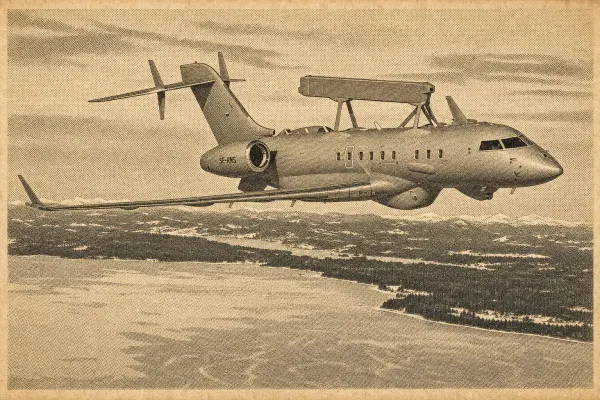
Carney said the federal government is negotiating to procure Saab’s GlobalEye aircraft, which are built on Bombardier’s Global 6500 business jet. That matters politically and economically because the jet is manufactured in Canada at Bombardier’s Toronto-area plant, while Saab supplies the radar and sensor package.
Carney also pointed out the aircraft includes about 20% U.S. content. Even with that, the pitch is clear: buy something that anchors more work at home and reduces Canada’s default habit of sourcing major defence equipment from American primes.
Ottawa has previously said it’s in the market for six radar aircraft. Carney did not announce a final contract, a price tag, or delivery timelines, describing the move as negotiations rather than a signed deal.
Arctic surveillance boost for Canadian Armed Forces
GlobalEye is designed to spot and track threats at long range. Carney told CANSEC that Saab’s system would be “a key resource” to help the Canadian Armed Forces “detect and deter threats across the Arctic.”
One of the key operational details cited in the reporting: the aircraft can track objects on land, at sea, or in the air out to about 650 kilometres. These kinds of platforms are often described as flying radar nodes: they provide wide-area situational awareness and can help direct fighter jets toward targets.
The push feels more urgent because of longstanding concerns about gaps in Arctic surveillance, and because early warning aircraft are useful not just at home but also for overseas operations alongside allies.
Boeing E-7 and L3Harris Aeris X lose out
Saab wasn’t the only bidder.
The competing options were Boeing’s E-7A Wedgetail (U.S.-built) and L3Harris’s Aeris X. Reuters notes the Wedgetail has faced delays and cost overruns, which likely did it no favours in a Canadian procurement environment that is already allergic to big-ticket surprises.
NATO’s interest also loomed over the decision. NATO is looking at GlobalEye as a contender to replace its aging Boeing E-3 Sentry fleet, and Carney argued the Saab aircraft is already a “product of choice” among several partners, naming France, Sweden, and the UAE.
Carney pushes defence spending beyond the United States
Carney has been blunt about wanting to shift Canadian military spending away from the U.S., previously saying no more than 70 cents of every dollar of Canadian military capital spending should go south of the border.
Canada also joined a major European Union defence fund last year, and the GlobalEye announcement fits that broader theme: diversify suppliers, deepen ties with European partners, and build what Carney calls “Canadian strategic autonomy.”
That political backdrop has sharpened since U.S. President Donald Trump launched a trade war and suggested Canada should become the 51st U.S. state, comments that angered many Canadians and helped create the environment for Carney’s confrontational stance to land.
What this means for the F-35 review
The GlobalEye decision lands while Ottawa is still reviewing its planned purchase of 88 F-35 fighter jets from Lockheed Martin. Reuters reports that after the U.S. slapped tariffs on key Canadian imports last year, Carney asked the military to look at whether Canada could cut back the F-35 order and buy some aircraft from another manufacturer. The government still hasn’t announced a decision.
Saab, for its part, has also been in the mix on the fighter side. Its earlier pitch to Canada promised that assembly and maintenance of the Saab Gripen would take place in Canada, and another report says Saab had bundled its GlobalEye proposal with its Gripen-E fighter bid, including promised technology transfer so both aircraft could be fully manufactured locally.
At CANSEC, Carney did not say whether the GlobalEye negotiations signal any coming shift on fighters. For now, the concrete change is on airborne surveillance: Canada is moving toward Saab’s GlobalEye, with the Arctic and domestic industrial work at the centre of the argument.
Support Independent Canadian News Analysis
The Canada Report is supported by readers like you. If this article helped you understand what’s happening, you can support our work with a one-time tip.
Support The Canada Report