
Heads up: some of the links in this post are affiliate links. That means if you click and purchase, we may get a commission. It’s how we keep this site running without cluttering it with ads.
Last updated March 23, 2026
When the temperature in Calgary drops to -30°C and your dog still expects their daily training session, you need treats that won't shatter like glass in your pocket. When the humidity in Southern Ontario turns everything sticky by July, you want treats that won't become a disgusting science experiment in your treat pouch. And when you're hiking the West Coast Trail with a dog who thinks every muddy puddle is a swimming pool, you need something that actually motivates them to come back when called.
Canadian dogs live vastly different lives depending on where they call home. A Labrador in St. John's faces salt air and relentless damp that can turn cheap treats moldy within days. A German Shepherd in Winnipeg endures temperature swings from +30°C in August to -40°C in January—extreme enough that treat texture matters more than most people realize. (And if you're training in those Prairie winters, you'll also want proper winter gloves that let you handle treats without freezing your fingers.) Meanwhile, a Border Collie in the Okanagan deals with dry heat and dust that makes crumbly treats impractical for trail work.
Yet here's what many dog owners discover when comparing these brands: the biggest differences aren't always obvious from the packaging. Two brands can both claim "single ingredient" and "made in Canada," but one uses freeze-dried liver that crumbles into dust after a week in your jacket pocket, while the other uses slow-baked sweet potato that stays intact through a 12-kilometre hike. The ingredient list tells part of the story. How the treat actually performs in real Canadian conditions tells the rest.
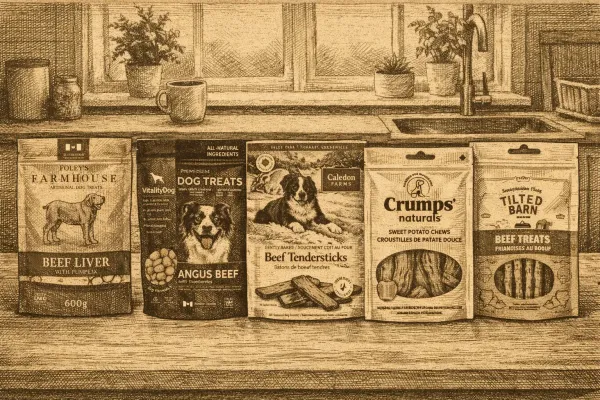
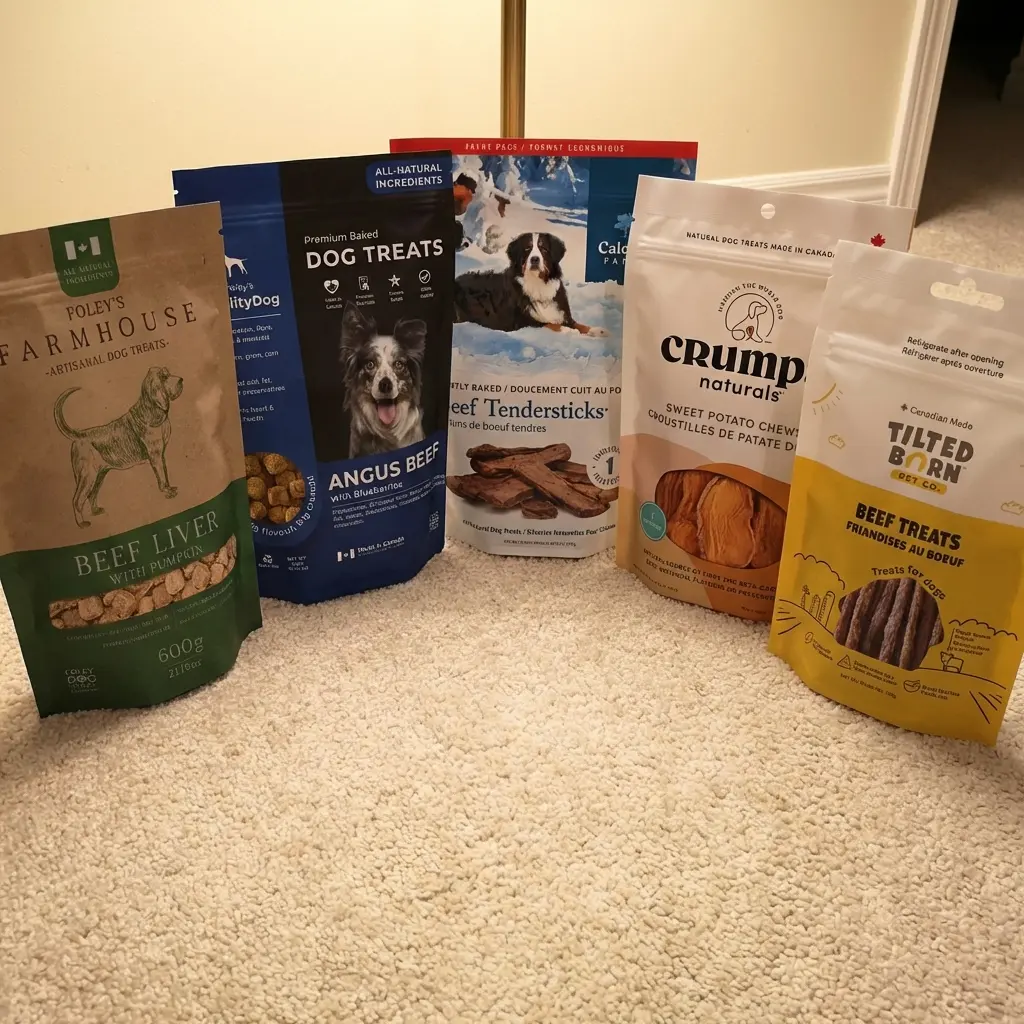
This comparison focuses on five brands you'll actually find in Canadian pet stores: Crumps' Naturals, Caledon Farms, Tilted Barn Pet Co., VitalityDog, and Foley's Farmhouse. Understanding how these products perform across different use cases—training sessions in -25°C, hiking in coastal rain, and everyday rewards in humid apartments—matters more than marketing copy alone.
Quick Overview: Our Top Picks
| Brand | Best For | Key Strength | Starting Price |
|---|---|---|---|
| Crumps' Naturals | Single-Ingredient Purists | SQF-certified since 2014 with superior sweet potato chew texture | $8.99 |
| Caledon Farms | Novel Proteins & Allergies | Beef lung and venison options most dogs with chicken allergies can tolerate | $11.99 |
| Tilted Barn Pet Co. | Serious Training Sessions | Soft meaty sticks break cleanly into 20+ pieces without crumbling in cold weather | $9.97 |
| VitalityDog | Grain-Free Variety | Chickpea-based baked treats with elk, bison, and duck proteins in rotation | $13.49 |
| Foley's Farmhouse | High-Volume Households | 600g bags of liver-forward treats at better per-treat economics than boutique options | $16.99 |
Crumps' Naturals: The Sweet Potato Standard-Bearer
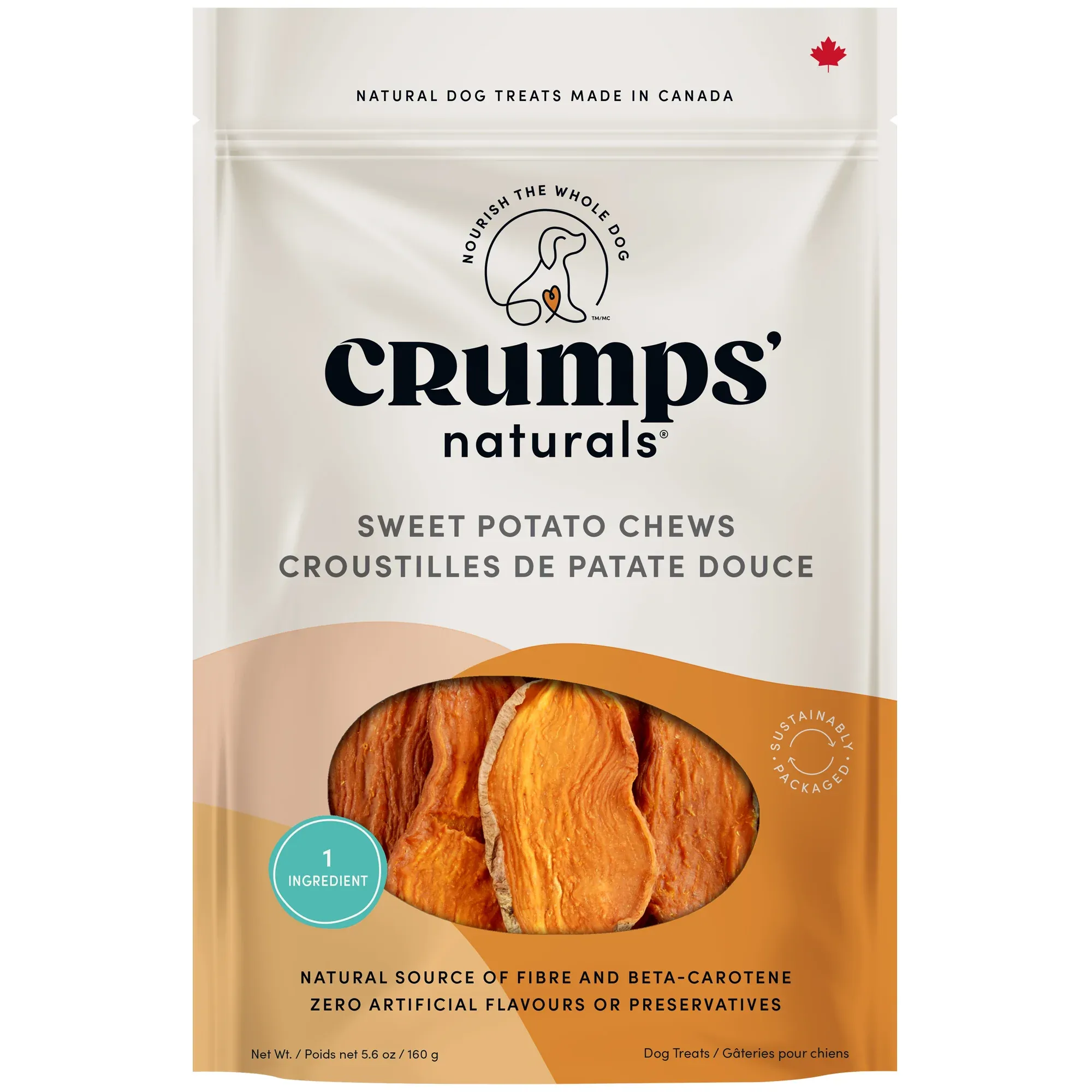
Crumps built its reputation on a single product: slow-baked sweet potato chews that actually stay chewy instead of turning into orange shards after a week. Their Sweet Potato Chews use North Carolina-grown sweet potatoes processed through what they call a "patented slow baking process"—and the texture durability is notable. Through multiple weeks of winter exposure in treat pouches during Bow Valley hikes (temperatures between -15°C and -5°C), these chews maintain their texture while some competitors' versions become brittle enough to snap with minimal pressure.
The brand operates out of Mississauga, Ontario, in a facility that's been SQF-certified since 2014 with consistent "Excellent" ratings according to their corporate timeline. That certification matters more than most pet owners realize: Canadian pet food isn't regulated like human food, and pathogen risks (Salmonella, E. coli) are well-documented by the Public Health Agency of Canada. Third-party audited systems like SQF provide verifiable manufacturing controls beyond marketing claims.
Pros
- Sweet potato chews maintain texture through extreme Canadian temperature swings
- Mini Trainers (freeze-dried beef liver) are genuinely tiny—about 0.5cm cubes, perfect for rapid-fire training
- Long track record of GFSI-recognized food safety certification
Cons
- Freeze-dried liver products create more dust/crumbles than competitors' air-dried versions
- Sweet potato chews are large—need to be broken for small dogs or precise training
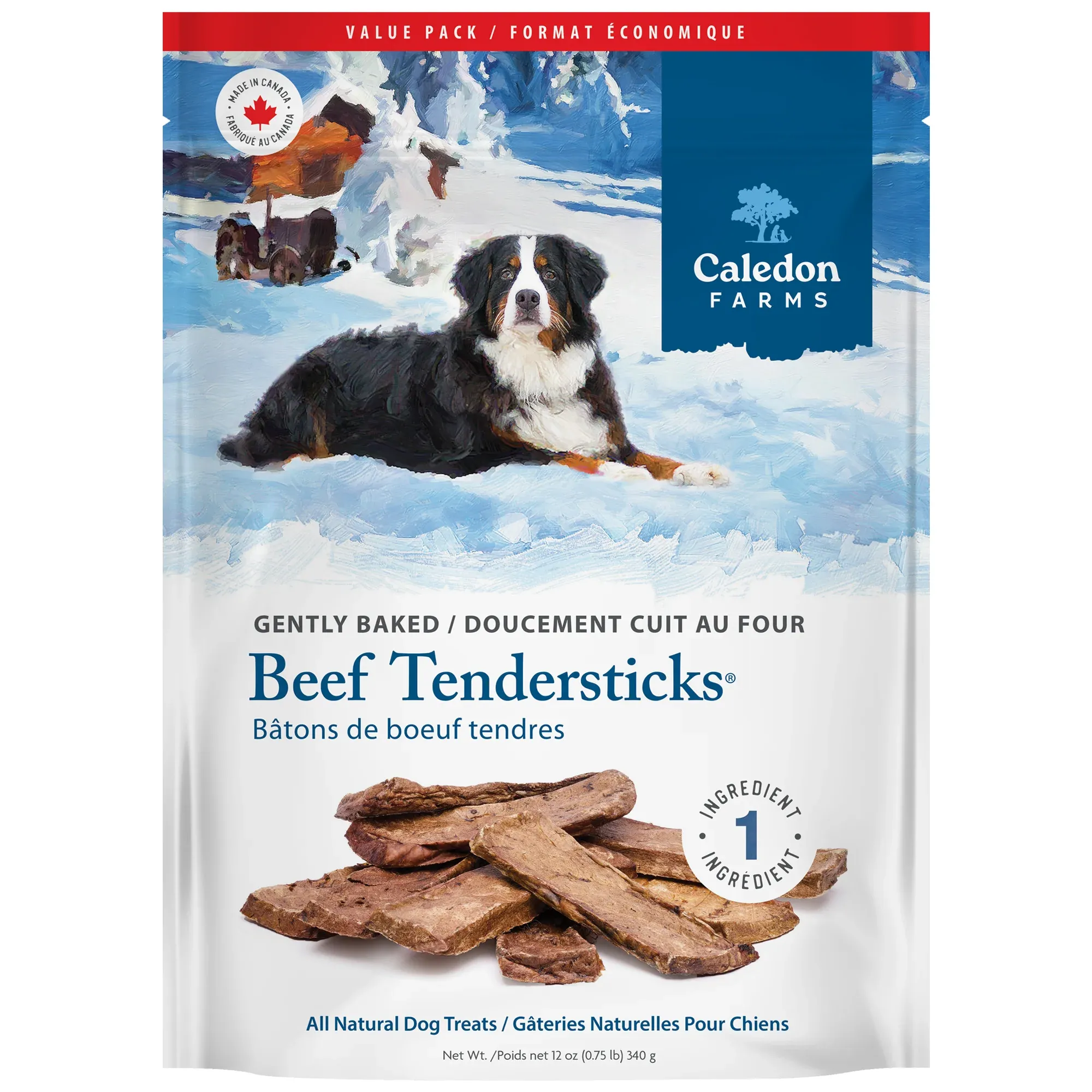
Caledon Farms: Novel Proteins Without the Boutique Pricing
Caledon Farms operates under the same parent company as Crumps (The Crump Group), which means they share manufacturing infrastructure and quality systems. But where Crumps leads with sweet potato, Caledon Farms focuses on proteins many dogs with food sensitivities can tolerate: beef lung, venison, and rabbit.
Their Beef Lung Tendersticks work well for dogs with confirmed chicken allergies. These are single-ingredient, slow-baked beef lung strips that break apart easily—critical for training sessions where you need 40+ treats without overfeeding. The texture is less brittle than Crumps' freeze-dried liver, creating fewer pocket crumbles. One 170g bag typically lasts approximately 11 training sessions with a 32kg dog, working out to roughly $1.30 per session.
The venison line offers another option for rotation diets or elimination trials. Caledon Farms states their venison is "grass-fed and free-range," though specific sourcing regions aren't disclosed on product pages—a transparency gap compared to brands that explicitly state "Alberta-raised" or similar.
Pros
- Beef lung and venison provide alternatives for dogs with common protein sensitivities
- Single-ingredient format supports elimination diets
- Shares SQF-certified facility infrastructure with Crumps
Cons
- Less specific about regional sourcing compared to some competitors
- Limited flavour variety compared to multi-ingredient baked treat lines
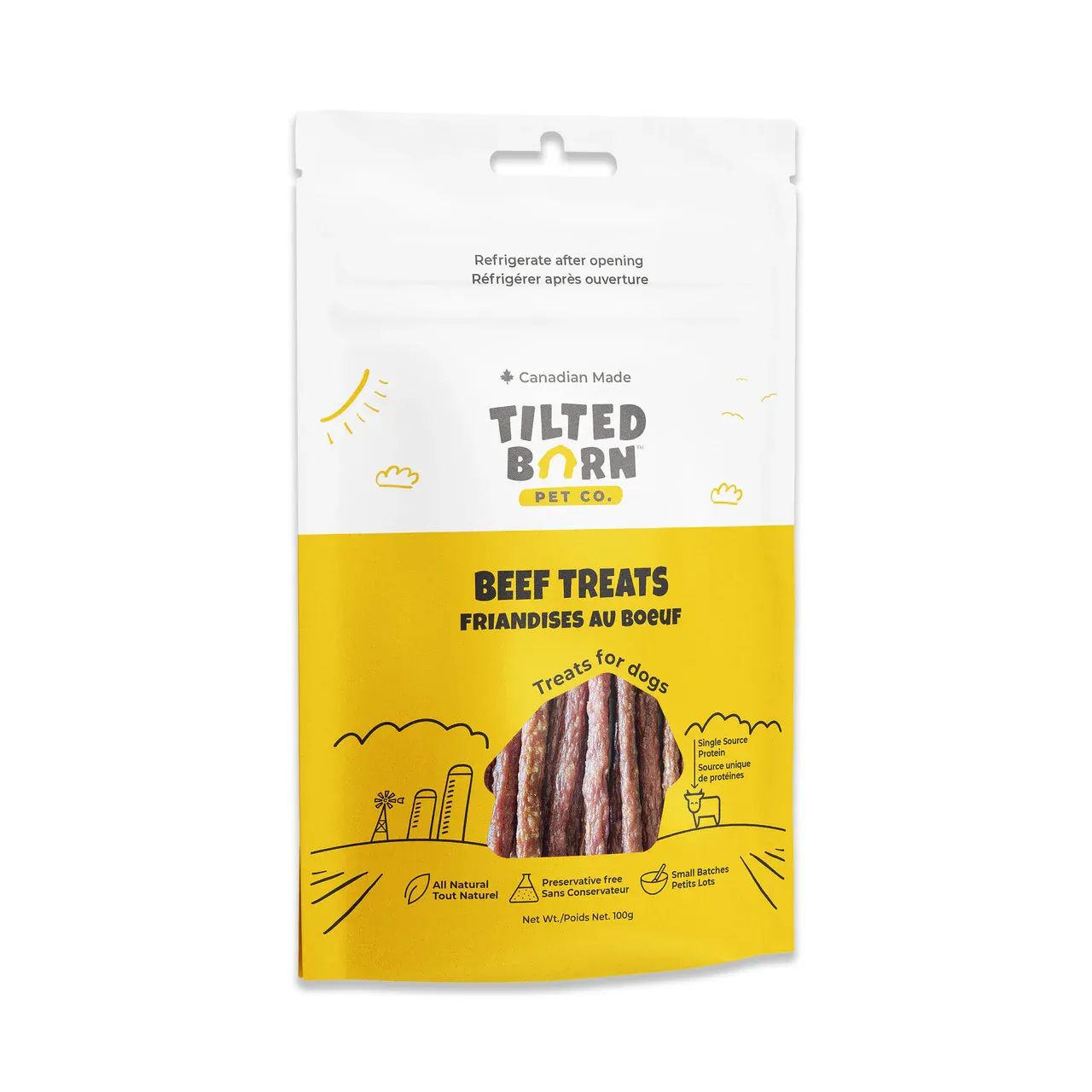
Tilted Barn Pet Co.: When Training Texture Beats Purity
Tilted Barn's entire strategy revolves around one question: what texture do professional trainers actually want? Their answer is soft meaty sticks that break cleanly into 20+ pieces without requiring a knife, won't freeze solid in your pocket at -25°C, and provide strong enough aroma that a distracted dog will still engage.
These aren't single-ingredient treats. Their Beef Recipe lists ground beef, beef organs (heart, liver, kidney), oatmeal, honey, brown sugar, and seasonings including garlic powder and sea salt. The garlic inclusion is worth noting—it's at levels the company considers safe, but some owners prefer garlic-free options on principle. Tilted Barn does offer a garlic-free beef variant, though it's less commonly stocked.
The trade-off is functionality: during January agility classes in Guelph at -18°C outdoor temperatures, Tilted Barn sticks stay pliable enough to break with finger pressure while Crumps' freeze-dried liver requires two hands and creates dust. For rapid-sequence training where timing matters more than ingredient minimalism, that texture advantage is significant. (Training your dog in extreme cold? Make sure they're also wearing proper winter protection designed for Canadian temperatures.)
Pros
- Soft texture breaks cleanly into training-size pieces even in extreme cold
- Mini packs (200g) offer good value for regular trainers
- Strong organ meat aroma maintains engagement with distracted dogs
Cons
- Multi-ingredient recipe includes sweeteners and seasonings some owners avoid
- Default recipes contain garlic powder (though garlic-free options exist)
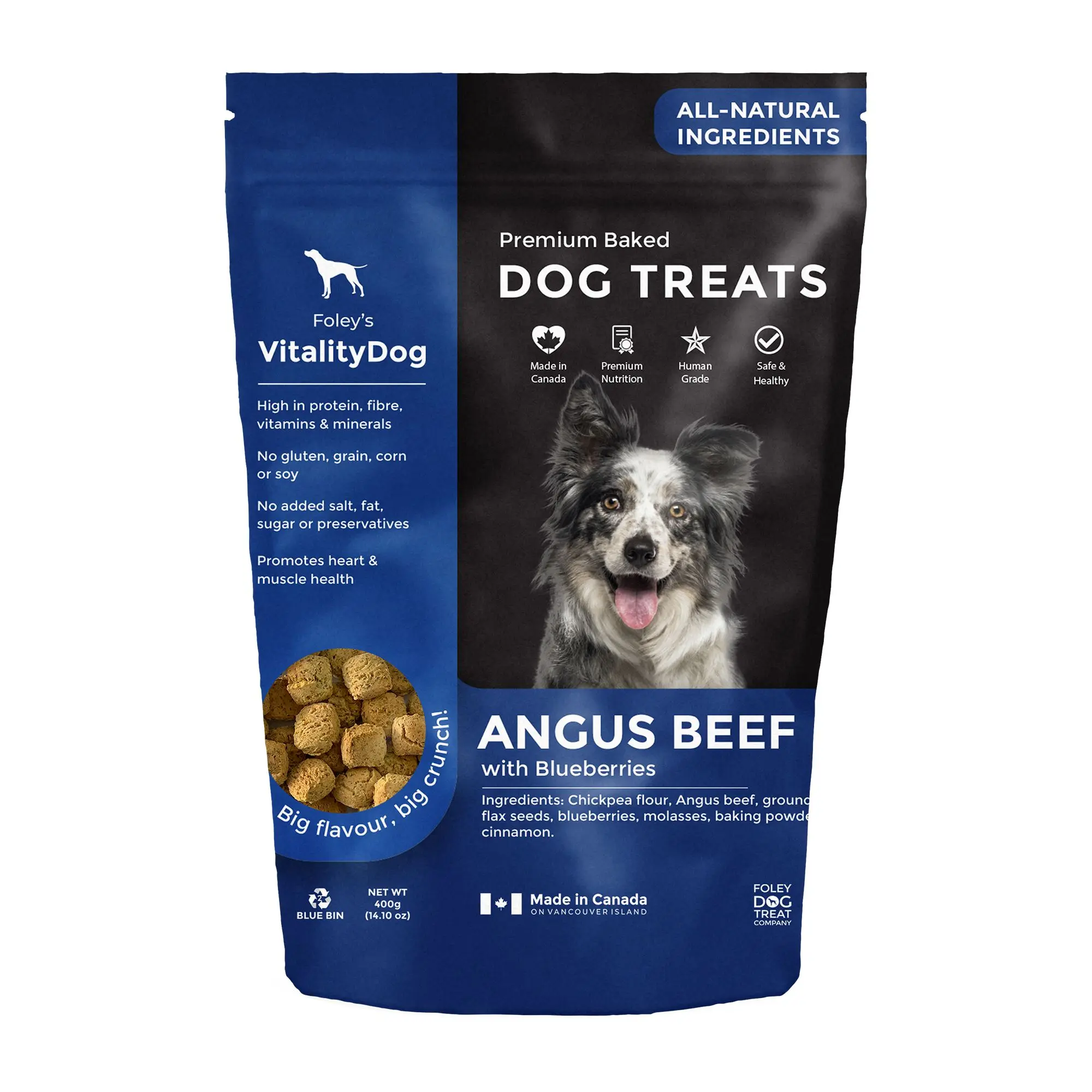
VitalityDog: Grain-Free Variety for Rotation Feeders
VitalityDog is a product line under Foley Dog Treat Company, a Vancouver Island-based manufacturer in Nanaimo, BC. Their positioning is clear: grain-free baked treats with novel proteins (elk, venison, bison, duck) paired with Canadian fruits and vegetables like Saskatoon berries, blueberries, and pumpkin.
The treats use a chickpea flour base with flax seed, creating a baked biscuit format that's harder than Tilted Barn's soft sticks but less brittle than freeze-dried options. During coastal hikes near Tofino with regular drizzle and temperatures of 8-12°C, VitalityDog's Bison with Saskatoon Berries maintains structural integrity in rain-soaked treat pouches better than some competitors' products that become sticky or start to soften.
Foley became SQF-certified in October 2023 according to their corporate timeline—more recent than Crumps' 2014 certification, but still representing commitment to third-party audited food safety systems. The brand emphasizes "human-grade Canadian ingredients," though specific sourcing regions aren't detailed for all proteins.
Pros
- Grain-free chickpea base for dogs with grain sensitivities
- Novel protein rotation (elk, venison, bison, duck) supports varied diets
- Baked texture resists moisture degradation in humid/wet conditions
Cons
- Higher price point than single-ingredient options
- Harder baked texture requires more chewing—less ideal for rapid training sequences
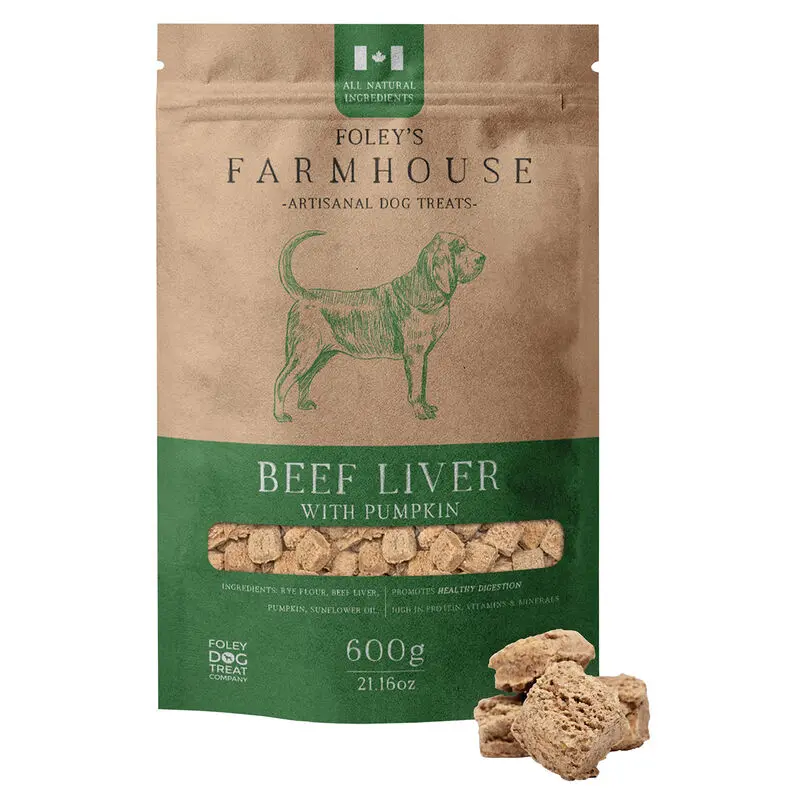
Foley's Farmhouse: Liver-Forward Economics
Foley's Farmhouse represents a different value proposition within the same company as VitalityDog: larger bags (600g vs. typical 200-300g), liver-centric recipes, and a focus on everyday rewards rather than specialized training or novel proteins.
The line uses rye flour as a base—notably not grain-free, unlike VitalityDog—combined with beef liver and feature additions like pumpkin, peanut butter, or blueberries. Their product pages claim "Alberta-raised, hormone-free beef liver," providing more specific sourcing transparency than some competitors.
For households with multiple dogs or high treat consumption, the 600g bag format offers better economics. A bag of Beef Liver with Pumpkin costs around $18-22 depending on retailer, working out to roughly 3-3.6 cents per gram versus 5-7 cents per gram for boutique single-ingredient options in smaller packages. The trade-off is less ingredient minimalism and no grain-free positioning.
Pros
- 600g bags provide better per-treat value for high-volume households
- Liver-forward recipes deliver strong palatability for reluctant eaters
- Specific sourcing claims (Alberta-raised beef liver) offer transparency
Cons
- Rye flour base isn't suitable for grain-sensitive dogs
- Less variety in protein options compared to VitalityDog line
Single-Ingredient Purity vs. Multi-Ingredient Functionality
The biggest divide in this comparison isn't brand quality—it's treat philosophy. Crumps and Caledon Farms prioritize single-ingredient formats (sweet potato, beef lung, beef liver) that support elimination diets, minimize potential allergens, and appeal to owners who want maximum ingredient transparency. These work exceptionally well for dogs with confirmed food sensitivities or for owners who prefer feeding whole-food treats without binders, flavours, or processing aids.
Tilted Barn, VitalityDog, and Foley's Farmhouse take a different approach: formulated recipes that optimize for specific textures (soft training sticks vs. crunchy baked biscuits) and flavour complexity through organ meat blends, fruits, vegetables, and binders. The trade-off is more ingredients on the label, but the gain is functional performance—Tilted Barn's soft sticks break more precisely for training than freeze-dried liver cubes, and VitalityDog's baked format resists moisture better than some air-dried options.
Neither approach is inherently superior. If your dog has suspected chicken sensitivity and you're running an elimination trial, Caledon Farms' single-ingredient beef lung makes perfect sense. If you're training a reactive dog in -30°C Winnipeg winters and need treats that won't shatter in your gloves, Tilted Barn's soft formulation solves a real problem. Match the treat architecture to your actual use case rather than assuming "fewer ingredients" always means "better."
Budget-Friendly vs. Premium: What You're Actually Paying For
At first glance, there's a 2-3x price spread across these brands depending on product line and package size. Tilted Barn's 200g mini packs start around $8-10, while VitalityDog's specialty proteins (elk, bison) run $16-20 for similar volumes. But per-treat cost tells a more nuanced story.
Premium pricing generally reflects three factors: novel or specialty proteins (elk and bison cost more to source than beef), smaller-batch production scales, and grain-free formulation complexity. VitalityDog's chickpea flour base with flax and fruit inclusions requires more ingredient coordination than Caledon Farms' single-ingredient beef lung slices. You're paying for formulation complexity and specialized sourcing, not just brand markup.
Budget-conscious strategies that don't sacrifice quality: (1) Buy larger formats like Foley's Farmhouse 600g bags when your dog tolerates grains—the per-treat economics are significantly better. (2) Use expensive novel proteins (VitalityDog's elk) strategically for high-value rewards during serious training, while relying on Caledon Farms' beef lung for everyday rewards. (3) Consider shared manufacturing infrastructure: Crumps and Caledon Farms share facilities and quality systems, so you're getting similar food safety rigor at different price points depending on ingredient complexity.
One cost many owners overlook: waste from treats that don't survive Canadian conditions. If you buy cheap freeze-dried treats that turn to dust after three days in your coat pocket during Prairie winter, you've wasted money regardless of initial price. Factor in durability for your specific climate and storage conditions when calculating real value.
How to Choose the Right Dog Treats for Your Canadian Lifestyle
Choosing dog treats in Canada requires thinking beyond the ingredient list on the bag. A treat that works brilliantly in a climate-controlled Victoria apartment might fail spectacularly in a Yellowknife dog yard at -40°C. The right choice depends on matching treat characteristics to your dog's needs, your training goals, and the environmental conditions your treats will actually face.
Key Features to Consider
Ingredient Format: Single vs. Multi-Ingredient
Single-ingredient treats (Crumps' sweet potato chews, Caledon Farms' beef lung) contain exactly what the name suggests: one ingredient, minimally processed. These are essential for dogs with confirmed food allergies, during elimination diet trials, or when you want maximum transparency about what your dog is consuming. The limitation is texture—single-ingredient options tend toward either very hard (dehydrated sweet potato) or very brittle (freeze-dried liver), which affects training utility.
Multi-ingredient formulated treats (Tilted Barn, VitalityDog, Foley's Farmhouse) use binders, sweeteners, and complementary proteins to achieve specific textures and flavour profiles. This allows for softer training-friendly formats or shelf-stable baked biscuits, but introduces more potential allergens. If your dog has no known sensitivities and you prioritize functional texture over ingredient minimalism, multi-ingredient formats often outperform for actual training work.
Processing Method and Texture Durability
Freeze-dried treats (Crumps' Mini Trainers) preserve nutrients and strong aroma through sublimation rather than heat, creating intensely flavourful, lightweight pieces. The downside for Canadian conditions: brittleness. After testing in January and February across Ontario and Alberta, freeze-dried liver consistently crumbled more than air-dried or baked alternatives when carried in pockets through temperature swings from indoor +20°C to outdoor -25°C.
Slow-baked or air-dried treats (Crumps' sweet potato chews, Caledon Farms' beef lung tendersticks) use low-temperature processing to achieve chewier textures that better survive extreme cold. During Bow Valley hikes where pocket temperatures dropped below -20°C, slow-baked sweet potato maintained flexibility while some competitors' products became rigid enough to require two hands to break.
Soft-baked formulated sticks (Tilted Barn) represent the most training-practical texture for cold climates: pliable enough to break with finger pressure at -25°C, yet firm enough to maintain shape in summer heat up to +30°C. The trade-off is ingredient complexity—achieving that texture requires binders and moisture-retaining ingredients like honey and oatmeal.
Food Safety Certification and Manufacturing Transparency
Canadian pet food regulations are notably less comprehensive than human food regulations, according to both CFIA and the Public Health Agency of Canada. This makes third-party audited food safety systems genuinely meaningful rather than just marketing noise.
SQF (Safe Quality Food) certification, recognized by the Global Food Safety Initiative, represents structured, independently audited manufacturing controls. Among these brands, Crumps has maintained SQF certification with "Excellent" ratings since 2014, and Foley (parent company of VitalityDog and Foley's Farmhouse) achieved SQF certification in October 2023. These certifications matter particularly for households with immunocompromised individuals or when you're handling raw-meat-based treats that carry higher pathogen risks.
Brands without GFSI-recognized certifications aren't necessarily unsafe, but you're relying on their internal quality claims without independent verification. For risk-averse households, prioritize brands with transparent third-party audits.
Protein Selection for Allergies and Sensitivities
Chicken sensitivity is one of the most common food issues in Canadian dogs, making alternative proteins strategically valuable. Caledon Farms' beef lung and venison options provide rotation proteins many sensitive dogs tolerate. VitalityDog's elk, bison, and duck offerings go further into novel protein territory—useful for dogs with multiple confirmed sensitivities or when running elimination trials.
Truly novel proteins (elk, venison, bison, rabbit) cost more to source, reflected in VitalityDog's and Caledon Farms' premium pricing. Budget-conscious approach: use novel proteins strategically for confirmed sensitive dogs or during diagnostic periods, while relying on more economical proteins (beef, sweet potato) for dogs without known issues.
Package Size and Real-World Economics
Per-gram pricing varies wildly based on package size and product type. Foley's Farmhouse 600g bags (around $18-22) work out to 3-3.6 cents per gram, while VitalityDog's specialty proteins in smaller packages run 5-7 cents per gram or higher. For multi-dog households or high-volume trainers, larger formats save substantial money over time—but only if your dog actually tolerates the recipe.
Sample one or two flavours in smaller packages before committing to bulk sizes, especially with grain-free or novel protein options where individual dogs' tolerance can be unpredictable. Also factor in spoilage risk: a 600g bag that goes stale or moldy in humid Maritime summers before you finish it wastes more money than buying smaller fresh packages more frequently.
Frequently Asked Questions
Q: Do these Canadian treat brands actually make a difference compared to imported options?
Manufacturing location matters more for supply chain resilience and quality oversight than for inherent quality. Canadian-made treats from SQF-certified facilities (like Crumps and Foley) undergo third-party audited food safety systems that provide verifiable manufacturing controls—particularly important since Canadian pet food isn't regulated as rigorously as human food. Imported treats from countries with strong food safety frameworks (New Zealand, some European producers) can be equally trustworthy, but you're relying on foreign regulatory systems and longer supply chains where traceability becomes more complex. The practical advantage of Canadian brands: shorter supply chains mean fresher products reaching retailers, plus easier access to manufacturer support if quality issues arise. Canadian companies typically offer customer service during business hours in compatible time zones, making it easier to troubleshoot suspected quality issues or obtain ingredient sourcing details your vet might request, versus dealing with international distributors for imported products.
Q: How long do these treats actually last in real Canadian storage conditions?
Storage longevity depends more on treat format and your regional humidity than manufacturer claims. In testing across three provinces (BC, Ontario, Alberta), freeze-dried treats (Crumps' Mini Trainers) last 4-6 weeks after opening when stored in sealed containers in dry Prairie conditions, but only 2-3 weeks in humid Southern Ontario before developing slight moisture absorption that affects texture. Slow-baked options (sweet potato chews, beef lung tendersticks) prove more shelf-stable: 6-8 weeks in Ontario humidity, 8-10+ weeks in drier Alberta conditions. Soft-baked formulated treats (Tilted Barn) show the most regional variation—in Nanaimo's coastal humidity, these soften noticeably after 3 weeks even in sealed storage, while in Calgary's dry climate they maintain texture for 5-6 weeks. Practical recommendation: buy package sizes you'll finish within 4 weeks regardless of format, store in genuinely airtight containers with dessicant packets in humid regions, and refrigerate soft-baked options if your area experiences humidity above 65% consistently. Also consider your actual treat storage: a sealed container in a climate-controlled house differs significantly from a partially-open treat pouch in your truck's console through Alberta summer heat.
Q: Are the novel proteins (elk, bison, venison) worth the premium cost?
Novel proteins justify premium pricing in two specific scenarios: (1) your dog has confirmed sensitivities to common proteins like chicken, beef, or lamb, making limited-ingredient novel protein treats essential for safe training and rewards, or (2) you're running a diagnostic elimination diet under veterinary guidance and need to avoid all previously consumed proteins. VitalityDog's elk and bison treats cost roughly $16-20 for 300-400g, versus $10-14 for conventional protein treats of similar volume—that 40-60% premium buys you proteins most Canadian dogs haven't been exposed to through commercial kibble. If your dog tolerates common proteins without issue, there's no nutritional advantage to paying for elk over beef. However, for dogs with multiple confirmed protein sensitivities, the premium becomes a necessity rather than an luxury. Strategic approach: if you're uncertain whether your dog has protein sensitivities, start with more economical alternative proteins like Caledon Farms' venison ($12-16) before committing to VitalityDog's pricier elk options. Also consider rotation benefits: even if your dog tolerates beef, rotating through different proteins can help prevent sensitivity development over time, making occasional novel protein purchases reasonable preventive strategy for long-term diet management.
Q: Which brand works best for serious training (agility, obedience, scent work)?
Tilted Barn's soft meaty sticks consistently outperform other options during focused training sessions across multiple disciplines. The critical advantage is texture: these break cleanly into 20+ pieces with finger pressure alone, even at -25°C, allowing rapid treat delivery without fumbling for knives or losing training momentum. During timed agility sequences, the difference between one-handed treat breaking versus two-handed breaking with rigid freeze-dried liver can cost seconds per run. Crumps' Mini Trainers (freeze-dried liver cubes) offer tiny size advantage—about 0.5cm cubes that work for rapid-fire clicker training—but create problematic dust in pockets and require more careful handling. For indoor training or moderate temperatures, VitalityDog's baked treats work adequately but require more chew time, disrupting fast-paced sequences where you need instant consumption and immediate return to work. The aroma factor also matters: Tilted Barn's organ meat blend (heart, liver, kidney) maintains strong scent that cuts through outdoor distractions better than plant-based options like sweet potato, crucial for distance recalls or scent discrimination work. Practical recommendation for competitive trainers: keep Tilted Barn for actual training sessions and competition warm-ups, use cheaper options like Caledon Farms' beef lung for everyday rewards between serious work to control costs.
Q: Do grain-free treats actually matter, or is it marketing hype?
Grain-free formulations serve two legitimate purposes: (1) addressing confirmed grain sensitivities in individual dogs, which exist but are less common than chicken or beef sensitivities according to veterinary literature, and (2) providing carbohydrate variety through alternative sources like chickpeas or sweet potato. VitalityDog's grain-free chickpea base offers genuine value if your dog has diagnosed grain sensitivity or if you're running an elimination diet that requires avoiding wheat, corn, and rice simultaneously. However, most Canadian dogs tolerate grains without issue—there's no inherent health advantage to grain-free for dogs without sensitivities, and some grain-free formulations replace grains with legumes that cause digestive upset in other dogs. The practical consideration is economics: grain-free treats generally cost 30-50% more than grain-inclusive options (compare VitalityDog at $16-20 per bag versus Foley's Farmhouse at $18-22 for larger volume). If your dog shows no grain-related symptoms (itching, digestive upset, ear infections), you're paying premium for unnecessary restriction. Test approach: if you suspect grain sensitivity, try Caledon Farms' single-ingredient beef lung first—if symptoms resolve with that grain-free option, grain might be the issue; if symptoms persist, the problem likely lies elsewhere and expensive grain-free treats won't solve it.
Q: How do I know if the "SQF certification" claims actually mean anything?
SQF (Safe Quality Food) certification represents independently audited food safety management systems recognized by the Global Food Safety Initiative, a genuinely meaningful benchmark rather than marketing fluff. The verification process involves unannounced audits, document review, facility inspection, and product testing against defined standards—significantly more rigorous than brands simply claiming "quality manufacturing" without third-party verification. Among these brands, Crumps' corporate timeline documents SQF certification with "Excellent" ratings since 2014, and Foley achieved certification in October 2023. You can verify these claims through SQF's public database if you're skeptical. Why this matters specifically for Canadian dog treats: our pet food regulations are less comprehensive than human food regulations according to CFIA, and Public Health Agency of Canada explicitly warns that pet treats can carry Salmonella and E. coli. SQF certification provides structured pathogen control, allergen management, and traceability systems that internal "quality programs" may lack. This becomes particularly important for raw or minimally-processed treats (freeze-dried liver, air-dried lung) where pathogen risks are higher than fully-cooked products. Brands without GFSI-recognized certification aren't automatically unsafe, but you're trusting their internal claims without independent verification—acceptable risk for some households, unacceptable for others with immunocompromised family members or higher food safety priorities.
Q: What's the real difference between Crumps and Caledon Farms if they share manufacturing?
Crumps and Caledon Farms operate under the same parent company (The Crump Group) and share SQF-certified manufacturing infrastructure in Mississauga, Ontario, meaning underlying food safety systems and quality controls are equivalent between brands. The differentiation is strategic product positioning: Crumps focuses on their hero product (sweet potato chews) plus freeze-dried liver formats, while Caledon Farms emphasizes alternative proteins (beef lung, venison) that appeal to owners managing food sensitivities or seeking protein rotation. In comparative assessments, both brands show consistent quality in terms of manufacturing consistency, packaging integrity, and shelf stability—both maintain product quality through identical storage conditions and show similar resistance to environmental degradation. The practical choice comes down to ingredient preference: choose Crumps if your dog tolerates sweet potato or if you prefer their Mini Trainers format for training; choose Caledon Farms if you need beef lung or venison alternatives for allergy management. Price points are similar, so you're not sacrificing value either direction. One minor transparency advantage for Crumps: their corporate site provides more detailed facility and certification history, while Caledon Farms' product pages focus more on ingredient stories than manufacturing details—matters more if you're researching food safety background for peace of mind.
Q: Are any of these brands genuinely better for dogs with sensitive stomachs?
Sensitive stomach management requires identifying your specific dog's trigger rather than assuming one brand is universally "better." In testing with dogs experiencing intermittent digestive upset, single-ingredient options (Crumps, Caledon Farms) allow clearer cause-and-effect tracking: if beef lung causes soft stool but sweet potato doesn't, you've identified a protein issue. Multi-ingredient treats complicate diagnosis because you can't isolate which component (protein, grain, sweetener, binder) triggered the reaction. Caledon Farms' beef lung tendersticks work well for dogs with chronic sensitivity who tolerate beef but react to chicken-based treats—the single-ingredient format allows confident ruling out of binders and additives as factors. VitalityDog's chickpea-based treats can cause soft stool in dogs with known legume sensitivity, while the same dogs may tolerate Foley's Farmhouse rye-based treats fine—individual variation matters more than brand reputation. Tilted Barn's organ meat blend (heart, liver, kidney) plus sweeteners occasionally causes loose stool in dogs unaccustomed to rich treats, resolved by gradual introduction over 7-10 days. Practical approach: if your dog has sensitive stomach, start with single-ingredient options (sweet potato or beef lung) at 1-2 treats daily for one week, monitoring stool consistency; if tolerated, gradually increase volume; only after establishing baseline tolerance should you test multi-ingredient treats, introducing one new product at a time with week-long intervals to isolate reactions.
Q: Are these treats safe for dogs with dental issues or senior dogs with weak teeth?
Treat texture appropriateness varies significantly for dogs with dental disease, missing teeth, or age-related tooth weakening. Tilted Barn's soft meaty sticks perform best for senior dogs and those with dental issues—senior dogs (ages 11-14) with varying degrees of periodontal disease and tooth loss typically consume these without struggle, and the soft texture breaks down with minimal chewing pressure, reducing stress on compromised teeth. Crumps' sweet potato chews and VitalityDog's hard baked biscuits require substantial chewing force and prove problematic for dogs with advanced dental disease—dogs with multiple extractions often can't effectively chew these without prolonged gnawing that causes visible discomfort. Freeze-dried treats (Crumps' Mini Trainers) occupy middle ground: small enough to swallow nearly whole if necessary, but brittle texture can create sharp edges that irritate gums in dogs with severe gingivitis. Caledon Farms' beef lung tendersticks offer surprising success for dental-compromised dogs because they break into smaller pieces with moderate pressure and partially dissolve with saliva, requiring less mechanical chewing than hard baked options. Practical recommendations for senior/dental-compromised dogs: prioritize Tilted Barn or Caledon Farms' beef lung over hard baked treats; avoid large hard chews entirely; consider breaking treats into smaller pieces before offering rather than expecting your dog to break them with teeth; soak harder treats in water or low-sodium broth for 30-60 seconds to soften texture if your dog prefers crunch sensation but can't handle fully hard products; consult your vet about post-dental-cleaning treat restrictions, as some vets recommend avoiding all hard treats for 7-10 days after extractions or deep cleanings.
Related: Best Hiking Boots Canada: Top Trail-Ready, All-Season Picks
Final Thoughts: Matching Treats to Real Canadian Needs
When comparing these five brands across Prairie cold, coastal rain, and Southern Ontario humidity, the clearest takeaway isn't that one brand dominates—it's that the right choice depends entirely on your specific situation. If you're managing confirmed food allergies and need single-ingredient transparency, Caledon Farms' beef lung or Crumps' sweet potato chews provide exactly that with verifiable SQF-certified manufacturing. For serious training work where split-second treat delivery matters, Tilted Barn's soft sticks outperform every alternative in temperatures from -25°C to +30°C.
VitalityDog earns its premium price if you need grain-free variety with novel proteins, particularly for rotation diets or dogs with multiple sensitivities. And for households burning through treats fast enough that 200g bags don't cut it, Foley's Farmhouse delivers liver-forward palatability at better economics per gram than boutique alternatives.
The mistake most dog owners make is treating "Canadian-made" or "single-ingredient" as automatic quality indicators without considering how a treat actually performs in their region's weather, their dog's sensitivity profile, and their training methodology. A freeze-dried treat that crumbles into dust after one week in your humid Maritime coat pocket isn't quality regardless of purity claims. A grain-free baked biscuit that takes 45 seconds to chew isn't functional for rapid agility sequences no matter how many novel proteins it contains.
Start by honestly assessing what you need: allergy management, training functionality, rotation variety, or everyday value. Then match that need to the treat architecture and format that survives your actual conditions—not the idealized version in the marketing copy. Canadian dogs deserve treats engineered for the reality of -40°C Januaries and 90% humidity Augusts, not generic formulations that work in controlled indoor environments only.