
Government Files is The Canada Report's public-records analysis series examining government documents obtained through Canada's Access to Information (ATI) and provincial Freedom of Information (FOI) laws. These transparency laws allow members of the public to request internal government records from federal and provincial institutions. This article reviews documents released through those processes and summarizes what the records contain and what they show. While we strive for accuracy, this article represents an analysis and interpretation of the source material. For complete accuracy and full context, readers should review the original documents, which are available in full below.
Full Document
The complete document is available for download below:
Internal Canada Energy Regulator correspondence shows that the energy framework Prime Minister Mark Carney and Alberta Premier Danielle Smith signed in Calgary commits Ottawa to a one-million-barrel-per-day bitumen pipeline to the Pacific, the suspension of the Clean Electricity Regulations, and a decision not to bring in the long-promised Oil and Gas Emissions Cap. The records also set a hard deadline: Alberta is to have a pipeline application ready for the federal Major Projects Office on or before July 1, 2026.
The documents were released by the Canada Energy Regulator (CER) under file number A-2025-12 — a re-release package of records covering the Canada-Alberta Memorandum of Understanding. They consist of an internal Parliamentary Affairs briefing prepared by CER staff and a Natural Resources Canada commitment table circulated among senior officials in the days around the November 27, 2025 signing. Together they lay out, in the federal government's own internal language, what each side agreed to give up and what each side expects to get.
What the Documents Show
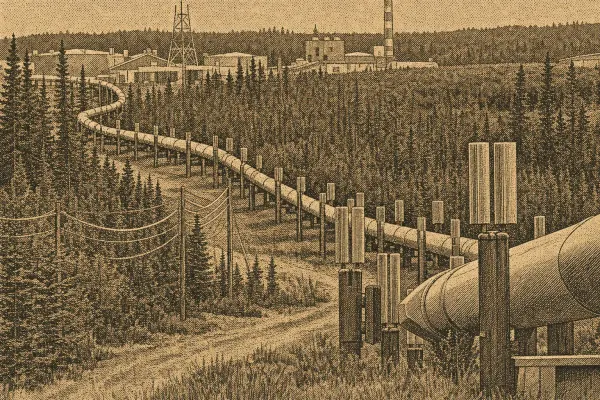
At the centre of the agreement is a single new export pipeline. According to the CER briefing, the MOU envisions one or more privately constructed and financed pipelines carrying at least one million barrels per day of what the records repeatedly describe as "low emission" Alberta bitumen, routed to increase access to Asian markets. The briefing is explicit that this line would be in addition to the existing Trans Mountain expansion, which the documents say is itself slated to grow by a further 300,000 to 400,000 barrels per day destined for Asia.
The internal records frame the pipeline and emissions reduction as a package deal. The briefing states that increased oil production enabled by the new pipeline would be "decarbonized" through the Pathways Alliance project — a proposed carbon capture, utilization and storage (CCUS) network the documents describe as intended to be the world's largest. The commitment table goes further, recording that the two governments agree the Pathways project is a prerequisite to the approval, commencement and continued construction of the bitumen pipeline, "given that the two projects referred to in this MOU are mutually dependent."
On the regulatory side, the documents name the CER directly. Federal agencies, the regulator, the Alberta government and municipalities are committed to streamlining approvals toward a maximum two-year timeframe, with shorter timelines targeted where feasible. The parties also agreed to negotiate a cooperation agreement on impact assessments on or before April 1, 2026, aimed at reducing duplication through a single assessment process. One line in the commitment table stands out for what it signals about the CER's own footing: Ottawa committed to suspend the Clean Electricity Regulations in Alberta immediately, pending a new carbon pricing agreement, and the briefing notes that on completion of that agreement Canada would place the regulations "in abeyance" in the province.
The federal concessions extend across several files that have defined climate politics for the better part of a decade. The records show Canada agreeing not to implement the Oil and Gas Emissions Cap, which the briefing notes had not yet taken effect. Ottawa also committed to extend federal investment tax credits to encourage large-scale CCUS investment, including enhanced oil recovery — a use that had previously been excluded from the CCUS tax credits — and to propose amendments to the Competition Act to remove some of the so-called "greenwashing" provisions that industry has argued create investment uncertainty.
Want future Government Files like this?
We release new Canadian public-records breakdowns weekly.
The Carbon Price at the Centre of the Trade
In exchange for dropping the emissions cap and suspending the electricity regulations, the documents show Canada accepting Alberta's own carbon system as the primary mechanism for large emitters. The records commit both governments to conclude an agreement on industrial carbon pricing on or before April 1, 2026, built around Alberta's Technology Innovation and Emissions Reduction (TIER) program rather than federal rules. Under the deal, the TIER system would ramp up to a minimum effective credit price of $130 per tonne.
The commitment table adds a detail the public announcement did not dwell on: the carbon pricing agreement is to include a financial mechanism intended to hold both parties to their commitments over the long term. The two governments also agreed to design sector-specific stringency factors for large Alberta emitters across both oil and gas and electricity, and to adapt the system to the particular circumstances of sectors such as fertilizer and cement. This is the arrangement that the records present as the foundation everything else rests on — the cap comes off and the regulations are suspended on the understanding that a $130-per-tonne Alberta carbon market takes their place.
Methane is handled on a parallel track. The records commit Canada and Alberta to a methane equivalency agreement, also by April 1, 2026, with a 2035 target date and a 75 percent reduction target. Notably, the two documents disagree on the baseline year: the CER briefing cites a reduction relative to 2014 emissions levels, while the Natural Resources Canada commitment table cites 2012. The discrepancy is small but is the kind of detail that matters when an equivalency agreement is eventually drafted.
The British Columbia Problem
For a pipeline aimed at the Pacific, the documents are candid that the hardest piece is the province the line would have to cross. The records commit Canada and Alberta to engage with British Columbia immediately in a trilateral discussion on the project, and to ensure that British Columbians share substantial economic benefits. The agreement also acknowledges, in writing, that exporting bitumen from a deep-water port to Asia would require an adjustment to the federal Oil Tanker Moratorium Act — the law that currently bans large oil tankers along B.C.'s north coast.
That tension is not new. Earlier this year B.C.'s energy minister rejected a northern route for an Alberta pipeline, citing the tanker ban directly, a position covered in our reporting on B.C.'s rejection of the northern pipeline route. The MOU does not resolve that disagreement so much as schedule it: the documents say Canada will only confirm it will enable bitumen export through an appropriate adjustment to the tanker moratorium if a pipeline is approved under the Building Canada Act and provides Indigenous co-ownership and shared economic benefits. The route the project would take, and whether B.C. signs on, is left to the trilateral process the MOU sets up rather than settled in the agreement itself.
The pipeline at the heart of the MOU closely tracks the Indigenous-owned, one-million-barrel-per-day line Premier Smith proposed earlier. The records confirm Alberta will act as proponent for advancing the project, and that both the federal Canada Indigenous Loan Guarantee Corporation and the Alberta Indigenous Opportunities Corporation are to be used to backstop Indigenous co-ownership of the pipeline and, where appropriate, the Pathways CCUS network.
AI Data Centres, Nuclear and the Grid
Beyond oil, the documents reveal an agreement that reaches well into electricity and computing. Among the four major projects named in the MOU is the construction of thousands of megawatts of what the records call "AI computing power," with a large portion dedicated to a sovereign data cloud for Canada and its allies. Alberta committed to implement a policy framework to incentivize large data-centre investment, including incentives for Canadian sovereign computing, on or before July 1, 2026, with federal feedback on that framework due by the same date.
The records also commit the two governments to collaborate on a nuclear power generation strategy, to be finalized by Alberta on or before January 1, 2027, capable of serving Alberta and inter-connected markets by 2050. Rounding out the project list are large new transmission interties between Alberta, British Columbia and Saskatchewan, intended to move low-carbon power across the western grid to serve oil, LNG, critical minerals, agriculture, data centres and CCUS industries. Taken together, the documents describe not just a pipeline deal but an attempt to wire Alberta's grid for an electricity-hungry computing build-out at the same time.
What's Not in the Documents
The records have a notable gap relative to the request that produced them. The access-to-information request sought records, correspondence, emails, briefing notes and interdepartmental communications relating to Pathways Alliance, "Pathways Plus," any associated Alberta CCUS pipeline projects, and — specifically — Brookfield Asset Management or any Brookfield-affiliated entities and their potential involvement in project applications, regulatory filings or approvals. The released package contains no reference to Brookfield at all. The two documents in the re-release are a Parliamentary Affairs summary and a commitment table; neither names Brookfield, addresses any specific corporate proponent of the Pathways CCUS network, or includes the kind of project filing or regulatory correspondence the request was aimed at.
That absence may simply reflect that these particular records do not touch the company, rather than that no such records exist anywhere in the CER. But it means the central question the requester appears to have been investigating — whether a major asset manager is positioning around the Pathways CCUS build — is not answered, confirmed or denied by what was released. The package also puts no dollar figures on any of the projects. The MOU commits to the world's largest CCUS network, a million-barrel pipeline, thousands of megawatts of computing and a new nuclear strategy without the records specifying a cost, a financing structure beyond "private sector," or a named builder for any of them.
Why These Records Matter
What makes the package useful is that it is the federal government talking to itself. The public announcement in Calgary was a media availability; these documents are how senior officials at the CER and Natural Resources Canada described the same agreement internally, including which commitments they flagged as directly affecting their own regulator. The briefing's "Direct Impacts to the CER" section, and the line about placing the Clean Electricity Regulations "in abeyance," show an agency working out in real time what a political deal means for its statutory role.
The deal also reorders a long-running political fight rather than ending it. The same agreement these records summarize triggered the resignation of Liberal MP Steven Guilbeault over its environmental direction, and it leans heavily on the faster federal pipeline review process Ottawa has been building through the Building Canada Act. Every major commitment in the documents carries a 2026 or 2027 deadline, which means the months ahead will show whether the carbon pricing agreement, the methane deal, the trilateral talks with B.C. and the pipeline application all materialize on the schedule the two governments set for themselves — or whether, like previous west-coast pipeline ambitions, the timeline slips.
Reader-funded. No ads. No paywall.
The Canada Report is independent, reader-funded Canadian news — no advertisers, nothing behind a paywall, kept free for everyone. If you value it, you can help keep it that way.
Support The Canada Report →All documents referenced are from the Canada Energy Regulator, file number A-2025-12, obtained through an Access to Information request. The records consist of an internal CER Parliamentary Affairs briefing and a Natural Resources Canada commitment table summarizing the Canada-Alberta Memorandum of Understanding signed November 27, 2025.