
| Sourced from 4 independent sources · no points in dispute |
The Globe and Mail, Edmonton Sun, Financial Post, and TS2 Technology
Every key fact in this report is confirmed by more than one independent source.
9 key facts · 9 corroborated · none disputed
This summary is compiled from the independent sources listed above.
At a Toronto Loblaws, Matthew Avenins and Sarah Baldwin were doing what Loblaw now says it wants to make easier: checking where their groceries come from before putting them in the cart.
“The more that we can support our own economy, the better. The less reliant we are on the U.S., the better off we’re going to be,” Avenins said.
Tariff labels return to shelves
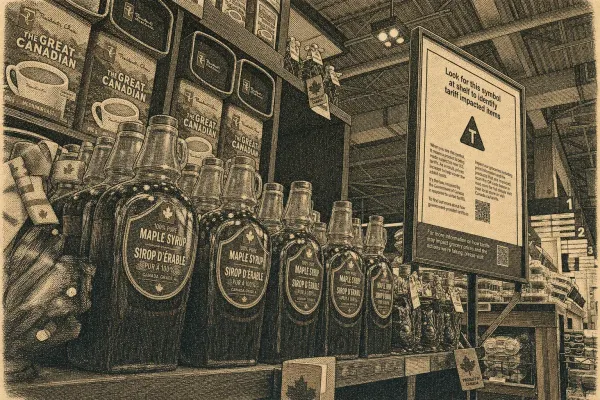
Loblaw is reinstating its black-triangle “T” shelf label for products sourced from the United States that are affected by Canadian retaliatory tariffs.
The company first used the symbol in 2025 to identify U.S. products subject to retaliatory tariffs. Now, as Canada-U.S. trade uncertainty returns, Loblaw says the markers will come back gradually as affected products are identified and shelf labels are updated.
“We are reinstating the T symbol on shelf labels for products sourced directly from the U.S. that are affected by tariffs,” Loblaw spokesperson Youmna Rab said in an emailed statement. “Customers will begin to see the T symbol appear as affected products are identified and shelf labels are updated.”
The company is also reintroducing country-of-origin labels in its fresh produce aisles. Canadian products will continue to be marked with maple-leaf labels or symbols in Loblaw stores.
Shoppers pushed for clarity
The reversal followed public pressure from Canadian shoppers who have been trying to buy Canadian and avoid U.S. products amid the trade dispute.
Loblaw had recently removed country-of-origin produce labels before deciding to restore them. The change landed at a moment when many shoppers were already scrutinizing labels, looking for signs that their grocery dollars were staying in Canada.
“As Canada enters another period of trade uncertainty with the United States, we are once again taking steps to give customers clear information about products affected by tariffs and make Canadian products easier to identify,” Rab said.
That is exactly the kind of information some shoppers say they want.
David McLachlan said he checks whether blueberries are Canadian before buying them. “I’m going to pay more for Canadian stuff every time. I’m voting with my wallet,” he said.
Stephanie Turner described the choice in broader terms. “We want to support our friends and merchants here to make sure that Canada remains the amazing country it is,” she said.
Produce labels are complicated
For a national grocery chain, country-of-origin labelling is not as simple as printing a sign and leaving it there.
Changing seasonal supply, supplier availability and country sourcing make accurate produce-origin labelling difficult for national grocers. Fresh produce can shift quickly depending on what is available, where suppliers can source it and how seasonal patterns affect supply.
Agricultural economist Ellen Goddard described the task of updating produce labels, signs and flyers as a logistical “nightmare” for grocery stores.
That complexity helps explain why Loblaw had removed country-of-origin produce labels before restoring them. But the public pressure around “Buy Canadian” shopping has made the absence of those labels harder for the company to sustain.
Maple leaves and black triangles
The renewed labelling creates two clear signals for shoppers walking the aisles: maple-leaf symbols for Canadian products, and the black-triangle T for U.S.-sourced products affected by Canadian retaliatory tariffs.
Loblaw says the goal is to help shoppers identify tariff-affected products and choose Canadian goods during renewed Canada-U.S. trade uncertainty.
For shoppers such as Avenins, the labels are not just store signage. They are a way to turn a weekly grocery run into a small political and economic choice.
“The more that we can support our own economy, the better,” he said.
Reader-funded. No ads. No paywall.
The Canada Report is independent, reader-funded Canadian news — no advertisers, nothing behind a paywall, kept free for everyone. If you value it, you can help keep it that way.
Support The Canada Report →