
| Sourced from 4 independent sources (5 reports) · no points in dispute |
The CJN, ABC Nepal, The Gateway Pundit, and PressBee
Every key fact in this report is confirmed by more than one independent source.
9 key facts · 9 corroborated · none disputed
Why some reports were counted once
PressBee and RT — the same report, published near-identically, counted once.
When several outlets publish the identical article — often because they ran the same wire-service story — we count it as one source, not several, so the count reflects independent reporting rather than how widely one story was republished.
Allegations described here are not proven in court unless stated.
A CAD$30,000 University of Alberta research endowment named for Yaroslav Hunka can be dissolved, a Court of King’s Bench justice has ruled, ending one stage of a dispute that began after one of Canada’s most embarrassing parliamentary moments in recent memory.
Justice Debra Yungwirth found the university was authorized to close the endowment, which was intended to fund research on the history of the Ukrainian Catholic Church at the University of Alberta. The ruling turns on institutional reputation, not a court finding about Hunka’s wartime conduct.
Court backs University of Alberta
The endowment carried Hunka’s name, and his service in the Waffen-SS Galicia Division during the Second World War became central to the controversy surrounding it.
After the issue reached court, Yungwirth ruled that the University of Alberta could dissolve the fund. According to the decision quoted in source reporting, the university “did not terminate the Hunka Trust because it determined that Yaroslav was a war criminal or anti-Semitic.”
“Rather, it did so because it perceived that any continued association with an individual who had served in a regiment connected to the Nazis would adversely affect the University of Alberta,” Yungwirth wrote.
That distinction sits at the heart of the ruling. The university did not have to prove the broader historical allegations around Hunka. It had to show that keeping the endowment, after the public controversy around his name, was not in the university’s best interests.
Parliament ovation cast long shadow
The dispute cannot be separated from what happened in Ottawa during Ukrainian President Volodymyr Zelensky’s 2023 visit to Canada’s Parliament.
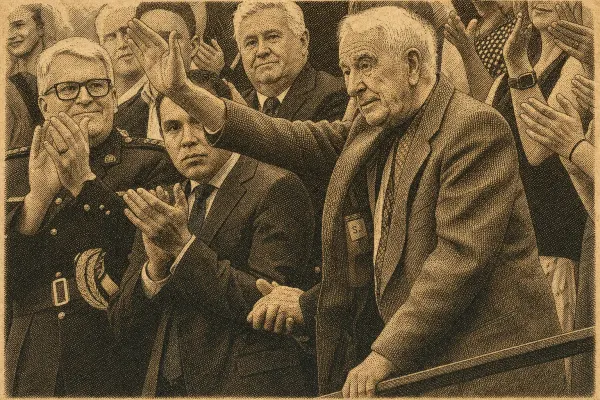
Hunka received a standing ovation from members of the House of Commons. After his Waffen-SS service became public, the incident drew international condemnation. Speaker Anthony Rota resigned, and Justin Trudeau publicly apologized.
The fallout quickly reached Edmonton. The University of Alberta moved to close the endowment because continued association with Hunka posed reputational concerns for the institution.
Yungwirth’s ruling accepts that logic. In the wording quoted from the decision, “The House of Commons incident, and the public response that followed, made it clear that maintaining the Hunka Trust was not in the University’s best interests.”
Family opposed the closure
Hunka’s family opposed the university’s move. Their central argument was that the university knew about Hunka’s Waffen-SS service when it accepted the donation.
That argument gave the case its tension: if the university accepted the endowment with knowledge of Hunka’s past, could it later dissolve the fund because that same association became publicly damaging?
Yungwirth’s answer was yes. The ruling found the university had authority to protect its reputation and broader institutional interests, even if that meant ending an endowment that had been accepted earlier.
The decision does not erase the family’s objection. It rejects it legally.
A ruling, not a verdict
The judgment is notable for what it does not do. Yungwirth said the university’s decision did not rest on declaring Hunka a war criminal.
That matters because the case unfolded amid intense public emotion over memory, wartime history, antisemitism and Canada’s handling of the Parliament incident. The court narrowed the question to the university’s authority over the endowment and its ability to act in its own best interests.
Steve Shafir, quoted by The CJN, said he found the decision encouraging because it showed the university had “recognized the errors of the past.” He also said the episode showed that “more education” is needed.
For the university, the ruling affirms that reputational risk can be enough to unwind a donor-linked honour. For Hunka’s family, it is a loss in a fight over whether the institution should have been able to reverse course after accepting the endowment.
Appeal still being considered
The legal fight may not be over.
Hunka’s lawyer, Julian Savaryn, said Hunka was disappointed and considering an appeal.
For now, the University of Alberta has the court’s authorization to dissolve the CAD$30,000 endowment. But the case leaves behind a larger Canadian argument that no court ruling can fully settle: how public institutions should handle names, donations and honours when the history attached to them becomes impossible to ignore.
Reader-funded. No ads. No paywall.
The Canada Report is independent, reader-funded Canadian news — no advertisers, nothing behind a paywall, kept free for everyone. If you value it, you can help keep it that way.
Support The Canada Report →