

| Sourced from 6 independent sources · 1 point in dispute |
CTV News, Townhall, Geo News, Europe Says, New York Post, and News18
Sources agree on most key facts but differ on 1 point.
10 key facts · 7 corroborated · 1 disputed
Where sources differ
The estimated value of Canadian goods subject to the U.S. 50% tariffs
Europe Says: Trump levied 50% taxes on $20 billion of Canadian goods.
New York Post: On Aug. 22, the U.S. imposed 50% duties on an estimated $28 billion of Canadian goods.
This summary is compiled from the independent sources listed above.
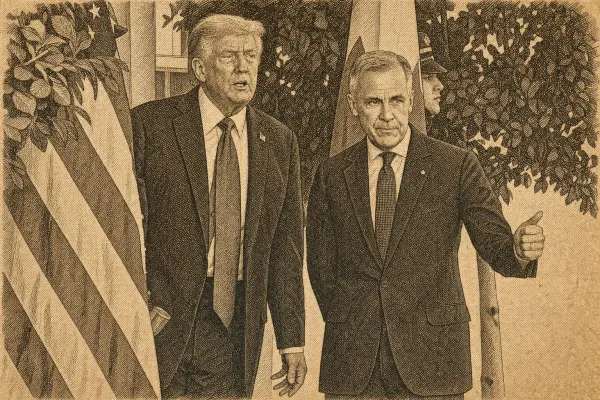
Mark Carney has publicly acknowledged that Canada examined the possibility of a U.S. military attack, describing it as an “extreme tail risk” that cannot be treated as the most likely outcome but cannot simply be ignored.
In an interview with The New York Times, the Prime Minister said a U.S. attack was not a “base case” and was highly unlikely. But, he said, “it would be irresponsible not to” prepare for such a possibility.
Planning for an extreme risk
Carney’s wording matters. He did not portray military action as imminent, nor did he suggest Canada expects an attack. Instead, he framed the work as risk management: considering a rare event with potentially catastrophic consequences.
Defence Minister David McGuinty has urged Canadians to view the discussion in that light. Militaries routinely plan for scenarios that may never happen, McGuinty said, calling that kind of preparation normal.
The remarks arrive amid an unusually fraught period in Canada-U.S. relations. Donald Trump has repeatedly suggested Canada could become the 51st U.S. state. While Trump ruled out military annexation in January 2025, he has since spoken about using “economic force” instead.
That combination of rhetoric and economic pressure has given Carney’s comments a sharper public resonance, even as the Prime Minister stresses that military conflict remains highly unlikely.
Trade tensions deepen the strain
The more immediate dispute is trade. Canada and the United States saw trade talks collapse in August, followed by new tit-for-tat tariffs imposed by both sides.
On Aug. 22, after new 50 per cent U.S. tariffs were imposed, Carney described the situation in striking terms.
“You’re at war when you get attacked. We got attacked,” he said. “That’s fine. We’ve got the reserves. We’ve got the resilience. We’ve got the plan. We’ve got the focus. We will respond.”
The language captured the political intensity of the moment, but Carney has also kept open a direct line to Trump. He has said the two speak frequently about issues, including after the trade talks broke down.
That leaves Ottawa managing two messages at once: a readiness to respond to pressure and an insistence that dialogue remains possible.
Washington signals no rush
The American side has offered little sign of urgency about reviving a trade agreement.
According to CTV News, U.S. Trade Representative Jamieson Greer told CNBC there was “no urgency” for the United States to strike a deal with Canada, while adding that his team was still having “good conversations” with Canadian officials.
The contrast is stark. Carney has spoken of an attack and of economic warfare, while continuing to talk directly with Trump. Washington, meanwhile, is signalling that discussions continue but that it does not feel pressed to reach a deal.
Scaramucci calls risk “not zero”
Anthony Scaramucci, a former Trump communications director, said Carney would be right not to dismiss the military scenario altogether.
In an interview with CTV News, Scaramucci said the prospect should be “zero,” but added: “It’s not zero.” He called Trump a “wild card” and said it would be imprudent for Carney not to contemplate the possibility.
Scaramucci also argued that delaying a trade deal beyond Oct. 1 could put Trump in a “nightmare scenario” economically.
For Carney, the public challenge is to prepare without inflaming a situation he says is not likely to happen. His comments put that balancing act plainly: Canada is planning for the outer edge of risk while still speaking to the neighbour whose actions have made that planning part of the national conversation.
Reader-funded. No ads. No paywall.
The Canada Report is independent, reader-funded Canadian news — no advertisers, nothing behind a paywall, kept free for everyone. If you value it, you can help keep it that way.
Support The Canada Report →Source 1 | Source 2 | Source 3 | Source 4 | Source 5 | Source 6