
Heads up: some of the links in this post are affiliate links. That means if you click and purchase, we may get a commission. It's how we keep this site running without cluttering it with ads.
A ski helmet is simple gear with a non-negotiable job: it needs to fit your head properly and stay put through a full day of skiing or snowboarding. Canadian conditions make the supporting details matter too. A bluebird day in Banff, damp snow near Vancouver, and a windy afternoon at a Quebec hill (a few of the best winter destinations in Canada) can call for very different amounts of insulation and airflow. Goggles must sit cleanly against the brim, vents need to manage heat without becoming an icy draft, and a liner should suit the temperature rather than fight it.
This curated guide focuses on seven available options, selected from published specifications, listed features, prices, and buyer ratings and feedback. The right choice is not automatically the most expensive helmet. A well-fitted basic model is a better purchase than a feature-packed one with the wrong head shape or loose fit. Start with protection standards and fit, then decide if you need Mips, a goggle bundle, a lighter shell, removable ear pads, or adjustable venting.
Quick Overview: Our Top Picks
| Product | Best For | Why We Love It | Price |
|---|---|---|---|
| Tight budgets | Budget-friendly protection with adjustable fit, washable padding, and 14 vents for comfort. | $39.99 | |
| Added impact protection | MIPS protection, goggle-focused ventilation, and adjustable fit make it a strong premium choice. | $169.99 | |
| Complete starter setup | Budget set includes adjustable goggles, removable warmth layers, and ventilation designed to reduce fogging. | $79.99 | |
| Premium complete setup | Premium bundle combines protective construction, adjustable warmth, and goggles designed for airflow and compatibility. | $89.99 | |
| Lightweight comfort | Certified protection, low weight, removable lining, and 10 vents support comfortable all-day slope use. | $64.99 | |
| Low-profile fit | Budget helmet offers dial adjustment, eight vents, and clips that help secure goggles. | $59.39 | |
| Mid-range value | Mid-range set pairs adjustable comfort features with shock-absorbing construction and anti-fog ventilation. | $85.99 |
OutdoorMaster Ski Helmet
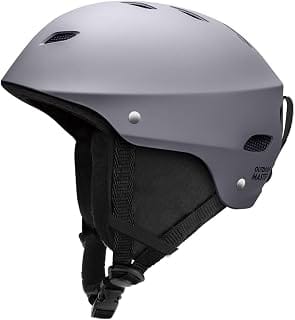
The OutdoorMaster Kelvin is the practical budget pick for a new skier, a growing household of snow-sport users, or anyone who wants a conventional helmet rather than a bundled kit. Its reinforced ABS shell and EPS core cover the basics, while the rear adjustment dial helps refine the fit. Fourteen vents make it a sensible choice for riders who run warm during active laps, and the removable fleece liner and ear pads simplify seasonal cleanup. Buyers frequently praise the adjustable fit, interior comfort, and value, though some mention that the chin strap can be finicky. It comes in 13 matte colour options, useful if several family members need distinct gear. The trade-off is that no named safety certification or rotational-impact system is listed, so buyers should verify marking on the helmet before purchase.
Check OutdoorMaster Ski Helmet on Amazon for current availability.
Pros
- Reinforced ABS shell with a shock-absorbing EPS core
- Adjustment dial, removable fleece liner, and washable ear pads
- Fourteen vents and 13 matte colour options
Cons
- No named certification is listed in the supplied features
- Some buyers find the chin strap less straightforward to adjust
Giro Ledge MIPS Helmet
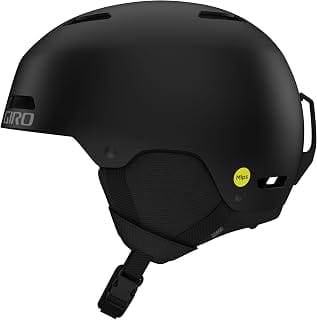
The Giro Ledge MIPS is for the park rider or frequent resort skier who wants a hard-shell helmet with Mips and is prepared to pay more for those features. Its rugged outer shell is attached to an EPS liner, and the Mips system is the central reason to choose it over basic models. Stack Vent at the front is intended to align with goggles, while top Super Cool vents release hot air. Removable ear pads, a removable goggle retainer, vertical tuning, and compatibility with aftermarket audio systems add versatility. Buyer feedback is positive on fit, but the Asian Fit designation is a serious sizing cue rather than a cosmetic label. Its trade-off is less universal sizing and a substantially higher cost than simple dial-fit helmets.
Check Giro Ledge MIPS Helmet on Amazon for current availability.
Pros
- Includes Mips and hard-shell construction with an EPS liner
- Stack Vent and top vents support goggle airflow and heat release
- Removable ear pads, goggle retainer, and audio-system compatibility
Cons
- Asian Fit may not suit every head shape
- Higher-cost choice than the basic helmet options
Odoland Helmet and Goggles
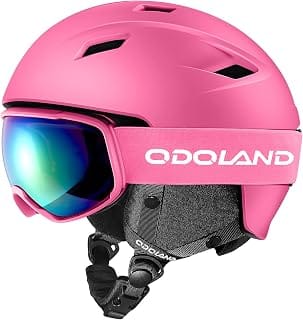
The Odoland helmet-and-goggles set is a strong starting point for beginners, occasional skiers, and families that need both pieces at once. The helmet combines a polycarbonate outer shell with an EPS inner shell, and the package includes detachable goggles plus a carry bag. Twelve vents and the goggles’ Flow-Tech venting design target the two problems that derail a cold day: excess heat and foggy vision. Detachable lining and earmuffs, a soft chin band, and adjustable bands make the set adaptable as temperatures change. Buyers often highlight the value, secure fit, and included goggles. The honest limitation is that a bundle gives less freedom to choose a specific goggle lens or frame shape, and no named safety standard appears in the supplied details. Measure carefully; this listed small fits 52 to 55 cm.
Check Odoland Helmet and Goggles on Amazon for current availability.
Pros
- Helmet, detachable goggles, and carry bag in one package
- Polycarbonate shell, EPS liner, and 12 air vents
- Removable lining and earmuffs for changing conditions
Cons
- Included goggles may not suit every face or lens preference
- No named certification is provided in the supplied features
OutdoorMaster Helmet and Goggles
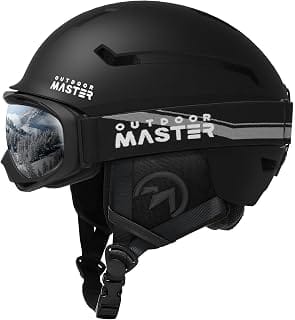
OutdoorMaster’s adult helmet set suits a first-time snowboarder or skier who needs goggles and wants an option that can accommodate glasses underneath. The helmet pairs a PC shell with protective EPS foam, while the included goggles are described as anti-fog, UV400, and OTG. That OTG detail is the differentiator for prescription-glasses wearers, though buyers should still confirm space and comfort with their own frames. Detachable lining and earmuffs help with Canadian temperature swings, and the soft chin band aims to reduce pressure under the jaw. The listing describes either 8 or 12 vents in different supplied details, so buyers should confirm the selected version before ordering. Reviews commonly mention the fit, bundle value, and glasses compatibility. It is less compelling for someone who already owns well-matched goggles or wants a named standard clearly listed.
Check OutdoorMaster Helmet and Goggles on Amazon for current availability.
Pros
- Includes OTG anti-fog UV400 goggles
- PC shell, EPS foam, detachable lining, and detachable earmuffs
- Designed for skiing, snowboarding, skating, and other snow sports
Cons
- Vent count is inconsistent across the supplied listing details
- No named certification is specified in the supplied features
InnerKing Ski Helmet
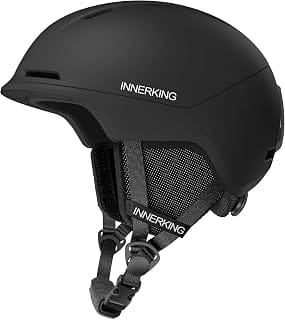
The InnerKing is the choice for an adult who puts low weight and clearly named safety standards near the top of the list. At about 0.9 lb according to the manufacturer, it is notably lighter than several alternatives here. Its reinforced PC shell, shock-absorbing EPS, and inner lining are paired with stated CE EN1077 and ASTM F2040 certification. Ten vents, a removable liner, and a quick-release buckle make it well suited to riders moving between warmer resort afternoons and colder lift rides. The listed one-year manufacturer warranty is another welcome detail. Buyers frequently mention fit, comfort, and easily removed earmuffs. The trade-off is a shorter buyer-feedback history than established high-volume models, and it is helmet-only, so goggles remain a separate purchase. The listed small range is 52 to 55 cm.
Check InnerKing Ski Helmet on Amazon for current availability.
Pros
- Listed CE EN1077 and ASTM F2040 certification
- About 0.9 lb, with 10 vents and removable lining
- Quick-release buckle and one-year manufacturer warranty
Cons
- Goggles are not included
- Fewer buyer reviews than several other options in this guide
Odoland Adjustable Ski Helmet
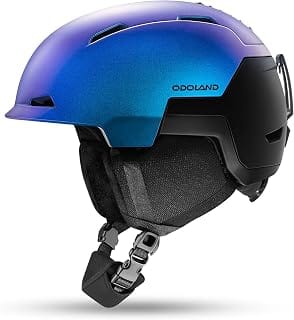
This Odoland helmet is for the skier or snowboarder who already owns goggles and wants a compact-looking dial-fit shell rather than a bundle. Its low-profile design combines a PC outer shell and EPS foam, with an adjustment dial intended to keep the helmet close to the head. Eight vents are adjustable, a meaningful advantage for variable weather, and the goggle clips are designed to hold a strap in place. Plush padding, soft ear cups, a chin guard, and a carry bag round out a sensible resort package. Buyers often describe it as comfortable, warm, and easy to fit. The trade-off is straightforward: it supplies no goggles, and its eight-vent layout has fewer openings than the 12- and 14-vent choices here. No specific certification standard is named in the supplied information.
Check Odoland Adjustable Ski Helmet on Amazon for current availability.
Pros
- Adjustment dial and low-profile PC-and-EPS construction
- Eight adjustable vents and dedicated goggle clips
- Soft ear cups, comfort-fit chin guard, and carry bag
Cons
- Goggles are not included
- No named certification is provided in the supplied features
Findway Helmet and Goggles
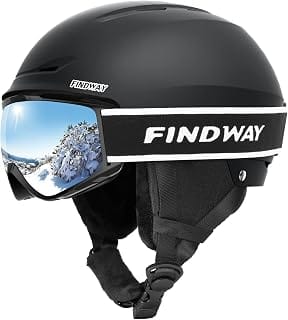
The findway helmet set is a good fit for a family member who wants an all-in-one snow-sports setup with separate storage for the helmet and goggles. It uses an ABS outer shell and EPS inner shell, includes goggles, and has eight ventilation holes. The removable padding and detachable ear covers bring useful flexibility for changing temperatures, while the adjustable goggle and helmet straps aim for a secure setup. Buyers frequently mention the lightweight feel, fit, goggle packaging, and value; one review also notes that the ear covering still allowed control of earbuds. That should not be mistaken for a reason to tune out on the hill. The limitation is that the bundled goggles leave fewer lens choices than buying separately, and the supplied listing does not name a certification standard. It is best for casual resort use rather than a buyer seeking Mips or a highly specialized fit system.
Check Findway Helmet and Goggles on Amazon for current availability.
Pros
- ABS shell and EPS inner shell with included goggles
- Eight vents plus removable padding and ear covers
- Helmet and goggles each come with a bag
Cons
- Bundled goggles limit lens and fit customization
- No named certification or rotational-impact system is listed
How to Choose the Best Ski Helmet in Canada
Buy the helmet that fits your actual head measurement and your usual ski day, not the one with the longest feature list. Measure the circumference of your head about 2.5 cm above your eyebrows, then use the manufacturer’s size chart for the exact model. A rear dial can fine-tune fit, but it cannot turn a too-large shell into the right size.
For frequent resort skiers, prioritize a recognized snow-sport safety standard, stable goggle compatibility, and enough ventilation for chairlift-to-run temperature swings. Skiers who are building a first kit may get good value from a helmet-and-goggles set, provided the helmet itself fits before the goggles enter the equation. Commuters to local hills and families with growing teens may value washable liners and detachable ear pads.
Canadian winters are not uniformly cold. Fixed vents can be welcome during hard runs in milder weather but may feel chilly in exposed lift lines. Adjustable vents offer more control; removable liners and ear pads also help adapt a helmet between early-season wet snow and midwinter cold. Do not buy based on colour, a dial, or an included carry bag ahead of fit and safety information.
Safety Standards and Certifications to Look For
Look inside the helmet, on its packaging, or in its official listing for a snow-sports certification label. ASTM F2040 is a North American standard used for recreational snow-sport helmets, while CE EN1077 is the corresponding European ski and snowboard standard. A helmet carrying either label gives a buyer a defined standard to verify; a listing that says only “protective” or “safety” is less useful than a named certification.
Construction matters, but it is not a substitute for checking the label. Many accessible ski helmets pair an EPS foam liner, which is designed to absorb impact energy, with an ABS or polycarbonate outer shell. Mips, found on the Giro Ledge MIPS here, is a rotational-motion management system incorporated into certain helmet designs. It can be a sensible feature to seek out, especially for riders prepared to spend more, but it does not excuse poor fit.
A helmet is designed for a single significant impact. Replace it after a crash, even if the shell looks largely intact, because damage to the energy-absorbing foam may not be obvious. Also replace a helmet with cracks, crushed foam, damaged straps or buckles, or a fit system that no longer holds adjustment.
Fit and Sizing: Getting the Helmet Right
Try a helmet with the thin base layer or toque you genuinely expect to wear underneath. Most ski helmets are intended to sit directly on the head, with their own liner supplying warmth; a thick knit hat can interfere with fit and move the helmet too high. Place it level, low enough to protect the forehead without blocking vision, then tighten the rear dial if the model has one.
With the chin strap fastened, the helmet should feel evenly secure. It should not roll forward, backward, or side to side when you move your head. The strap needs enough room to speak and swallow, yet it should not hang loose under the jaw. Pressure points at the temples or forehead are a reason to try another model or shell shape, not something to hope will disappear.
Check goggles before removing tags. Their upper frame should meet the helmet brim without a large exposed gap, and the strap should lie securely around the shell. Families buying online should measure every wearer separately. An adult, youth, or unisex label does not replace the centimetre range supplied for that particular size.
Helmet Features That Matter on the Slopes
Ventilation is more than a comfort extra. When a skier overheats on a climb or in a long lift line, moisture can build inside the helmet and around goggles. Front vents or goggle-aligned channels can help direct air around the lens area, while top vents let warm air escape. Adjustable vents give more weather control than fixed openings, though the mechanism adds another part to inspect.
A removable liner is particularly practical in Canada. It can be cleaned after a wet spring day and removed or adjusted as conditions change. Detachable ear pads offer similar flexibility, but they must fit securely when installed. A soft chin guard may reduce strap irritation, and a quick-release buckle can make it easier to manage gloves. If your hands are the weak link on cold lift rides, our guide to the best ski gloves in Canada covers waterproof, leather and heated picks.
Goggle retention clips deserve a quick check. They keep the strap in place, but the real test of compatibility is the gap and fit at the helmet brim. Audio-ready ear pads may appeal to some riders, but slope awareness comes first. Keep music low enough to hear skiers, snowboarders, lift announcements, and changing conditions around you.
Ski Helmet vs. Ski Cap vs. Bike Helmet
A ski cap or beanie provides warmth, not the impact protection a purpose-built ski or snowboard helmet is designed to provide. It can still be useful under a properly sized helmet if it is very thin, but many helmets already include insulated liners and ear coverage. Adding a bulky cap commonly compromises fit.
A bike helmet is made for a different activity and should not be treated as an interchangeable substitute for a snow-sport helmet. Ski and snowboard helmets are shaped and insulated for winter use, designed to work with goggles, and are assessed against snow-sport standards when the relevant certification is present. They also tend to cover more of the head and ears than a typical cycling design.
For skiing, snowboarding, skating, or sledding, select equipment intended for the activity and verify its stated standard. A helmet is not a licence to ski beyond one’s ability or enter terrain with avoidable hazards. Speed, visibility, snow conditions, and respectful spacing still do much of the safety work.
Top Helmet Types for Different Skiing Styles
The all-round resort helmet is the right place for most Canadian skiers to start. It needs a secure dial or fit system, practical ventilation, compatible goggles, and a liner warm enough for lift rides. The OutdoorMaster Kelvin and Odoland dial-fit helmet suit this straightforward brief, with different approaches to vents and shell profile.
Freestyle riders and park regulars may prefer a lower-profile hard-shell look, removable ear pads, and room for an aftermarket audio system. The Giro Ledge MIPS is the more specialized option in this group, with Mips and a hard-shell build. Its Asian Fit designation makes careful sizing especially relevant; head shape is as important as circumference.
Helmet-and-goggle kits make sense for first-time skiers, occasional visitors, and households equipping several people. The Odoland, OutdoorMaster, and findway bundles reduce the work of finding an initial pairing. They are not automatically the best solution for someone who already owns premium goggles that fit well. Lightweight choices, such as the InnerKing, can appeal to riders who dislike the bulk of a heavier helmet, though the same precise fit rules apply.
Care, Storage, and When to Replace Your Helmet
After a ski day, let the helmet air-dry at room temperature before putting it in a bag or closed gear bin. Canadian slush, sweat, and condensation can leave a liner damp, and storing that moisture encourages odour. Remove washable liners or ear pads only as the manufacturer permits, and follow the specified cleaning directions. Avoid harsh solvents, stickers, paint, or drilling holes into the shell; changes can affect materials or hide damage.
Keep the helmet out of a hot vehicle, away from direct heat sources, and clear of heavy gear that could dent or crush it. A garage shelf is fine when it remains dry and protected from temperature extremes, but the bottom of a crowded ski bag is not ideal.
Retire the helmet after any meaningful impact, even if there is no obvious exterior crack. Replace it as well when EPS foam is visibly compressed, the shell splits, straps fray, buckles fail, or the fit system slips. If the helmet no longer fits its wearer, its useful life is over regardless of condition.
Where to Buy Ski Helmets in Canada
A local ski shop is the strongest option when fit is uncertain. Shops like Sport Chek, MEC and the rental-and-retail shops at most Canadian hills will let you try shells on with your own goggles. You can measure your head, try several shell shapes with your own goggles, and ask staff to check strap adjustment. This is particularly useful for children, teens, first-time buyers, and people who regularly find that hats or helmets fit awkwardly.
Online shopping offers more colours, sizes, and bundled options, often with helpful buyer feedback. Read the product’s stated size range in centimetres rather than relying on small, medium, or large alone. Confirm the return policy before removing packaging, since goggle compatibility and pressure points are difficult to judge from photos. Keep the helmet clean and tags intact while you assess fit.
For a purchase from any retailer, verify the actual certification marking and model details on the product you receive. Marketplace listings can group colourways or versions together, so check that the selected size and variant match the features you intended to buy. A low price is worthwhile only when the helmet fits correctly and provides clear, verifiable safety information.
Frequently Asked Questions About Ski Helmets in Canada
Which helmet features help reduce goggle fogging on Canadian slopes?
Look for front or goggle-aligned vents, plus upper vents that release warm air from the helmet. A close helmet-to-goggle fit also matters: a large gap can expose skin and disrupt airflow. Some bundled goggles use lens venting designed to reduce fog, but clean, dry lenses and avoiding overheating are still part of the equation.
Is a removable liner worthwhile for changing Canadian winter conditions?
Yes, for many skiers. A removable liner can be aired or cleaned after wet snow days, and it gives more flexibility across mild spring conditions and colder midwinter outings. Confirm that the helmet still fits securely with the liner installed as intended; do not remove padding if doing so creates movement or pressure points.
Should I choose a helmet-only option or a goggles set?
Choose a helmet-only option if you already have goggles that fit well or want control over lens type and goggle brand. A set is practical for a first kit, a casual skier, or a family purchase because it supplies an initial pairing. Fit the helmet first, then check that the included goggles sit properly at the brim.
How do adjustable vents affect comfort during long ski days?
Adjustable vents let you reduce airflow on cold chairlifts and open it during warmer, more active runs. That flexibility can help manage heat and moisture across a variable Canadian day. Fixed vents are simpler and can work well, but offer less control when temperatures and wind shift.
Are removable ear pads useful for Canadian skiing and snowboarding?
They can be. Ear pads add warmth in cold or windy conditions and can be removed for warmer days or cleaning when the helmet design allows it. Make sure replacement or reinstalled pads sit securely and do not change the helmet’s fit. Riders should also keep enough environmental awareness to hear nearby traffic and lift instructions.