
Heads up: some of the links in this post are affiliate links. That means if you click and purchase, we may get a commission. It's how we keep this site running without cluttering it with ads.
It’s 7 a.m. and −25°C in Saskatoon, the kids are buckled in, and your car gives one weak click—then nothing. Cold is hard on car batteries, and the same hassle can strand a driver outside a Halifax office, at an Ontario cottage or beside a trailhead, with no second vehicle nearby for a boost. A compact jump starter gives common 12V cars, SUVs, trucks and motorcycles a practical escape route, as long as it suits the engine and stays charged in your emergency kit. That same self-reliance matters beyond the driveway, too, as explained in our guide to backup generators.
For most Canadian drivers, we recommend the NOCO Boost GBX45 1250A UltraSafe Jump Starter. Its 4.5-star rating from more than 15,000 reviews, spark-proof and reverse-polarity protections, and stated support for gas engines up to 6.5L and diesel engines up to 4.0L make it the strongest proven all-around choice. Budget boosters start around $56, while premium high-output units reach about $163; the real choice is simple: a smaller battery booster, or an all-in-one model with a tire inflator. The comparison table below shows how the leading options stack up.
Quick Overview: Our Top Picks
| Product | Best For | Why We Love It | Price |
|---|---|---|---|
| Spending more for reliability | Spark-proof protection and broad vehicle compatibility support confident emergency starts up to 6.5L gas. | $162.95 CAD | |
| Larger engines, fast recharging | High claimed peak current, 65W charging, and support for engines up to 10L. | $149.99 CAD | |
| Tight budgets | Affordable 12V backup with flashlight modes for cars, motorcycles, and smaller diesel engines. | $55.99 CAD | |
| Emergency starts and flat tires | Combines a 5000A booster with a 150PSI inflator, fast charging, and bright lighting. | $99.99 CAD | |
| Larger diesel engines | Large 26800mAh capacity and support for gas engines plus diesel engines up to 12L. | $94.49 CAD |
NOCO Jump Starter
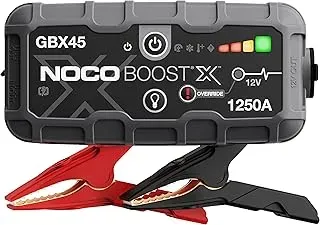
With 1,250 amps of peak output and stated coverage for gas engines up to 6.5 L and diesel engines up to 4.0 L, the NOCO Boost GBX45 is the dependable battery-only choice for households wanting more than the cheapest booster. Spark-proof and reverse-polarity protection address two common concerns when connecting to a dead 12V battery. Universal fit and compatibility with passenger cars, trucks, motorcycles, RVs, ATVs, lawn mowers, UTVs, vans and watercraft add real flexibility for Canadian homes, work vehicles and road trips. At 9.2 x 20.9 x 12.8 cm and 1.2 kg, it is compact enough for a vehicle kit, though not featherweight. Its lithium-ion battery has a 31 Wh capacity, and it runs about $163. A 4.5-star average across more than 15,000 ratings gives this pricier pick substantial buyer feedback behind it.
Pros
- Supports gas engines up to 6.5 L
- Spark-proof and reverse-polarity safety protection
- Deep 15,000-review rating history
Cons
- Costs considerably more than basic battery boosters
- No integrated tire inflator is listed
WOLFBOX Jump Starter
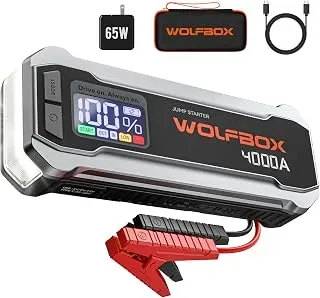
For drivers who want extra claimed starting headroom for a larger car, truck, SUV or diesel vehicle, the WOLFBOX MV24 is a well-reviewed high-output option. It lists a 4,000A peak output and compatibility with 12V gas and diesel engines up to 10L, so its stated range goes well beyond typical commuter vehicles. The 24,000mAh battery, 65W quick charging, spark-proof design and reverse-polarity protection make it a practical emergency tool to keep at home, work or in a road-trip kit across Canada. At 9.8 x 23.7 x 3.8 cm and 1.36 kg, it is compact enough to store but not a pocket-size booster. It also includes a three-mode LED light and is rated to operate from −20°C to 60°C. At about $150, its 4.5-star average from more than 5,900 ratings provides credible buyer backing, though it is battery-only: there is no built-in tire inflator.
Pros
- 4,000A claimed peak output for larger-engine compatibility
- Spark-proof and reverse-polarity safety protections included
- 65W charging and three-mode LED emergency light
Cons
- No integrated tire inflator for roadside tire top-ups
- Costs about $55 more than the similarly rated TREKURE
AstroAI Jump Starter
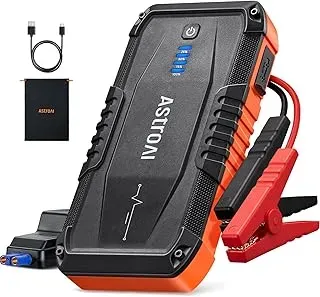
At about $56, the AstroAI S8 gives tight-budget shoppers a straightforward 12V emergency backup rather than a costly all-in-one unit. Its 1,500A peak output is specified for gas engines up to 6.0 L and diesel engines up to 3.0 L, making it a sensible fit for many cars, SUVs, motorcycles, ATVs and lighter-duty trucks. The 8,000mAh NMC lithium battery and included jumper cable handle the core dead-battery problem, while three flashlight modes add useful visibility for roadside stops, home garages and road trips. At 430 g and listed at 11.4 x 20.1 x 9.4 cm, it should be easy to keep in a vehicle. The retailer does not list operating temperature ratings, a consideration for Canadian conditions, and there is no integrated tire inflator. Still, its 4.6-star rating from more than 10,500 reviews is strong proof for a budget pick.
Pros
- Affordable entry point with 1,500A peak output
- Supports up to 6.0L gas and 3.0L diesel engines
- Three flashlight modes improve roadside utility
Cons
- No built-in tire inflator for flat-tire emergencies
- No listed operating temperature range
YaberAuto Jump Starter
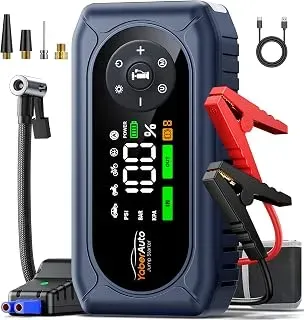
Unlike the battery-only boosters in this guide, the YaberAuto AP02 combines a 5,000A 12V jump starter with a 150 PSI tire inflator, making it a practical all-in-one emergency tool for home, work commutes and road trips across Canada. It is rated for all gas engines and diesel engines up to 9L, with listed compatibility for cars, motorcycles, trucks, lawn mowers and boats. At 0.7 kg, it is relatively easy to keep in a vehicle without giving up much cargo space. The 18W fast-charge feature, 800-lumen light and a listed −20°C to 60°C operating range add useful roadside backup. At about $100, it costs more than a basic booster, and its 4.6-star average rests on a smaller pool of about 760 ratings, but it brings real value for drivers who also want help with a low tire.
Pros
- Combines 5,000A jump starting and 150 PSI inflation
- Supports all gas engines and diesel engines up to 9L
- 18W fast charging and 800-lumen emergency light included
Cons
- Fewer buyer reviews than the guide’s top pick
- Costs more than a straightforward battery-only booster
TREKURE Jump Starter
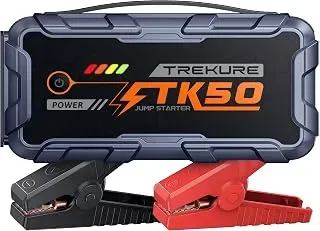
Support for diesel engines up to 12 L is the central appeal of the TREKURE TK50. This 12V booster is aimed at drivers who need more engine-size headroom than a basic commuter-car pack, including SUV and larger diesel owners. The listing pairs a 26,800mAh capacity with four included lithium-polymer batteries, safe jumper cables, fast-charge capability and an LED light for roadside use at home, work or on longer Canadian drives. At 640 g and 18.9 x 9.3 x 4.5 cm, it remains compact enough for a glove box or cargo kit. At about $94, it is the best value for bigger engines in this guide, with a 4.6-star rating from 1,200 buyers. One caution: the title cites 6000A while retailer specifications list 9000A, so confirm the output before purchasing. It is rated to operate from −20°C to 60°C, though there is no tire inflator.
Pros
- Listed for gas engines and diesel engines up to 12 L
- Large 26,800mAh capacity for an emergency power pack
- Compact 640 g, 18.9 cm-long format
Cons
- Listing conflicts on 6000A versus 9000A output
- No integrated tire inflator
Portable Jump Starters vs Traditional Jumper Cables: Which Emergency Tool Makes More Sense?
Traditional jumper cables remain the cheapest emergency option, and they do not need charging between uses. The catch is obvious: you need another vehicle with a healthy battery, a willing driver and enough room to position both vehicles safely. That can be inconvenient at home, at work or on a road trip, especially when help is not nearby. A portable jump starter is self-contained, so it can restart a 12V vehicle without a donor car. Models with spark-proof clamps and reverse-polarity protection also reduce the risk of a simple connection mistake. They do need periodic recharging, and their internal lithium battery will eventually age. For most Canadian drivers, a battery booster is the more practical first emergency tool; keep jumper cables as a low-cost backup if space allows. Choose cables if you rarely drive alone and want the least expensive solution. Choose a portable unit for independence and simpler roadside readiness.
What Does Spending More on a Portable Jump Starter Actually Buy You?
The entry point in this group is the AstroAI S8 at $55.99. Its stated support for engines up to 6.0L gas or 3.0L diesel makes it genuinely enough for many cars, motorcycles and smaller SUVs, and its 10,500-review history adds useful confidence at the low end. Spending about $100 adds a different kind of convenience: the YaberAuto combines a jump starter with a 150 PSI tire inflator, making sense for drivers who want one device for a flat battery and low tire pressure. For bigger trucks or diesel vehicles, the TREKURE covers diesel engines up to 12L for about $94, while the WOLFBOX MV24 costs about $150 for a 10L rating, a larger 88.8Wh battery and a longer review record. At $162.95, the NOCO GBX45 costs more without offering the highest advertised peak-amperage figure, but its deep review base, established safety features and broad everyday compatibility make it the better proven choice for most buyers. Pay more for capacity, faster charging, an inflator or a longer record of buyer feedback—not just a larger amp number. Warranty terms can differ by brand and seller, so confirm coverage before buying; a durable, supported unit costs less than replacing a neglected bargain booster.
The Specs That Matter When Choosing a Battery Booster
Engine Capacity and Claimed Starting Power
Peak amperage is useful, but it should not be the only number guiding your purchase. Check the manufacturer’s stated engine limits first, especially for diesel vehicles, larger pickups and RVs. Our top pick, the NOCO Boost GBX45, is rated for gas engines up to 6.5L and diesel engines up to 4.0L, covering many everyday vehicles while offering 1,250A of starting power. The AstroAI S8 is a budget-friendly choice for up to 6.0L gas or 3.0L diesel engines. For much larger engines, the TREKURE TK50 lists all gas engines and diesel engines up to 12L, and the WOLFBOX MV24 claims up to 10L gas and diesel.
Clamps That Help Prevent Common Mistakes
A dead battery is stressful enough without worrying about connecting the clamps incorrectly. Prioritize spark-proof construction and reverse-polarity protection, which are listed on both the NOCO GBX45 and WOLFBOX MV24. These safeguards are especially worthwhile for first-time users, shared family vehicles and roadside situations with poor visibility. Read the manual before an emergency: connect the positive clamp to the positive battery terminal, the negative clamp as directed by the manufacturer, power on the booster, then start the vehicle. Disconnect the clamps in the recommended order once the engine is running. A jump starter is a temporary starting aid, not a fix for a failing battery or charging system.
Battery-Only Booster or a Model With a Tire Inflator
A battery-only unit is smaller and keeps the job simple: restart the vehicle, recharge the pack and return it to the glove box or cargo area. An integrated inflator makes more sense for drivers who also want help with a low tire during road trips or daily commuting. The YaberAuto combines a 5,000A booster with a 150 PSI tire inflator, 18W fast charging and an 800-lumen light. At $99.99, it is worth considering for people who would otherwise carry a separate inflator. The trade-off is that combination products have more functions to maintain, so keep the instructions accessible and check the charge periodically.
Size, Charging and Emergency-Light Features
Portability determines whether the booster actually stays in your vehicle. The AstroAI weighs 430 g, while the TREKURE measures 18.9 by 9.3 by 4.5 cm and weighs 640 g, making both easier to store than a full-size battery charger. Charging speed can matter when preparing for a long drive; the WOLFBOX includes a 65W quick charger, and the YaberAuto lists 18W fast charging. LED lights are more than a bonus when checking battery terminals in an underground parkade, on a rural road or after a late shift. The WOLFBOX has a three-mode LED light, as does the AstroAI.
Cold-Weather Performance
Cold is where a jump starter earns its place in a Canadian vehicle—and where it can let you down. Lithium packs deliver less power as they get colder, so a booster that spent a −30°C night in the trunk may struggle on exactly the morning you need it. Check the listed operating temperature before buying: the TREKURE, WOLFBOX and YaberAuto are all rated down to −20°C, while the NOCO and AstroAI listings give no rating at all. Below −20°C, treat any of them as a tool you store indoors. The simplest habit is to keep the booster indoors and bring it out when a cold snap is forecast, or let it warm up in the cab for a few minutes before connecting. Make the season’s first snowfall your cue to charge and check it, rather than waiting for the first dead battery. One hard rule: if the vehicle battery itself is frozen—a bulging case or visible ice are the giveaways—do not jump it. A frozen battery can crack or rupture, so thaw or replace it first. And if you already plug in a block heater on cold Prairie nights, keep doing it; a booster is a backup, not a substitute.
Proven Reliability Versus the Lowest Price
Lower-priced boosters can be sensible for smaller vehicles and occasional backup use, but a jump starter is an emergency tool, so review depth deserves real weight. The AstroAI costs $55.99 and covers many cars, SUVs, motorcycles and ATVs. For the strongest established all-around choice, we recommend the NOCO Boost GBX45. It costs $162.95, but its 4.5-star rating across more than 15,000 reviews, stated vehicle compatibility and established spark-proof and reverse-polarity protections support the premium. Keep any model charged according to its instructions and inspect the cables before relying on it for work commutes, family trips or everyday roadside readiness.
Frequently Asked Questions
How do I use a portable jump starter safely?
Charge the unit first, switch off the vehicle, then connect the red clamp to the battery’s positive terminal and the black clamp to a clean negative terminal or approved ground point. Turn on the booster if required, start the vehicle, and remove the clamps in reverse order. Check the manual for model-specific steps. Spark-proof and reverse-polarity protection, such as on the NOCO Boost GBX45, can help prevent common connection mistakes but do not replace careful setup.
What size portable jump starter do I need for my vehicle?
Match the starter to your engine type and size, not just its peak-amp number. A compact unit rated for a 6.0L gas or 3.0L diesel engine suits many cars, motorcycles and SUVs; larger trucks and diesel engines need more stated capacity. The NOCO Boost GBX45 is rated for up to 6.5L gas and 4.0L diesel. Confirm your vehicle is a conventional 12V system and leave a margin above its engine size.
Is a jump starter with a tire inflator worth buying?
It is worth it if you want one roadside device for a dead battery and a slowly leaking or underinflated tire. An integrated inflator reduces the number of items to store, though it is larger than a battery-only booster and needs periodic charging. The YaberAuto Jump Starter with Air Compressor combines a booster with a 150 PSI inflator. Choose a battery-only model instead if compact storage and straightforward jump-start duty are the priority.
How should I store and maintain a jump starter in Canada?
Keep it charged according to the manufacturer’s schedule, commonly every few months and after use. Store it dry, with its clamps protected, away from direct sun, moisture and prolonged temperature extremes. Avoid leaving lithium boosters in a vehicle through long spells of severe cold or heat; bring one indoors when practical, especially before a road trip. Inspect cables and clamps for damage, and replace the unit if it will no longer hold a useful charge or shows swelling.
Should I buy a cheap jump starter or pay more for a proven model?
Budget boosters around $56 can make sense for a small 12V car with occasional emergency use, but verify engine ratings, safety protections and review history. Paying more is sensible when reliable starting matters for work, family travel or a larger vehicle. The NOCO Boost GBX45 costs more than entry-level options, yet its 4.5-star rating across more than 15,000 reviews, established safety features and broad compatibility support its value as a dependable all-around choice.
Which Portable Jump Starter Is Best for Your Vehicle and Roadside Kit?
For most Canadian drivers, the NOCO Boost GBX45 is the clear pick for keeping in a daily-driver SUV, pickup or family car. It costs $162.95, but its 1250A rating, compatibility with engines up to 6.5L gas and 4.0L diesel, and established spark-proof and reverse-polarity protections make it a sensible emergency tool rather than a bargain-bin gamble. Its 4.5-star average from more than 15,000 reviews also provides more reassurance than a lightly reviewed alternative when you need dependable help at a work parking lot, cottage driveway or roadside stop.
Spend less with the AstroAI S8 1500A if your vehicle falls within its 6.0L gas or 3.0L diesel limits and you want a compact, basic booster for $55.99. For owners of larger gas or diesel engines, the TREKURE TK50 is the stronger value: it covers all gas engines and diesel engines up to 12L, is rated down to −20°C and costs $94.49. The WOLFBOX MV24 ($149.99) is the alternative if you want a much longer review record and 65W quick charging.
Before ordering, check your engine size in the owner’s manual—not just the vehicle type—and choose a booster with capacity to spare. Charge it when it arrives, learn which clamp goes where before an emergency, and set a reminder to check its charge a few times a year. If low tire pressure is a recurring problem, a standalone unit from our portable tire inflator picks paired with a battery-only booster is often simpler to keep ready than one combination device.
Choose the model that suits your engine, keep it charged, and put it in the vehicle now—before a dead battery turns a normal day into an unnecessary wait.