
It's nearly midnight in a Toronto condo, and the west-facing wall of glass has been baking your living room since dinner. The thermostat reads 29°C, your sheets feel damp, and the hallway air barely moves. Your building banned window shakers years ago, and with wildfire smoke drifting into Southern Ontario on and off each summer, cracking a window for a cross-breeze doesn't feel like a win either.
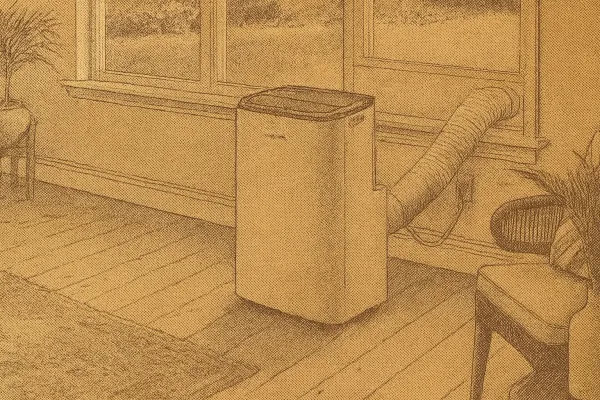
A portable air conditioner — one you can roll in, vent through a window, and run on a standard 115V outlet — is often the fastest renter-friendly fix. But buying one isn't as simple as grabbing the biggest BTU number on the box. In Vancouver during smoke season, sealing and hose design can matter as much as raw cooling. In Montreal and Ottawa, humidity removal makes the difference between "tolerable" and "finally comfortable" when the humidex spikes. And in Calgary, a basement bedroom needs completely different sizing math than a top-floor walk-up that cooks all afternoon.
This guide covers how to size, compare, and install a portable AC for Canadian conditions — from SACC ratings and hose types to noise, efficiency, window kits, and the apartment realities that most buying guides skip.
BTU vs. SACC: The Number That Actually Matters
If you've browsed Amazon.ca or Canadian Tire, you've seen the big "14,000 BTU!" headlines on every box. BTU measures heat removal — how much heat the unit can pull out of the air per hour. The problem is that portable air conditioners lose a significant chunk of that capacity in real rooms because the exhaust hose dumps heat out the window while also warming the unit itself and, in single-hose models, pulling warm replacement air back into the space.
That's why the DOE SACC rating (Seasonally Adjusted Cooling Capacity) is the number to trust when shopping. SACC accounts for the heat that leaks back in and reflects something closer to what you'll actually feel at 3 p.m. on a 32°C day — not what the machine could theoretically do in a sealed lab. When a listing only shouts "12,000 BTU" with no SACC figure, treat it as marketing, not a promise.
A useful rule of thumb: SACC ratings tend to land roughly 30–40% below the advertised BTU. A unit marketed at 12,000 BTU might deliver around 7,000–8,000 SACC in practice.
Sizing for Canadian Rooms: Floor Area, Sun Exposure, and Regional Adjustments
Start with your floor area, then adjust for the realities of your space.
SACC sizing starting points:
- 14–23 m² (150–250 sq ft): approximately 5,000–6,500 SACC
- 23–37 m² (250–400 sq ft): approximately 6,500–8,000 SACC
- 37–51 m² (400–550 sq ft): approximately 8,000–10,000 SACC
- 51–65 m² (550–700+ sq ft): approximately 10,000–12,000 SACC (often better served by two smaller units)
Then adjust for your specific situation:
Add capacity if you have west- or south-facing glass in a Toronto or Vancouver condo — that late-day sun can push indoor temps to 29–31°C even with blinds drawn. Top-floor apartments need extra capacity too, since heat rises and the roof radiates warmth well into the night. High ceilings (2.7–3.0 m) mean more air volume to cool.
Size down for basements in Calgary or Edmonton. A below-grade room might sit at 19–22°C even when it's 30°C outside, so the unit is mostly dehumidifying and taking the edge off, not battling full solar gain.
As you consider the best portable air conditioners for your space, it may also be beneficial to explore ways to improve indoor air quality, especially during wildfire season; for more information, see our guide on top air purifiers for Canadian homes.
When one unit won't cut it: Open-concept layouts with a long hallway and closed bedrooms are where single-unit expectations fall apart. Portable ACs can't push cool air around corners the way a ducted system can. Better approaches include two smaller units (one for the living area, one for the bedroom), a ductless mini-split for homeowners who can invest in permanent installation, or a portable heat pump if you also want shoulder-season heating.
Common sizing mistakes to avoid: Buying purely by advertised BTU, ignoring sun exposure, and assuming a single portable will cool an entire townhouse. It might make things less miserable, but it won't feel like central air.
Single-Hose vs. Dual-Hose: How Hose Design Changes Comfort and Air Quality
The hose setup is more than a spec-sheet detail — it changes how your apartment breathes.
How Single-Hose Units Work
A single-hose portable pulls room air across the condenser, heats it up, and blasts it outside through the exhaust hose. The catch is that the air it expels has to be replaced from somewhere. Your home draws that replacement air in through hallway gaps, leaky window frames, bathroom fan ducts, and plumbing penetrations. That's the negative pressure effect, and it's why some people feel like their unit "never catches up" during a sustained heat wave.
This also matters during wildfire smoke season. Negative pressure can pull smoky outdoor air into your apartment through every small gap in the building envelope — even if the windows are closed.
How Dual-Hose Units Work
A dual-hose model separates the intake and exhaust. One hose brings in outdoor air specifically to cool the condenser; the other sends the heated air back outside. The room air you've already cooled stays inside, so you get faster temperature pull-down from 30°C to 24–25°C, better overall efficiency since less conditioned air is wasted, and less unwanted air infiltration — which is particularly helpful during smoke events.
The Tradeoffs
Dual-hose units tend to cost more, take up more floor space, and their window kits can be fussier to install. In a tight bedroom, the extra hose bulk can feel like you're living beside a small appliance aisle.
Regional Recommendations
Interior BC and the Lower Mainland: If smoke is a regular summer problem, a dual-hose unit paired with careful window sealing is a strong combination. Pair it with a standalone HEPA air purifier rather than relying on the AC's basic mesh filter for air quality.
Toronto and Southern Ontario: Long, humid run times favour better efficiency, and dual-hose helps. But a well-sealed, correctly sized single-hose unit can still work if you manage expectations.
The Prairies: With bigger overnight temperature swings, you can lean on cooler nights to pre-cool. Dual-hose still helps during the day, but smart overnight venting (when air quality allows) reduces how hard the AC works the following afternoon.
Apartment Realities: Windows, Bylaws, and Why Installation Goes Sideways
Apartments don't just limit your options — they shape how well a portable AC actually performs. In many Toronto condos, window shakers are banned outright, and some buildings restrict anything that looks like it could fall or alter the exterior. In Vancouver, strata rules can be strict about drilling or permanent fixtures. In Montreal rentals, you might have beautiful old windows and zero permission to modify them.
Matching the Window Kit to Your Window Type
Sliding windows (common in newer condos across Toronto and Vancouver): Most included window kits are designed for these. Measure the opening height and width in millimetres, and check whether the kit extends far enough without wobbling or leaving a gap at the top.
Casement windows (crank-out, common in older Montreal and Ottawa buildings): Standard sliding kits won't seal properly. The most effective renter-friendly approach is a clear plexiglass panel cut to the window opening, fitted with a round duct flange and foam weatherstripping. It looks tidy and comes off cleanly at move-out.
Tilt-and-turn windows: Similar challenge to casement — plan on a custom panel solution.
Sealing Against Smoke and Heat
A loose window kit doesn't just waste cooling — it can let wildfire smoke seep in. Foam tape along all panel edges, weatherstripping where the sash meets the kit, and attention to the small gaps (they add up) make a noticeable difference in both comfort and indoor air quality.
Small-Space Airflow Tips
Place the unit as close to the window as possible so the exhaust hose stays short and straight. Keep the hose from sagging behind a sofa where it radiates heat back into the room. Use a small circulation fan to push cooled air down a condo hallway — portable units don't throw air the way a central system does.
Dealing with Drainage
"Self-evaporating" is real but not magic. During sticky stretches — say 28°C with high humidity in Montreal or Ottawa — you may still need to empty an internal tank periodically, run a continuous drain hose to a nearby shower or floor drain, or expect the occasional shut-off when the tank fills. Plan your unit placement with drainage access in mind, especially in humid cities.
Matching the Unit to Your Layout
Studios typically do best with one correctly sized unit placed near the main living area. In a one-bedroom apartment, bedroom-first cooling at night with the door partially closed reduces the volume you're trying to chill and lets a smaller unit do its job effectively.
As you consider the best portable air conditioners for your living space, you might also be interested in optimizing your indoor environment with effective home workout equipment, especially during those hot summer days when outdoor exercise can be challenging. For tips on essential gear to keep you active at home, see our guide on best home workout equipment in Canada.
Efficiency, Operating Costs, and Why It Matters on Canadian Hydro Bills
Efficiency isn't just about being virtuous — it's about whether you can afford to run the unit through a multi-week heat wave without wincing at the bill. Prioritize SACC first (right-sized units cycle less and deliver steadier comfort), then look for CEER or EER where listed. Some models carry an Energy Star certification (check the Canadian database), but don't assume the sticker means cheap operation if the unit is undersized and running constantly.
A 30-Second Operating Cost Estimate
Find the unit's input power in watts on the spec label (most portables fall between 900 and 1,400 W). Divide by 1,000 to get kilowatts, then multiply by hours per day and your electricity rate.
Example: A 1,200 W unit running 8 hours per day = 9.6 kWh/day. At $0.17/kWh, that's about $1.63/day, or roughly $49/month.
Provincial Cost Considerations
Ontario: Time-of-use pricing can make evening and overnight cooling more expensive. Pre-cooling in the afternoon off-peak window (where applicable) can help.
Quebec: Hydro rates are generally lower, so running longer for dehumidification is less painful on the bill.
Alberta: Variable-rate plans can swing with demand, and heat waves sometimes coincide with higher pricing.
Features That Reduce Operating Costs
An inverter compressor adjusts speed rather than cycling on and off, which saves energy and delivers more consistent temperatures. A programmable timer lets you cool only when you need it. An eco mode that manages compressor cycling and fan speed can meaningfully reduce consumption over a full season. Multiple fan speeds give you the option to run quieter and lighter overnight without shutting the unit off entirely.
Noise: The Deal-Breaker for Bedrooms and Work-From-Home Setups
Portable air conditioners sit inside the room with you, so sound matters more than it does with window units or central systems. Most portables fall in the 50–55 dBA range on lower fan settings and can climb into the low 60s on maximum — noticeable during calls, podcasts, or sleep.
Two Things That Matter More Than the Decibel Number
Tone and cycling: A steady fan hum is far easier to sleep through than a compressor that kicks on with a clunk every few minutes, runs for a while, then shuts off. That start-stop pattern is what wakes people up.
Vibration: On laminate or floating floors common in condos, the compressor hum can travel through the structure. A thin rubber mat or anti-vibration pad under the unit can cut the buzz significantly.
Features That Help With Nighttime Use
A dedicated sleep mode that gradually adjusts the temperature target rather than abruptly raising it. A dimmable or off-switchable display — a bright LED panel can be surprisingly annoying in a dark bedroom. A low fan setting that still maintains meaningful airflow without triggering constant compressor restarts.
Humidity: The Hidden Comfort Factor in Eastern Canada
In Ottawa, Toronto, Halifax, and much of Southern Quebec, the humidity during a summer heat wave can make 27°C feel like 33°C. A portable AC that cools the air but leaves it clammy isn't doing the full job.
Look for a dehumidification rating listed in litres per day — higher is better for humid climates. Some units offer a standalone dehumidifier mode, which is useful during shoulder-season stretches when it's muggy but not necessarily hot enough to justify full cooling.
On the Prairies, where the air tends to be drier, dehumidification matters less. Cooling performance, airflow, and window sealing are more important priorities in Calgary, Edmonton, and Saskatoon.
What to Look for When Shopping in Canada
Where to Buy
Amazon.ca, Costco (seasonal stock), Home Depot Canada, Canadian Tire, Best Buy Canada, and RONA all carry portable ACs, but availability swings wildly by month. Once the first 30°C week hits, the popular models vanish fast. If you can, decide on your SACC range and window setup by late May or early June.
Power Requirements
Most portables run on 115V and plug into a standard household outlet, but they can draw close to a full 15A circuit. Avoid sharing that circuit with a microwave, space heater, or hair dryer.
Spec Sheet Checklist
When comparing models, focus on SACC (not just advertised BTU), dehumidification capacity in litres per day, published noise level in dBA (and at which fan speed), hose configuration (single or dual), included window kit dimensions and compatibility, unit weight (especially if you'll move it between rooms), and continuous drainage options for humid climates.
Maintenance That Actually Matters
Portable ACs are low-maintenance, but neglect costs you performance.
During the season: Rinse or vacuum the air filter every two to four weeks during heavy use. A clogged filter restricts airflow and forces the compressor to work harder. Wipe down the intake area periodically to prevent dust buildup. Check the window kit seals — foam weatherstripping can compress or peel over the course of a summer, and small air leaks undo a surprising amount of cooling.
End of season: Run the unit on fan-only mode for a few hours to dry out internal moisture. Store the unit upright to protect the compressor. If you're storing it somewhere unheated — a garage in Winnipeg, for example — make sure residual water in the lines has been fully drained, because freezing can crack internal components.
As you navigate the challenges of keeping your living space comfortable during hot summer months, it's also important to consider how to manage dryness in the winter. For those looking to combat the dry air that often accompanies colder weather, our guide on must-have humidifiers for dry Canadian winters offers practical solutions.
Frequently Asked Questions
Is a portable AC worth it compared with a window unit or mini-split?
For renters and condo owners who can't install a window unit or drill for a mini-split, a portable model is usually the most practical option. Window units generally offer better efficiency and lower noise for the price, but many buildings ban them. Mini-splits are the best long-term comfort upgrade for homeowners, but they require professional installation and a significantly higher upfront cost. If you need flexible, no-permit cooling that moves with you, portable is the typical compromise.
What's an acceptable noise level for sleeping?
Most people find units in the low-to-mid 50 dBA range tolerable for sleep, especially if the tone is a steady fan rather than a cycling compressor. For bedrooms in compact Vancouver or Toronto condos, placing the unit farther from the bed and using a short, straight hose run can reduce the perceived noise. Avoid running on the highest fan setting overnight — it's almost always the loudest mode.
How do I handle wildfire smoke season with a portable AC?
A portable AC is not an air purifier. Single-hose models can actually make indoor air quality worse during smoke events by creating negative pressure that draws smoky air in through gaps in the building envelope. If smoke is a regular concern, prioritize a dual-hose unit with a tightly sealed window kit, and pair it with a standalone HEPA air purifier. The AC handles temperature; the purifier handles particulates.
Can one portable AC cool my entire apartment?
Rarely. Portable units work best in a single enclosed or semi-enclosed space. If you have an open-concept living and dining area, one well-sized unit can handle that zone. But expecting it to also cool a bedroom down a hallway with a closed door is unrealistic. For multi-room comfort, two smaller units — one for daytime living space, one for the bedroom at night — usually outperform one oversized unit trying to do everything.
Do I need to drain the water tank constantly?
It depends on your climate. In drier Prairie cities, many self-evaporating units handle moisture without any intervention. In humid stretches across Ontario, Quebec, and the Maritimes, the internal tank can fill during sustained heat waves, and you'll either need to empty it periodically or run a continuous drain hose to a floor drain or bathtub. Plan your unit placement with this in mind.
Final Thoughts
Choosing the right portable air conditioner for a Canadian apartment comes down to matching capacity and layout to how you actually live. Undersizing leads to nonstop running and muggy air; oversizing can cause short-cycling and a clammy feel. For most Canadian apartments, a mid-range SACC unit with solid dehumidification is the practical sweet spot — larger open-concept spaces and top-floor rooms need more, especially during humid Southern Ontario or Montreal heat waves.
Before you buy, measure your window, confirm the vent kit fits your window type, and plan drainage. Consider how much noise you can tolerate in a bedroom and whether smoke season makes dual-hose worth the extra cost. The model that fits your space, your window, and your climate is always a better choice than the one with the biggest number on the box.