
Heads up: some of the links in this post are affiliate links. That means if you click and purchase, we may get a commission. It’s how we keep this site running without cluttering it with ads.
Your phone shows one lonely bar as you crawl along a snow-dusted highway outside Thunder Bay at -30°C, and of course that’s when the “No Service” warning flashes and your map freezes. A few weeks later you’re at a cabin in the BC Interior, standing on a picnic table with your arm in the air, hunting for enough signal to text home.
A cell phone signal booster pulls in the weak signal outside, amplifies it, and rebroadcasts it inside your house, cottage, or vehicle — so calls stop dropping and data speeds go from painful to usable. Below are six ISED-approved picks for real Canadian conditions, from a $135 kit for a small cottage to a full system for crossing the country in an RV. Every one works with Bell, Rogers, Telus, and the regional carriers.
Quick Overview: Our Top Picks
| Product | Best For | Why We Love It | Price |
|---|---|---|---|
| Best overall | The category’s best-selling kit on Amazon.ca, with a directional outdoor antenna you can aim at a distant tower across a lake or valley. | $179.99 | |
| Best budget home kit | A flat window-pass cable means no drilling through an exterior wall, which matters if you’re renting or the cottage isn’t yours. | $134.90 | |
| Households on different carriers | Five bands instead of the usual two or three, so one unit covers a family split across Bell, Rogers, Telus and the discount brands. | $179.99 | |
| Permanent cabin and shop installs | Built in Canada with a shielded metal amplifier rated for unheated spaces — garages, shops, and cottages that sit cold all winter. | $465.99 | |
| Trucks, SUVs and backroads | The magnetic roof antenna goes on and off in seconds, so it moves between the truck and the work van without drilling either one. | $134.00 | |
| Cross-Canada RV trips | A roof-mounted mast antenna and 25-foot cable run designed for a parked rig, not a car — the reason it reaches towers others miss. | $809.99 |
SignalBrick House & Cottage Cell Phone Booster
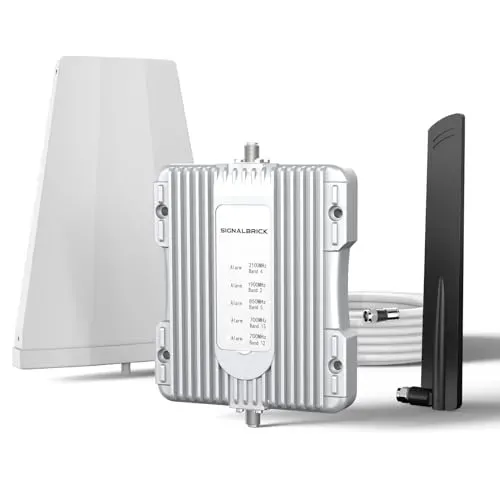
If you want one recommendation and no further reading, start here. The SignalBrick is a complete kit — outdoor directional antenna, amplifier, and indoor panel antenna — covering up to 280 m² when the outside signal is decent. It supports Bell, Telus, Rogers, Fido, SaskTel and MTS across 3G, 4G LTE and 5G bands, which is the compatibility question most people get wrong when buying blind. Up to 60 dB of gain puts it in the range that actually helps in those 1-to-3-bar spots where calls drop and data crawls, and automatic gain control keeps it from oscillating when the tower signal swings around with the weather. It sits at the top of Amazon.ca’s signal booster category, which is a reasonable proxy for how well it works for ordinary Canadian households.
Pros
- Directional antenna suits distant rural towers across open ground
- Covers every major Canadian carrier plus the regional players
- Automatic gain control handles fluctuating signal without fuss
Cons
- Coverage shrinks sharply when the outdoor signal is under one bar
ANNTLENT N30 House & Cottage Booster
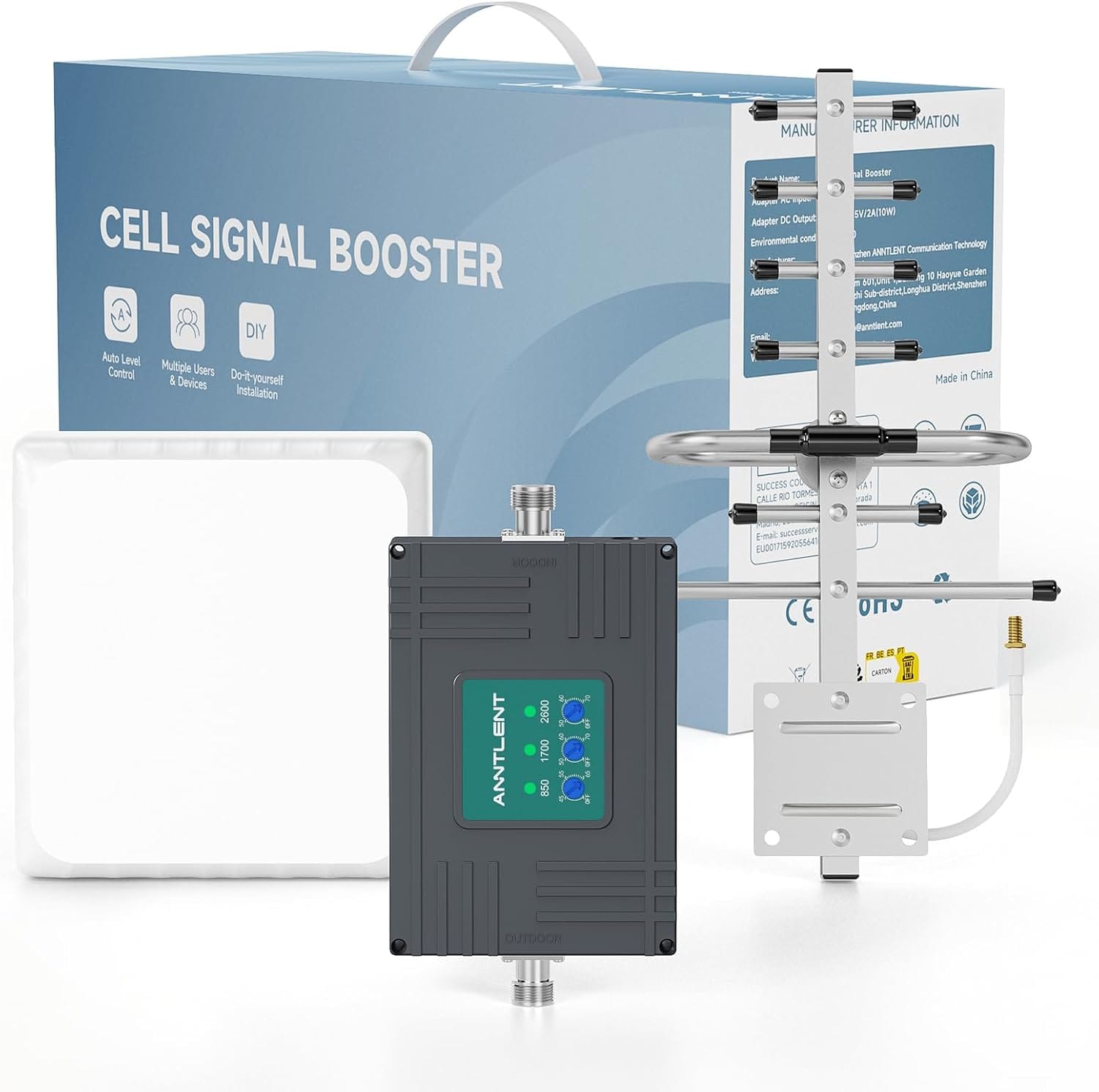
The ANNTLENT N30 is the cheapest kit here that we’d actually recommend, and the practical detail that earns it a spot is the flat window-pass cable. You route it under a closed window instead of drilling through siding, which makes it a realistic option for renters, seasonal cabins, and anywhere you don’t want to put a hole in someone else’s wall. It runs on bands 4, 5 and 7 — check yours before ordering, because that’s narrower than the five-band units — with a high-gain Yagi outdoor antenna and a claimed 4,500 sq ft of coverage in good conditions. ANNTLENT’s app helps you find the nearest tower so you can aim the antenna instead of guessing, which is the step most people get wrong. It’s ISED approved (IC 23915-CAL267001) and carries a two-year warranty.
Pros
- No drilling required thanks to the flat window cable
- Companion app helps aim the outdoor antenna at the right tower
- Lowest entry price of any full home kit on this list
Cons
- Three bands only — confirm your carrier uses band 4, 5 or 7 first
Atcall Studio 5 Cell Phone Booster for House
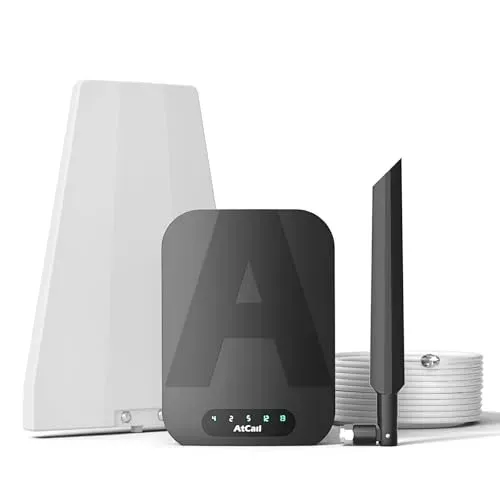
The Atcall Studio 5 is the one to pick when the phones in your house aren’t all on the same network. Its five-band design covers bands 12/17, 13, 5, 2/25 and 4, which between them account for the frequencies Bell, Telus, Rogers, Fido and SaskTel actually use in rural Canada — so a household split between a work phone on one carrier and family phones on another isn’t left half-covered. With 65 dB of gain it reaches up to 280 m², and the LED band indicators are genuinely useful during setup: they show you which band is working and which is overloading, so troubleshooting doesn’t come down to trial and error. It’s the most reviewed unit on this list by a wide margin, with over 2,500 ratings on Amazon.ca.
Pros
- Five-band coverage suits mixed-carrier households
- Per-band LED indicators make setup problems obvious
- Far more customer feedback behind it than most boosters in this price range
Cons
- 280 m² won’t stretch across a large farmhouse or a multi-building property
Smoothtalker Stealth Z1 (Made in Canada)
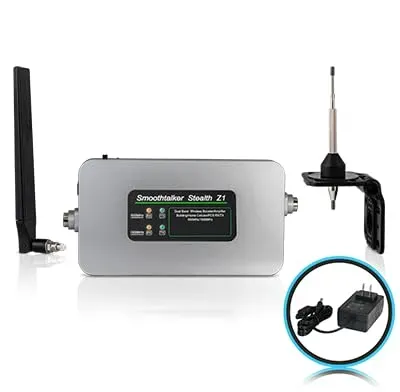
The Smoothtalker Stealth Z1 costs roughly two and a half times what the SignalBrick does, and the case for it is durability rather than raw performance. It’s built in Canada, and the shielded metal amplifier and hardware are specified for the kind of unheated spaces the cheaper plastic-cased units aren’t — a detached shop, a barn, a cottage that sits at outdoor temperature from November to April. With 65 dB of gain across 3G and 4G LTE it pulls a weak signal from a distant tower and holds it steady through a building, and full ISED certification (IC 3585A-BRBZ81975) means it’s legal to run anywhere in Canada. The trade-off is bands: it’s a two-band unit focused on 850 and 1900 MHz, so it’s a better fit for voice and LTE reliability than for chasing 5G.
Pros
- Made in Canada, with hardware specified for cold, unheated installs
- Strong 65 dB gain for genuinely weak fringe signal
- Coverage rated to a larger area than the mid-priced kits
Cons
- Two-band 3G/4G design, so no 5G band support
- Considerably more expensive than comparable home kits
ANNTLENT Vehicle Cell Phone Signal Booster
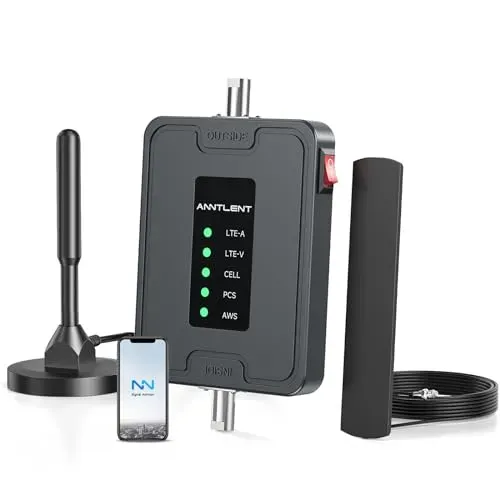
If you spend your days on the Trans-Canada, gravel backroads, or running between rural job sites, this ANNTLENT vehicle booster is the sensible amount to spend. It supports every major Canadian carrier on bands 2/4/5/12/13/17, boosts 4G LTE for calls and data, and is 5G compatible. The strong magnetic roof antenna installs without drilling and comes off in seconds, so one kit can move between a truck, a work van and a camper rather than living permanently in one vehicle. Automatic gain control adjusts as you pass between towers, and the LED indicators tell you at a glance whether it’s doing anything. It’s ISED approved and ICES-003 compliant, with a 30-day money-back window and up to three years of manufacturer repair coverage.
Pros
- Magnetic mount means no drilling and easy transfer between vehicles
- Wide band support covering all the major Canadian carriers
- Automatic gain control adapts as you move between towers
Cons
- Single-antenna design doesn’t match the reach of a full RV kit
- Boosted coverage only extends a short distance from the inside antenna
weBoost Drive Reach RV II
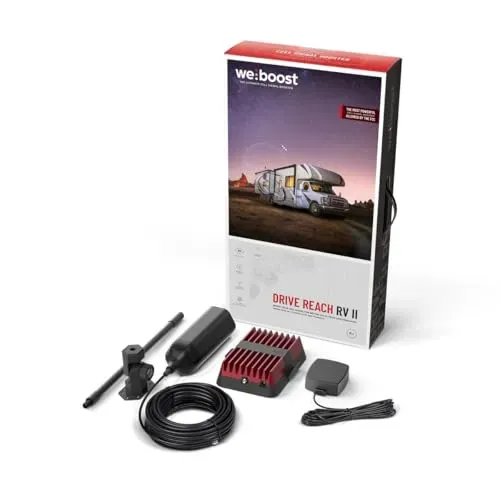
The weBoost Drive Reach RV II is the expensive option, and it earns that price only if you genuinely live out of an RV for stretches of the year. What separates it from a car booster is the hardware layout: a rugged mast-mounted outside antenna with 180° adjustment on T-slot, pole or fixed mounts, and a 25-foot low-loss cable run to a mini panel antenna inside. That combination is built for a parked rig at a rural campground, where you can raise and aim the antenna, rather than for a vehicle in motion. It’s ISED approved, covers all major Canadian carriers on 4G LTE and 5G, and holds up to highway speeds and year-round Canadian weather. If you work from the road or rely on hotspot data at campsites, it’s the one kit here with the reach to make that dependable.
Pros
- Longest effective reach of anything on this list for weak rural towers
- Flexible mounting and cable routing for different RV layouts
- 5G-ready and compatible with every major Canadian carrier
Cons
- Costs more than four times a capable vehicle booster
- Getting the best from it takes careful antenna placement and setup time
Cell Phone Signal Booster vs Wi-Fi Calling: Which Do You Need?
Before you spend anything, it’s worth asking whether you need hardware at all. A booster uses an outdoor antenna, an amplifier, and an indoor antenna to pull in weak signal and rebroadcast it inside your home, shop, or vehicle. It works with your existing carrier and improves voice, text, and data for several phones at once.
The alternative is leaning on Wi-Fi calling and messaging apps over your internet connection. That’s cheaper — no hardware, no installation — and works well in towns with decent cable or fibre. But it falls apart where satellite or DSL is slow, capped, or unreliable, and it does nothing for dead zones in a barn, a shop, or a vehicle. If your home internet is solid and you just want calls to hold indoors, Wi-Fi calling may be enough. If you’re often off-grid, or your internet is as flaky as your cell service, the hardware is the more dependable fix.
How to Choose for Canadian Conditions
Choosing well starts with matching the booster to your location, your carrier, and the building or vehicle you’re trying to cover. Coverage can swing from perfectly fine in town to one bar a few kilometres down a gravel road, so what you need has to handle distance from the tower, plus trees, hills, and weather. Whether you’re in northern Ontario, the Prairies, the BC Interior, or an Atlantic fishing community, the unit has to be certified for Canadian networks and sized correctly for your space.
Connectivity frustration in rural Canada isn’t imagined, either. A recent report found a 17% rise in telecom complaints, with Rogers topping the list of grievances in Canada's telecom landscape — which is part of why so many rural households end up solving the problem themselves.
Key Features to Look For
Carrier and Frequency Compatibility
Check compatibility before anything else. Rogers, Telus, Bell, and regional providers like SaskTel, Eastlink and Videotron use a mix of LTE and 5G bands, including Band 4, 5, 7, and 12/13. A good listing states its supported frequencies plainly and usually says “multi-carrier” or “all major Canadian carriers.” This matters more in rural areas, where a tower may only broadcast a couple of bands. If you might switch carriers, or family members are on different networks, a wide-band unit is the safer buy.
Gain, Output Power and Real-World Range
Amplifier strength decides whether a distant tower is usable. Look for high gain, measured in dB, along with solid output power. Home and cabin units commonly run 65–72 dB; vehicle kits are often around 50 dB. On a remote farm in Alberta or at a lakeside camp in northern Quebec, that difference can be the gap between “No Service” and stable LTE. Treat kilometre range claims with suspicion — terrain, trees and buildings all cut into it, so buy stronger specs than you think you need.
Indoor Coverage Area and Antenna Design
Think about how much indoor space you need covered and how the building is laid out. A small cabin may be fine with a compact desktop antenna, while a two-storey home in Manitoba benefits from a panel antenna upstairs. Coverage figures like “up to 280 m²” assume good outside signal; in fringe zones, expect less. Steel roofs, concrete basements and multiple interior walls all weaken the rebroadcast signal. Look for a dome antenna for central ceiling placement, or a directional panel to concentrate coverage where you actually use your phone.
Outdoor Antenna Type and Installation
Outside the city, the outdoor antenna matters as much as the amplifier. Directional Yagi or panel antennas are usually the better choice because you can aim them at a specific tower across a valley or lake. Omnidirectional antennas install more easily but are less effective in very weak signal. On the Shield in northern Ontario or in hilly Vancouver Island terrain, you want a directional antenna mounted high on a mast, roof or gable. Confirm the kit includes enough quality coax for your run, and mounting hardware rated for wind, snow load and ice.
If you’re building out the rest of a rural home setup, voice control can help when your hands are full — our guide to the best voice-controlled devices for Canadian seniors covers the options.
Boosters for RVs, Trailers and Vehicles
Vehicle and RV boosters solve a different problem than home units, and the distinction is worth understanding before you buy the wrong one. A vehicle kit boosts a small bubble around the interior antenna — enough for the phone in the cupholder or on the dash, not the whole cab. That’s fine, because in a moving vehicle that’s where the phone is anyway.
An RV kit is the middle ground. It’s designed for a rig that stops and stays put, so the outside antenna typically mounts on a mast or ladder and can be raised and aimed once you’re parked at a campground. That aiming step is what gives it reach a car booster can’t match. Both types run off 12V power, which means they keep working during a power outage as long as the vehicle battery holds — a real advantage in a Prairie ice storm.
What doesn’t work well is crossing the two. A home unit needs a fixed, properly mounted outdoor antenna and stable AC power, so it isn’t practical in a trailer that moves every few days. A vehicle kit put inside a cottage will boost signal within a metre or two of the inside antenna and nowhere else. If you need coverage in both an RV and a seasonal cabin, an RV-configured kit is the more flexible of the two.
Where to Buy a Cell Booster in Canada
Boosters are sold through several Canadian channels, and they aren’t equivalent. Canadian Tire and Best Buy both carry a small selection in-store and online, which is useful if you want to buy locally, handle a return in person, or need something today before a long weekend at the lake. The range is narrow, though, and tends toward vehicle kits and entry-level home units.
Amazon.ca carries by far the widest selection, including the multi-band home kits above and the Canadian-made Smoothtalker line, usually at lower prices than the big-box shelves. Specialist retailers like weBoost's Canadian storefront and dedicated signal booster shops sell the higher-end systems and will often help spec a setup for a specific address, which is worth the premium for a large or awkward property.
Wherever you buy, check one thing on the box or listing: an ISED (formerly Industry Canada) certification number. Boosters sold legally in Canada must be ISED approved, and every unit on this list is. An uncertified amplifier can interfere with the carrier network, and carriers can require it be shut down.
Frequently Asked Questions
What is the best cell phone booster for rural areas in Canada?
It depends on where you need the signal. For a rural house or cottage up to about 280 m², the SignalBrick House & Cottage is the strongest all-round pick, with the ANNTLENT N30 covering the same job for less if your carrier runs on bands 4, 5 or 7. For a household split across carriers, the five-band Atcall Studio 5 is the safer choice. For highway driving, the ANNTLENT vehicle booster handles most needs, and the weBoost Drive Reach RV II is the one to buy if you live out of an RV.
Do cell phone boosters work if I have no signal outside?
No. A booster amplifies existing signal — it can’t create one. You need at least a faint usable signal outdoors, generally around one bar or better (roughly -110 dBm), for a booster to have something to work with. Before buying, walk your property with your phone and check where the signal is strongest outside; that’s where the outdoor antenna goes. If there is genuinely nothing outside anywhere on the property, satellite internet with Wi-Fi calling is the more realistic answer.
Where can I buy a cell phone booster in Canada?
Canadian Tire and Best Buy stock a limited range in-store and online, which suits an urgent purchase or an easy in-person return. Amazon.ca carries the widest selection, generally at better prices. Specialist signal booster retailers sell higher-end systems and can help spec a setup for a difficult property. Whichever route you take, confirm the unit carries an ISED certification number — that’s the legal requirement for operating a booster in Canada.
How much does it cost to run a cell phone booster?
Very little. Most home boosters draw roughly 5–20 watts, about the same as an LED bulb, so running one around the clock adds a few dollars a month to a typical bill. Vehicle units draw from the 12V system with negligible effect on fuel or battery. There are no carrier fees, subscriptions, or data surcharges — the device simply amplifies the signal your existing plan already provides.
Will these boosters work with all Canadian carriers and 5G?
Most of them, yes. The SignalBrick and Atcall units explicitly support Bell, Telus, Rogers and Fido across 4G LTE and 5G bands. The weBoost and ANNTLENT vehicle kits cover bands 2/4/5/12/13/17, used widely for LTE and 5G-on-LTE. Two exceptions matter: the Smoothtalker Stealth Z1 is a 3G/4G two-band unit with no 5G support, and the ANNTLENT N30 covers only bands 4, 5 and 7 — check your carrier’s bands in your area before ordering either.
How long does a cell phone booster last?
A well-installed booster can run 5–10 years, and these are hardware amplifiers rather than software devices, so there are no firmware updates to keep up with. Replace yours if your carrier stops using the bands it supports, if you move to standalone 5G that an older unit can’t handle, if you see persistent error lights despite good outdoor signal, or if storms or ice damage the outdoor antenna or cabling. Inspect outdoor hardware once or twice a year, ideally after winter and after any major storm.
Final Thoughts: Finding Reliable Cell Coverage in Canada
For most Canadians dealing with a weak signal at home or the cottage, the SignalBrick House & Cottage is the pick we'd point to first: full carrier coverage, a directional antenna you can aim at a distant tower, and a price that doesn't require much deliberation. If the budget is tighter or you can't drill into the wall, the ANNTLENT N30 does much the same job for less.
If you're on the road more than you're home, the ANNTLENT vehicle booster is enough for most drivers, and the weBoost Drive Reach RV II is worth its price only if the RV is effectively a second home. For a permanent install in a cold outbuilding, the Canadian-built Smoothtalker Stealth Z1 is the durable choice.
Before you order, do three things: confirm which bands your carrier uses in your area, check your outdoor signal strength at a few spots around the property, and be honest about where you actually lose bars — on the road, at home, or at the cabin. Then prioritize gain, wide carrier compatibility, and ISED certification, which is the standard that matters for legal operation in Canada.
Match the booster to your real signal conditions and you'll notice the difference the next time the weather turns or you're kilometres from the nearest town.