
Heads up: some of the links in this post are affiliate links. That means if you click and purchase, we may get a commission. It's how we keep this site running without cluttering it with ads.
From brine-soaked sidewalks in Toronto and Montreal to −30°C mornings in Winnipeg and Edmonton and West Coast slush in Vancouver, Canadian winter can turn an ordinary dog walk into a paw-protection problem. Road salt stings, packed snow forms icy balls between toes, slush soaks fur, and dark afternoons make visibility matter. The best dog boots in Canada are not one universal category: a senior dog sliding on hardwood needs something very different from a retriever charging through snowbanks or a small dog whose boots routinely disappear halfway around the block.
We selected these options based on published specifications, prices, features, and buyer feedback. The shortlist includes thin rubber paw covers, indoor grip socks, insulated winter boots, taller waterproof designs, and connected suspender boots. Each has a sensible place, but each also asks something different of the dog and owner in sizing, adjustment, warmth, or maintenance.
Start with the job. For brief salted sidewalk walks, a close-fitting barrier can be enough. For long, cold outings, look for insulation, secure closures, and a sole that suits slick ground. In deep or wet snow, coverage above the paw may matter as much as the sole. A careful fit remains the deciding factor; even an excellent design can rub, twist, or fall off if the paw width and leg shape do not match the size chart.
Quick Overview: Our Top Picks
| Product | Best For | Why We Love It | Price |
|---|---|---|---|
| Quick salted-sidewalk walks | Biodegradable rubber boots provide simple protection from snow, salt, chemicals, and hot surfaces. | $25.40 | |
| Indoor traction | Extra-thick grip helps maintain traction when socks twist, supporting movement on slippery floors. | $21.99 | |
| Coldest prairie winters | Fleece lining, waterproof fabric, and flexible leather soles protect paws during severe winter conditions. | $69.10 | |
| Slushy daily walks | Water-resistant construction, rubberized soles, and adjustable closures balance protection, traction, and everyday convenience. | $65.99 | |
| Warmth on a budget | Plush lining, waterproof uppers, grippy soles, and reflective strips cover essential winter-walking needs. | $39.99 | |
| Snowy outdoor adventures | Waterproof boots combine warm lining, textured soles, visibility accents, and dual fasteners for active winter outings. | $55.99 | |
| Boots that stay attached | Connected boots with adjustable suspenders help prevent slipping while covering paws and lower legs. | $80.99 |
Pawz Rubber Dog Boots
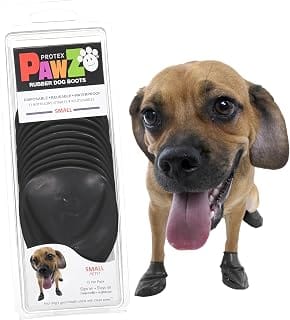
Pawz rubber boots are the straightforward pick for a small dog needing a light barrier from salted sidewalks, puddles, snow, lawn chemicals, or hot pavement. The specified small size fits paws measuring 2 to 2.5 inches, and the pull-on natural-rubber construction avoids straps and zippers entirely. Each pack includes 12 biodegradable boots, so there are replacements when one eventually wears out or goes missing. Buyers frequently describe these as less bulky than conventional booties, and some use socks underneath for snowier outings. The trade-off is clear: thin rubber adds little warmth and the snug opening can be difficult for dogs that dislike paw handling. Measure carefully; feedback also points to sizing and tightness challenges for some dogs.
Check Pawz Rubber Dog Boots on Amazon for current availability.
Pros
- Natural-rubber pull-on design has no straps or zippers
- Pack includes 12 boots, with each intended for multiple wears
- Provides a barrier from salt, snow, wet surfaces, chemicals, and hot pavement
Cons
- Thin rubber does not offer fleece-like insulation
- Snug fit and sizing can be challenging for some dogs
DOK TigerToes Dog Socks
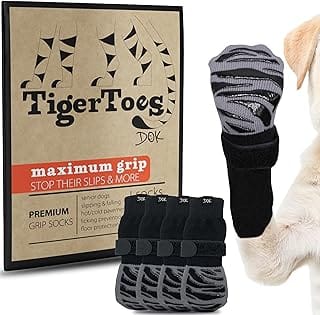
DOK TigerToes are not outdoor winter boots; they are the best fit here for a senior dog or recovering dog that slides on hardwood or other smooth indoor floors. The large size is listed for a 2.5- to 2.8-inch paw width, and the elastic cotton-polyester fabric is paired with a grip pattern designed to maintain traction if the sock twists. A buttonless strap is intended to avoid pressure points from hardware. Buyer feedback repeatedly centres on improved confidence on hard floors for dogs with arthritis or mobility trouble. The limitation is weather protection: fabric socks are not the answer for salt, deep snow, or slushy sidewalks. They can also take patience to put on, particularly with a wiggly dog.
Check DOK TigerToes Dog Socks on Amazon for current availability.
Pros
- Grip design is intended to work even when the sock rotates
- Buttonless strap is designed to reduce sore spots
- Useful for indoor traction on hardwood and similar smooth floors
Cons
- Not designed as protection for wet, salty outdoor winter routes
- Stretchy socks may be difficult to put on some dogs
Muttluks Winter Dog Boots
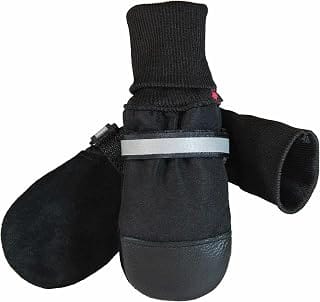
Muttluks Original Fleece-Lined boots suit the dog that needs genuine warmth for long, cold Canadian walks rather than a minimal salt barrier. Made in Canada since 1994, they combine a waterproof, breathable, windproof softshell outer with fleece lining and treated leather soles. Reflective accents add a practical safety detail for dark winter outings, while the flexible leather sole is intended to move with individual paw shapes. Buyers often praise the warmth, construction, and secure adjustable hook-and-loop closure. This is a premium winter-specific option, and it has two caveats. Careful measuring matters because reviewers mention tricky sizing, especially across different front and rear paw shapes. The maker lists the softshell as waterproof, but reviewers note the boots can absorb some moisture in heavy slush.
Check Muttluks Winter Dog Boots on Amazon for current availability.
Pros
- Fleece lining and weather-resistant softshell target serious cold
- Flexible treated leather soles are designed to adapt to paw movement
- Reflective accents and hook-and-loop closures support winter walk safety
Cons
- Sizing can be difficult, particularly when paws differ front to back
- Reviewers report some moisture absorption in heavy slush
Canada Pooch Snow Boots
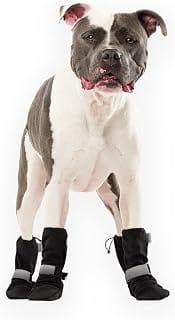
Canada Pooch Snow Boots are a sensible everyday choice for owners who want a conventional four-boot setup with more fit adjustment than a single strap. The water-resistant polyester-spandex shell, polyester lining, and rubberized grip sole target snowy, wet, and salty neighbourhood walks. A wide opening simplifies fitting, then a top toggle and reflective hook-and-loop strap help secure each boot. Buyers commonly mention that this two-part closure is easy to use and can help boots stay on during regular walks. The honest drawback is longevity at the closure: one reviewer reports hook-and-loop wear after a winter, even while valuing the fit and function. These are water-resistant rather than guaranteed waterproof, so set expectations accordingly for deep slush.
Check Canada Pooch Snow Boots on Amazon for current availability.
Pros
- Water-resistant upper and rubberized grip sole suit routine winter walks
- Top toggle plus reflective hook-and-loop strap offers two fit adjustments
- Cold gentle machine washing is permitted when washed inside out and hang dried
Cons
- Hook-and-loop durability may be a concern over time
- Water-resistant construction may not suit prolonged immersion in slush
BillionChains Winter Dog Boots
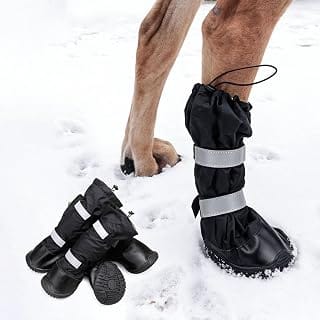
BillionChains Winter Boots make sense for a dog that needs a taller, insulated boot with broad coverage, including a paw that drags or needs protection from abrasion. The waterproof upper, soft plush lining, textured non-slip rubber sole, reflective strips, and adjustable tape closure are aimed at cold, wet walks. A wide opening can simplify getting the paw into the boot, while the moderate height covers more than a low-cut paw shoe. One buyer specifically found the design useful for shielding a recovering dog’s dragging foot. This model asks for precise sizing and a patient introduction. Reviews note that the taller shape can prompt an exaggerated gait in dogs new to boots, and dogs between sizes may still be difficult to fit securely.
Check BillionChains Winter Dog Boots on Amazon for current availability.
Pros
- Waterproof upper and plush lining address wet cold-weather walks
- Taller design provides a larger protective area than low-cut booties
- Textured rubber sole, reflective strips, and adjustable closure add practical winter features
Cons
- Tall shaft may take more acclimation for boot-inexperienced dogs
- Dogs between sizes may have trouble achieving a secure fit
LESYPET Winter Dog Boots
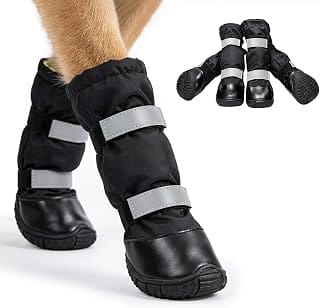
LESYPET Winter Boots are worth considering for a cold-prone dog that needs tall waterproof coverage but not a full connected suspender system. They use a soft inner lining, waterproof exterior, textured rubber sole, reflective strips, a drawstring, and reflective hook-and-loop tape. The dual fasteners are the key distinction: they offer more ways to tune the fit than a basic one-strap boot, while the wide opening is intended for bigger paws. The maker also suggests socks inside an oversized boot to create more grip, which may help in a borderline fit but should be checked closely for bunching. A practical limitation is cold-weather stiffness; the waterproof material can firm up in low temperatures and may need indoor storage or gentle warming before use.
Check LESYPET Winter Dog Boots on Amazon for current availability.
Pros
- Waterproof exterior and soft lining combine wet-weather protection with warmth
- Drawstring and hook-and-loop tape provide dual fit adjustment
- Textured rubber sole and reflective details support snowy, low-light walks
Cons
- Waterproof material can become stiff in cold temperatures
- Careful tightening is needed to keep the boots from coming off
Canada Pooch Suspender Boots
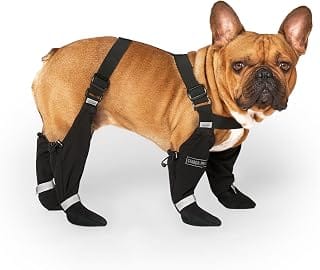
Canada Pooch Suspender Boots are the specialist pick for dogs that lose ordinary booties, wade through deeper snow, or need coverage beyond the paws. The four boots connect over the back, while adjustable straps, toggles, and body sliders aim to keep the set in place. The water-resistant polyester-spandex shell extends up the legs, and rubber soles, reflective hook-and-loop straps, and a polyester lining round out the winter-focused design. Short lengths are identified for Pugs, French Bulldogs, and Beagles, while regular lengths are listed for breeds such as Poodles, Doodles, Golden Retrievers, and Dobermans; individual measurements still matter more than breed labels. The trade-off is complexity. Reviews flag a size chart that may run large, and fitting four connected boots takes more setup than standard booties.
Check Canada Pooch Suspender Boots on Amazon for current availability.
Pros
- Connected four-boot design is intended to reduce lost boots
- Extended leg coverage helps limit snowballs, slush, salt, and mud exposure
- Rubber soles, reflective straps, and adjustable closures suit winter walks
Cons
- Requires measurements for paws and leg length plus more fitting steps
- Buyer feedback suggests sizing may run large for some dogs
How to Choose the Best Dog Boots in Canada
Choose boots by the conditions your dog actually faces, not by the thickest sole or the highest price. A city dog walking over heavily salted sidewalks needs a barrier against salt and slush. A dog spending time in deep snow may need a taller upper that limits snow entering around the ankle. Dogs with mobility issues can benefit from indoor grip socks or textured rubber soles, but those products solve different problems.
Fit security should rank near the top of the list. Pull-on rubber boots rely on a snug fit around the leg. Traditional boots use hook-and-loop straps, while some designs add a toggle. Connected suspender boots take a more involved approach, joining all four boots across the back to reduce the chance of losing one in a snowbank. The right system depends on your dog’s coat, leg length, paw shape, and tolerance for dressing.
Consider warmth separately from waterproofing. Fleece lining helps in serious cold, while thin rubber shields paws from wet pavement and salt but adds almost no insulation. Finally, plan for the routine: boots that are difficult to put on are less likely to be used consistently.
Sizing and Fit: How to Measure Your Dog’s Paws
Measure paws while your dog is standing squarely and bearing weight. A paw spreads under load, so a measurement taken while the leg is lifted can produce a boot that is too small. Place the paw on paper, trace around it, then measure the widest point and the length required by the manufacturer’s chart. Measure more than one paw when possible. Front and rear paws can differ, and a dog with substantial fur, dewclaws, or unusually shaped feet may need extra attention.
Do not use breed or body weight as the main sizing shortcut. A compact dog can have broad paws, while a tall dog may have narrow ones. For tall boots, measure leg length as well as paw width and length. This is especially relevant for suspender designs and models with a high shaft.
A correctly sized boot should let toes sit naturally without cramming them, while the closure holds the boot above the paw without digging into the leg. Check the fit indoors before committing to a long walk. Recheck after a few minutes of movement, since twisting, sliding, or bunching is usually a fit issue rather than something a dog will simply outgrow.
Weather and Terrain: What Boots Work Best in Snow, Ice, and Mud
For dry cold and light snow, fleece-lined boots provide useful warmth and a physical barrier from ice and road salt. They are a sensible choice for dogs that get cold feet quickly or walk slowly enough for cold exposure to add up. In wet snow, slush, and rain, prioritize a water-resistant or waterproof outer and a closure that limits water and snow entering from the top.
Thin rubber paw covers suit short outings on treated pavement, particularly when salt or lawn chemicals are the central concern. They pack easily and make sense for dogs that reject bulky boots, but they do not offer the insulation of fleece-lined footwear. Adding socks beneath rubber covers can add warmth, though it also changes fit and may make a close-fitting boot harder to apply.
Mud calls for easy-clean materials and enough coverage to keep debris off vulnerable paws. Taller boots can protect part of the lower leg, which is useful in deep snow or messy spring thaw conditions. No boot makes ice harmless. Slow down on polished ice, keep nails trimmed, and select routes with better footing where possible.
Materials and Construction: What to Look For
Material choice sets the balance between warmth, water resistance, flexibility, and cleaning effort. Natural rubber paw covers are thin, close fitting, and intended to create a barrier against salt, snow, wet surfaces, and chemicals. Their simplicity appeals to dogs that dislike straps, but rubber does not provide much insulation by itself.
Fleece-lined boots pair soft insulation with an outer shell or leather sole. This construction fits Canadian cold better than a bare fabric boot, especially for slower walks and cold-sensitive dogs. Leather soles may flex with the paw, while rubberized soles are commonly chosen for grip on wet and snowy surfaces. Polyester-spandex shells add some stretch and can help create a fitted upper.
Look closely at the closure setup. A hook-and-loop strap is straightforward, but its effectiveness depends on keeping it free of packed snow, fur, and lint. A top toggle can tighten the boot opening. Dual closures offer more adjustment but take longer to fit. Reflective strips or straps are worthwhile for dark winter mornings and evenings. For routine care, models that can be spot cleaned or cold-machine-washed offer a practical advantage, provided they are hung to dry.
Traction and Sole Design for Canadian Conditions
A sole should match the surface underfoot. Textured rubber or rubberized grips are the strongest fit for wet sidewalks, slush, packed snow, and slick indoor floors because they are designed to add friction. Deep texture can be helpful where meltwater freezes overnight, though it cannot guarantee traction on glare ice.
Flexible treated leather soles take a different approach. They may conform more closely to paw movement and can suit a dog that finds stiff footwear awkward. They are best considered for cold, snowy routes rather than repeated soaking in deep slush, since leather-based footwear may take on moisture. Grip socks are built primarily for hardwood, laminate, tile, and similar indoor surfaces. They are not a substitute for protective winter boots outdoors.
Inspect the bottom of every boot before walks. Worn tread, grit embedded in the sole, or a sole that has shifted off-centre can compromise footing. Keep expectations realistic as well: boots help protect paws and can improve stability, but a dog can still slip on ice, especially when running, pulling, or turning sharply.
Comfort and Safety: Preventing Slips, Hot Spots, and Injuries
Boots should protect a dog’s paws without creating a new problem. Before heading out, make sure the paw is fully seated and the sole sits beneath it rather than along the side. Fasten straps firmly enough to prevent rotation but not so tightly that they leave deep marks or restrict circulation. Check for rubbing around dewclaws, especially with taller uppers and boots that sit high on the leg.
Introduce footwear in short indoor sessions. Let your dog stand, walk, and earn a small reward before trying an outdoor route. A high-stepping gait is common at first; persistent distress, repeated chewing, or refusal to bear weight calls for a pause and a fit check. Never rely on a boot to cover an untreated wound or replace veterinary advice for lameness, skin irritation, or mobility concerns.
Remove wet boots promptly after the walk and inspect paws for redness, packed snow, cracked pads, or salt residue. For senior dogs, traction socks can help on slippery floors, but monitor fit closely because a twisted sock or bunched fabric can create friction rather than stability.
How to Put On, Break In, and Maintain Dog Boots
Begin indoors on a clean, dry floor. Open every strap and toggle before bringing the boot to the paw. Guide the paw fully into the toe area, straighten the boot so the sole is centred, then secure the lower closure before any top adjustment. For models with front and back labels, follow them; the shape and strap placement may differ between pairs. With suspender boots, position each rubber sole under the paw before tightening the body sliders.
Use a gradual break-in routine. Start with a few minutes indoors, then a brief dry walk, and build toward longer winter outings only if the boots remain correctly positioned. Watch for boot rotation, a dragging toe, a slipping heel, or straps that migrate down the leg. These signs often mean the size, shape, or closure tension needs attention.
After salted walks, wipe boots clean and rinse off residue where the care instructions allow. Fasten closures before machine washing models designed for it. Cold, gentle washing and hang drying are specified for the Canada Pooch options here. Avoid high heat, which can damage coatings, adhesives, hook-and-loop material, and rubber components. Air-dry them, or use a no-heat setting on a boot dryer, then store them paired together so the next walk does not begin with a missing boot.
Common Mistakes When Buying Dog Boots
The most common error is ordering by breed, age, or body weight rather than standing paw measurements. Size charts are product-specific. A large size in one boot can be narrower or shorter than a large size in another, and front paws may not match rear paws. Measure carefully, then compare every number to the chart for that exact model.
Another mistake is buying insulated boots for every winter job. Warm fleece-lined footwear is useful in cold weather, but a quick salty pavement walk may call for a lighter barrier. Conversely, thin rubber covers may not be enough for a cold-prone dog on a long outing in deep snow. Match the level of protection to the walk.
Avoid tightening straps until they bite. Boots lost in snow are frustrating, but overtightening can create sore spots and make a dog resist wearing them. Owners also sometimes skip indoor acclimation, then assume the dog hates boots after one awkward outdoor attempt. Give the dog time. Finally, do not overlook maintenance: salt, wet fur, and snow-packed closures can shorten the useful life of otherwise capable footwear.
Frequently Asked Questions About Dog Boots in Canada
Which dog boots suit snowy Canadian walks with salt and wet conditions?
For snowy, salty, wet routes, choose a boot with a water-resistant or waterproof upper, a textured rubber or rubberized sole, and a closure that holds the boot above the paw. Canada Pooch Snow Boots combine a water-resistant upper with rubberized grips, a top toggle, and a reflective hook-and-loop strap. For deeper snow and more lower-leg coverage, Canada Pooch Suspender Boots use a connected four-boot design with rubber soles and adjustable closures. LESYPET and BillionChains options also pair waterproof materials with rubber soles and adjustable fastening.
Should I choose fleece-lined boots or lighter rubber paw protection for winter?
Choose fleece-lined boots for longer outings, very cold conditions, or dogs that are cold-prone. The Muttluks design combines a fleece lining with a windproof, breathable softshell outer and treated leather soles. Lighter rubber paw protection is better suited to quick walks where salt, wet pavement, snow, or lawn chemicals are the main concern. Pawz covers provide a close-fitting natural-rubber barrier but do not supply the warmth of insulated footwear. Some buyers use socks under rubber covers in snow, but that requires careful fit checks.
How do I measure my dog’s paws while standing for the right size?
Have your dog stand on a sheet of paper with weight on the paw. Trace the outline, then measure the width at the widest point and the length required by the product’s chart. Standing matters because paws spread under weight. Measure more than one paw where possible, since front and rear paws can differ. For taller boots and suspender styles, measure leg length as well. If your measurement falls between sizes, follow the manufacturer’s stated guidance for that model.
Are suspender-style dog boots better for preventing boots from slipping off?
They can be a strong choice for dogs that frequently lose individual boots in deep snow or during active movement. Suspender-style designs connect the four boots across the dog’s back, adding another point of retention beyond ankle straps. The trade-off is a more involved fitting process: paw width, paw length, leg length, front/back placement, straps, toggles, and body sliders all need adjustment. They also provide more lower-leg coverage than standard booties, which can help in snow and slush.
How should I clean and dry dog boots after salty winter walks?
Remove boots after the walk, wipe away slush and grit, and clean off salt residue according to the care directions for that model. Let boots dry thoroughly before the next outing. For the Canada Pooch boots listed here, fasten closures, spot clean or machine wash inside out on a cold gentle cycle, then hang dry. Do not use bleach, dry clean, iron, or high heat. Also inspect hook-and-loop straps and tread for packed snow, fur, or debris.