
Government Files is The Canada Report's public-records analysis series examining government documents obtained through Canada's Access to Information (ATI) and provincial Freedom of Information (FOI) laws. These transparency laws allow members of the public to request internal government records from federal and provincial institutions. This article reviews documents released through those processes and summarizes what the records contain and what they show. While we strive for accuracy, this article represents an analysis and interpretation of the source material. For complete accuracy and full context, readers should review the original documents, which are available in full below.
Full Document
The complete document is available for download below:
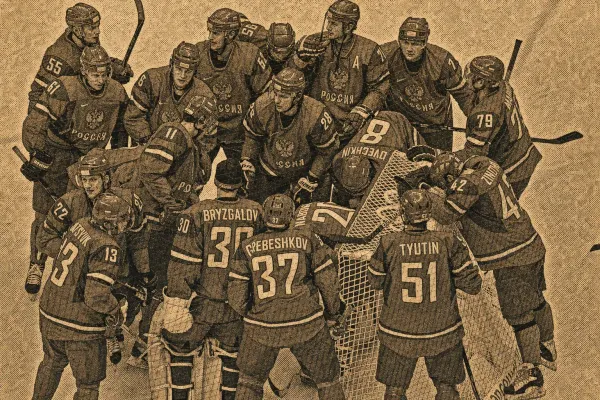
For roughly eight months, letters kept landing in the same two inboxes. Canadians wrote to the Prime Minister and to the Minister of Sport with a single, insistent demand: ban Russian and Belarusian athletes — and above all, ban the Russian players in the NHL. Records released under the Access to Information Act show at least three dozen separate pieces of correspondence on the question between October 2022 and May 2023, from ordinary members of the public, the Ukrainian Canadian Congress, and even a foreign sport minister. The government's own reply, repeated almost word for word across the file, quietly conceded the limit of what Ottawa could actually do about it.
The release, request number A-2025-00260 from the Department of Canadian Heritage, gathers correspondence sent to the Office of the Prime Minister and to Pascale St-Onge, then Minister of Sport, along with the department's template responses. It covers the period from October 1, 2022 to May 30, 2023 — a window that spans the second winter of Russia's full-scale invasion of Ukraine and the run-up to the fight over Russian participation at the Paris 2024 Olympics.
What the Documents Show
The volume is the first thing that stands out. The file carries more than 36 distinct correspondence reference numbers, most tagged "TO ANALYSE" by the department's ministerial correspondence unit. The overwhelming majority are from private citizens, many writing through the Prime Minister's website comment form on the subject line "Foreign Affairs." Their message is consistent to the point of repetition: Russia is committing atrocities in Ukraine, Russian NHL stars are earning millions in North America, and Canada should use whatever levers it has to send them home.
Alex Ovechkin, the Washington Capitals captain and a public supporter of Vladimir Putin, is named more than any other athlete across the file. One writer asked bluntly for a ban on him specifically; another pointed the minister to a CBC News article headlined around what to do "about a problem called Alex Ovechkin." The letters range from a single terse line to multi-page essays. One correspondent addressed a lengthy open letter directly to NHL commissioner Gary Bettman, laying out a menu of possible actions — from suspending Russian players' contracts to flying Ukrainian flags outside arenas in Winnipeg and Edmonton — and closing with a challenge borrowed from the writer's own mother: "can't you do something about it?"
The correspondence was not only domestic. The file includes a letter from Kamil Bortniczuk, Poland's Minister of Sport and Tourism, urging his counterparts — Canada among them — to jointly push for the International Boxing Association's removal from the International Olympic Committee after the IBA lifted its sanctions on Russian and Belarusian boxers. The Ukrainian Canadian Congress wrote to the Canadian Olympic Committee's president, appalled that Olympic stakeholders were exploring a pathway back for Russian and Belarusian athletes at Paris 2024. As the Paris question heated up in early 2023, the tone of the incoming mail shifted from hockey toward the Olympics.
Want future Government Files like this?
We release new Canadian public-records breakdowns weekly.
What Ottawa Actually Told Them
The most revealing part of the file is not the incoming mail. It is the reply. St-Onge's office answered the hockey letters with a standard template, and that template draws a sharp line between the sport Canada controls and the sport it does not.
On the amateur and international side, the government pointed to real action. The reply notes that in March 2022 a collective of 37 like-minded nations, Canada included, released a first joint statement on Russia's invasion and the role of sport; a second statement on July 4, 2022 spelled out the exclusion of Russian and Belarusian governing bodies from international federations and the removal of their officials from positions of influence. Sport Canada, the department said, continues to urge federally funded sport organizations to keep athletes representing the Russian or Belarusian states out of competition in Canada. This broader picture of Canada's support for Ukraine, from military aid to humanitarian funding, has run alongside the sport question throughout the war, and the government positioned its sport stance as one strand of that larger effort. Canada also signed on to a letter pressing the IOC to hold its February 2022 line against Russian and Belarusian participation.
Then came the sentence that answered the letter-writers' actual request — and told them no. On the NHL, the template is explicit: the league is a private business, Russian and Belarusian players there are not representing their home countries, and they may play "based on their individual immigration status." In a passage that recurs in the file, the department states plainly that "the operations of professional sport leagues and their decisions regarding the participation of athletes from certain countries are beyond the scope of Sport Canada's mandate," and that any such decisions must be consistent with current Government of Canada immigration regulations.
In other words, the lever the public kept reaching for — a federal ban on Russian NHL players — was not one Sport Canada held. The department's mandate covers the national amateur sport system, not the contracts of a private North American league.
The Visa Argument Nobody in Government Took Up
At least one correspondent saw the gap in that answer and pushed on it. Replying to St-Onge's template, the writer accepted that professional leagues have their own economic priorities but argued the federal government still controls one thing the leagues do not: visas. The letter pointed to the previous year's COVID-19 rules, when unvaccinated professional athletes were barred from entering Canada over the objections of their teams, and asked why Ottawa could not use the same immigration authority to keep Russian players out.
The records do not show the government engaging with that argument. The released correspondence contains no analysis weighing an immigration-based route, no legal opinion on whether visa powers could be used this way, and no reconsideration of the template line. The file simply moves on to the next letter. Whether that reflects a deliberate policy choice or a limit on what the department chose to release, the documents on their own do not say.
What the Records Don't Show
For a file this thick, the substance is thin in a few telling places. There is no internal briefing note, decision memo, or policy analysis in the release — the government's position is visible only through the outward-facing template reply, not through whatever discussion produced it. The correspondence names the Minister of Sport, the Deputy Prime Minister, and the Minister of Foreign Affairs as recipients or forwarders, but the records do not reveal any deliberation among them about hardening Canada's stance on professional athletes.
The release is also, by design, anonymized. Names, email addresses, and contact details of members of the public are withheld under section 19(1) of the Access to Information Act, the personal-information exemption, so the letters read as a chorus of unnamed voices. What survives is the shape of the pressure and the shape of the answer: months of public demand meeting a single, unchanging line about the limits of Sport Canada's mandate.
Broader Context
The correspondence captures a genuine tension that ran through the war's second year. Governments across the democratic world leaned hard on the amateur and Olympic movement to isolate Russia and Belarus, and Canada was an active signatory to that effort. But professional leagues — the NHL most visibly for Canadians — sat outside that framework, governed by private contracts and by immigration law rather than sport policy. The players the public most wanted removed were precisely the ones the sport minister had the least authority over.
That distinction did little to cool the mail. Chrystia Freeland, then Deputy Prime Minister, appears in the file forwarding a constituent's letter on the subject; years later she would leave cabinet for a role tied to Ukraine, a reminder of how central the file's underlying cause remained to Canadian politics. For the letter-writers of 2022 and 2023, though, the answer never really changed: Ottawa condemned the invasion loudly, pressed the amateur sport world hard, and told them the NHL was someone else's call.
Support Public-Records Analysis
This analysis is based on government records released under access-to-information laws. If this breakdown was useful, you can support future Government Files work with a one-time tip.
Support Government FilesAll correspondence and figures referenced are from the Department of Canadian Heritage, request A-2025-00260, obtained through an Access to Information request. The records contain correspondence sent to the Office of the Prime Minister and the Minister of Sport regarding the banning of Russian and Belarusian athletes from sporting events, together with the department's template responses, covering October 1, 2022 to May 30, 2023.