
Based on coverage from The Star, CHAT News Today, Medicine Hat News, and Brandon Sun.
Canada’s biggest flight-attendant union is taking aim at Ottawa’s investigation into alleged unpaid work in the airline industry, arguing the process is giving airlines too much control and missing how the job actually works.
As the federal investigation into unpaid work in the airline sector unfolds, it comes amid broader concerns about job security in the public sector, as outlined in Ottawa's plan to cut 12,000 federal jobs by 2026-27. This context raises questions about the government's commitment to labor rights across various industries.
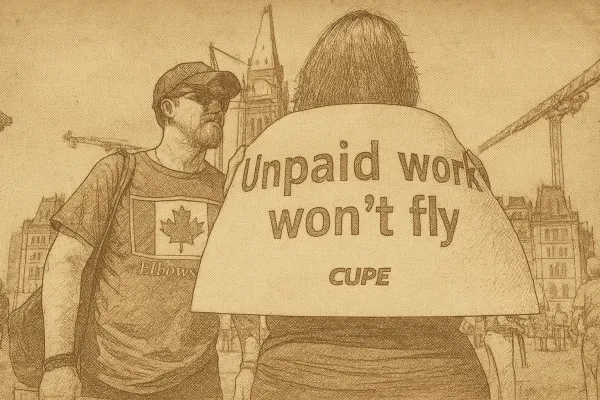
The Canadian Union of Public Employees (CUPE) says the federal probe, launched after last summer’s Air Canada strike, is failing to take workers’ examples seriously. The union’s bottom line: flight attendants can spend long stretches on duty during delays or ground time, but under the industry’s pay system, that time may not count as paid work.
Ottawa probe into airline unpaid work
The federal government opened its investigation in August 2025, after negotiations between Air Canada and CUPE’s flight attendants escalated into a strike that grounded planes. CUPE’s central claim during that dispute was that flight attendants are regularly expected to work without pay when aircraft are grounded.
Jobs Minister Patty Hajdu asked her department to examine whether airline workers were being paid below a standard set by the federal minimum wage. The first phase of the probe, published in February, found little evidence that unpaid work is widespread across the industry. Investigators did, however, flag potential issues affecting part-time and entry-level flight attendants for closer review.
Hajdu said at the time that the government needed more data before it could settle the question.
CUPE challenges credit-based flight attendant pay
Wesley Lesosky, president of CUPE’s Airline Division, called the initial findings “a little frustrating,” saying the union sees “copious amounts of times where we are unpaid,” tied to scheduling and the way compensation is calculated.
The dispute centres on the credit-based compensation model that’s standard in Canadian airlines, a system Hajdu has previously described as the product of decades of collective bargaining. Under that approach, pay is largely tied to time in the air, combined with other factors and daily or monthly minimums.
CUPE says that model breaks down when flights are delayed or operational issues keep crews on the ground but still working. Lesosky argues that if you are stuck dealing with delays and duties on the tarmac, “none of that’s compensated because you didn’t fly. You’re not credited.”
Airlines self-audit under federal investigation
The second phase of the federal probe relies heavily on airlines conducting self-audits of pay records to identify cases where workers may have performed work that effectively fell below the federal minimum wage.
CUPE says that setup lets the airline industry “fly the plane” in an investigation meant to scrutinize it. Lesosky’s specific concern is the audit design: he says airlines can choose as few as 40 workers to track, and there’s no requirement for random sampling. CUPE also argues timing matters, saying the probe is happening outside peak travel seasons, when packed schedules can increase the likelihood of the kinds of uncompensated ground-time situations the union is talking about.
WestJet, for its part, told The Canadian Press it supports the government’s “collaborative approach,” adding that it values cabin crew and remains committed to “transparent and constructive dialogue.” Air Canada did not respond to a request for comment in the story.
Definition of “work” in Canada Labour Code
CUPE’s other major criticism is more basic: the union says the government hasn’t clearly defined what counts as “work” for flight attendants in the first place.
Lesosky pointed to the real-world grey zones: does a shift start when a flight attendant is in uniform at the airport, does it include time spent managing a delay, and what about extra tasks after the plane hits the tarmac?
CUPE argues that without a definition of work specific to airline employees set out in Canada’s labour code, the probe can’t properly determine whether workers are being paid below federal standards. Lesosky also says that gap leaves the union bargaining at a disadvantage, because it ends up negotiating over what it sees as minimum standards.
What happens next for Air Canada flight attendants
Hajdu’s office says the second phase is expected to provide the detail needed to determine whether unpaid or unfair working conditions exist in the sector, and that Ottawa will act if it finds non-compliance with the Labour Code. Her office also encouraged workers who believe they’re not being compensated properly to file grievances through their union or submit a formal complaint through the federal labour program.
Meanwhile, Air Canada and CUPE have already reached an arbitrated wage settlement, announced in February, running until March 2029. Under that agreement, Air Canada flight attendants will receive half their hourly wage rate for 60 minutes of ground time on narrow-body aircraft and 70 minutes on wide-body aircraft. That ground-time rate rises to 60 per cent in April, 65 per cent in 2027, and 70 per cent in 2028.
CUPE says if it feels workers’ experiences still aren’t being reflected in the federal probe, it will keep making its case publicly.
Support Independent Canadian News Analysis
The Canada Report is supported by readers like you. If this article helped you understand what’s happening, you can support our work with a one-time tip.
Support The Canada Report