
Based on coverage from Insauga, Winnipeg Free Press, The Peterborough Examiner, CJME, CHAT News Today, and Brandon Sun.
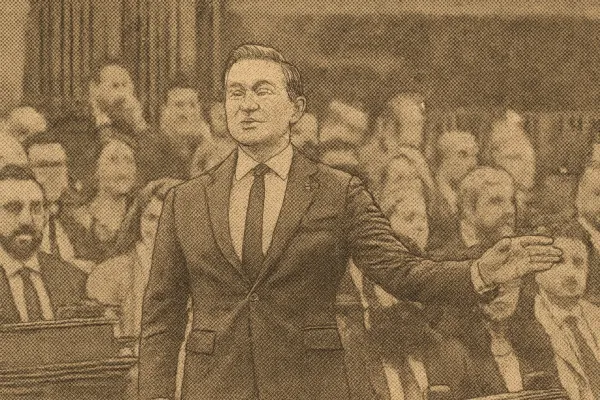
Conservative Leader Pierre Poilievre is throwing his support behind a new International Olympic Committee policy that would bar transgender women from competing in women’s events at the Olympic Games. The decision is set to shape eligibility rules ahead of Los Angeles 2028, and it has already sparked a political and human-rights fight that’s spilling into Canada.
Poilievre’s endorsement came via a repost on X of author J.K. Rowling, who praised the IOC move as a “welcome return to fair sport for women and girls.” Poilievre added: “What she said.”
IOC transgender women ban for LA 2028
The IOC’s new policy limits eligibility for any female category in individual and team sports to “biological females,” according to the policy language cited in reporting. It also requires mandatory genetic testing to establish an athlete’s sex.
The change comes ahead of the next Summer Games in Los Angeles in 2028. Reporting also notes the policy aligns with an executive order from U.S. President Donald Trump.
It’s unclear how many athletes, if any, this affects right now at an Olympic-qualification level. The coverage notes there may not be any transgender women currently competing at that level, although New Zealand weightlifter Laurel Hubbard competed at Tokyo 2021 and did not medal.
Mandatory genetic testing and SRY gene screening
Under the IOC policy, athletes would undergo genetic testing using saliva, cheek swabs, or blood samples. The test screens for the SRY gene, described in the policy as DNA “typically found on the Y chromosome that initiates male sex development in utero.”
Chromosome testing has a long and controversial history in elite sport. It was common in the 20th century but was largely abandoned in the 1990s because of what the reporting describes as “numerous ambiguities” that could not be easily resolved, including cases often grouped under differences in sex development.
That history matters because critics argue genetic testing doesn’t neatly sort athletes into simple categories, and supporters argue the women’s category needs stronger protections.
Pierre Poilievre reposts J.K. Rowling statement
Rowling’s post went beyond general support for the IOC decision. She referenced the “scandal of Paris 2024” and said she would never forget “people who consider themselves supremely virtuous and progressive publicly cheered on men punching women.”
Her post included a photo of Algerian boxer Imane Khelif, who won gold in Paris in 2024 amid intense controversy tied to misconceptions about her sex. Rowling referred to Khelif as a man, and reporting says both Rowling and Trump have repeatedly described Khelif as male.
Other reporting included a key detail: Khelif was born female and met IOC eligibility rules in 2024.
Imane Khelif, World Boxing, and testing debates
Khelif’s case has become a flashpoint in how sex eligibility is debated in public, even when the athlete in question is not transgender.
World Boxing, the reporting notes, implemented a policy last year requiring all fighters to take a genetic test that would identify the presence of a Y chromosome. Khelif told CNN she would take such a test if it were conducted by the IOC.
The intersection here is messy: a policy aimed at transgender participation can also pull in cisgender women who have differences in sex development, raising concerns about who gets flagged, tested, or excluded.
Canada response from Sport Minister Adam van Koeverden
Secretary of State for Sport Adam van Koeverden said the federal government believes in a sport system that “provides opportunities for all Canadians, including the transgender community, to participate in sport and excel without discrimination.”
He said Ottawa is aware of the IOC decision and, while international and national sport organizations operate independently of government, Canada will work with sport partners to review impacts on Canadian athletes. He also framed the government’s focus as preserving “integrity and fairness” in sport categories while promoting equal opportunity and respecting human rights.
The Canadian Civil Liberties Association took a sharper line, arguing the IOC changes are fundamentally at odds with the Olympic Charter’s commitment to sport as a human right. The CCLA said the measures not only bar transgender women, but also “target and disqualify cisgender women with differences in sex development.”
Support Independent Canadian News Analysis
The Canada Report is supported by readers like you. If this article helped you understand what’s happening, you can support our work with a one-time tip.
Support The Canada ReportSource 1 | Source 2 | Source 3 | Source 4 | Source 5 | Source 6