
Based on coverage from The Star, CP24, Insauga, Winnipeg Free Press, and CityNews.
Halton Regional Police say they’ve busted an online counterfeit-cash operation that sold fake bills across Canada while marketing them as “film prop money” on Instagram. Six Toronto-area suspects have been arrested, and police say the investigation linked some of the counterfeit bills to frauds around the Greater Toronto Area.
This operation is part of a broader trend of criminal activities being conducted online, similar to a recent case where Durham Region Police arrested six individuals involved in a human trafficking operation targeting minors. For more details on that investigation, see our coverage on human trafficking arrests in Durham.
Police estimate the group generated more than $60,000 in online sales before officers moved in with search warrants at the end of March.
Project Mirage targets Instagram counterfeit cash
Halton police say the case, called Project Mirage, started in August 2025 after investigators with the Financial Crimes Unit learned about two public Instagram accounts advertising counterfeit currency. According to police, the accounts directed people to online stores selling bundles of fake money, presented as “film prop money.”
Police allege purchases were processed by credit card and orders were shipped across Canada, which helped widen the potential fallout well beyond the GTA.
Fake bills tied to GTA fraud reports
Investigators say they connected the counterfeit bills being sold online to frauds across the Greater Toronto Area, including Halton Region. Police have not detailed the full list of alleged incidents, but they say the links helped them identify the people they believe were behind the accounts and the online shops.
The Canadian Press report frames the case as a “counterfeit currency sales ring operating through social media,” and Halton police describe it as a coordinated operation rather than isolated one-off counterfeit attempts.
Toronto search warrants seize cash, devices
Police say officers executed search warrants on March 31, 2026, at three Toronto residences and also searched vehicles linked to the accused.
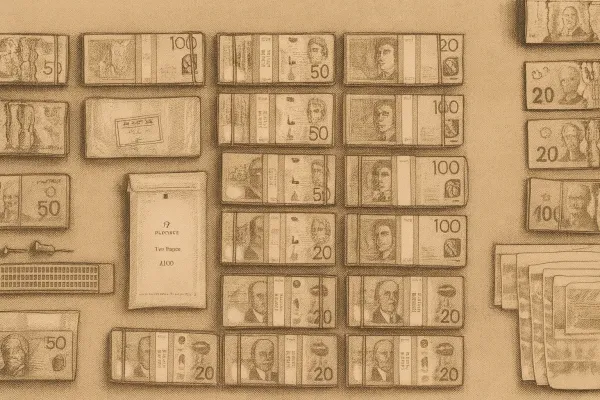
Across the reports, police list a wide range of items seized, including bundles of counterfeit Canadian dollars along with counterfeit Euros and Australian currency. Investigators also seized tools and materials used to produce counterfeit money, plus packaging materials and business cards connected to the online counterfeit stores.
Halton police also report seizing 13 cell phones and several laptops. A one-ounce gold bar valued at about $6,500 was also taken, according to police.
Drug allegations add trafficking charges
Alongside the counterfeit-related evidence, police say they found illegal drugs during the searches. One report specifies more than 12 ounces of cocaine, about two ounces of MDMA, six ounces of methamphetamine, and 80 Xanax tablets.
Two of the accused face drug-related charges. Police allege these were possession for the purpose of trafficking offences connected to cocaine, MDMA, methamphetamine, and Xanax.
Who was charged and how to spot fakes
Halton police name the six accused as Rafi Ahmed (23), Shafi Ahmed (24), Levente Glonczi (21), David Ho (29), Jason Ho (31), and Thanh Bui (29), all from Toronto. Police say the group faces a combined total of 20 charges. In the counterfeit portion of the case, police list allegations including fraud over $5,000, uttering counterfeit money, and advertising and dealing in counterfeit money for four of the accused.
Police also used the announcement to remind the public what to watch for if a bill feels off: repeated serial numbers on multiple notes, “prop money” or other non-standard wording, a holographic strip that looks like a removable sticker, dull colours, and poor print quality. They also suggest comparing the texture and thickness to a known genuine Canadian note.
Halton police are asking anyone with information to contact their Financial Crimes Unit or provide tips through Crime Stoppers.
Support Independent Canadian News Analysis
The Canada Report is supported by readers like you. If this article helped you understand what’s happening, you can support our work with a one-time tip.
Support The Canada Report