
Government Files is The Canada Report’s public-records analysis series examining government documents obtained through Canada’s Access to Information (ATI) and provincial Freedom of Information (FOI) laws. These transparency laws allow members of the public to request internal government records from federal and provincial institutions. This article reviews documents released through those processes and summarizes what the records contain and what they show. While we strive for accuracy, this article represents an analysis and interpretation of the source material. For complete accuracy and full context, readers should review the original documents, which are available in full below.
Full Document
The complete document is available for download below:
The Scale of Canada's Border Infrastructure
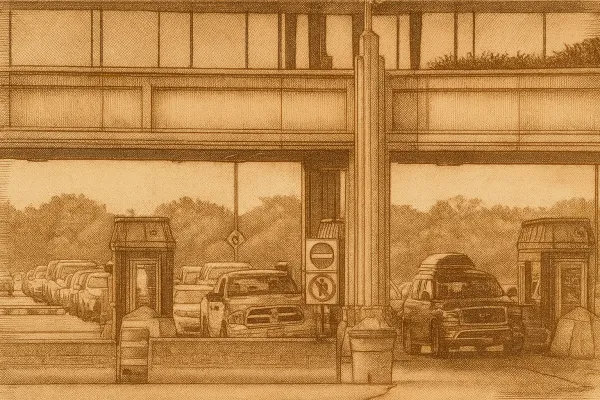
The Canada Border Services Agency operates one of the largest real estate portfolios of any federal law enforcement body, with records released under Access to Information revealing hundreds of properties spanning every province and territory from the Atlantic to the Pacific, and north to the Yukon. The documents, current as of September 2025, provide a rare window into the physical infrastructure that underpins Canada's border security operations—and the substantial public investment it represents.
The portfolio ranges from modest garages at rural border crossings to a British Columbia Immigration Holding Centre valued at nearly $179 million, making it one of the single most valuable properties in the CBSA's inventory. In total, the records document properties with individual assessed values ranging from under $100,000 to well over $100 million, with the complete portfolio representing billions in Crown-owned assets.
What the Documents Reveal
The released records organize CBSA properties into several categories of information: structure names and custodian details, property use designations and assessed values, street addresses and construction years, and provincial locations. Nearly all properties are identified as Crown Owned, meaning they are federal government assets rather than leased facilities.
The majority of properties fall under the designation "Law Enforcement and Corrections" with sub-categories including Main Customs Buildings, inspection stations, commercial facilities, and traffic operations buildings. However, the portfolio extends well beyond what the public might typically associate with border services. CBSA maintains residential properties at many remote crossings—houses, duplexes, and even trailers—where officers and their families live on-site. The records list properties designated as "Residential - Housing - barracks/dormitory" as well as numerous standalone residences scattered across rural border points.
The documents also reveal specialized facilities that support CBSA operations. The CBSA College in Quebec, housed across multiple blocks (identified as Bloc A through N, plus a hangar and firing range), serves as the agency's primary training facility. Health, medical, and dental facilities appear in the records, including two properties in this category valued at $139 million and $56 million respectively.
The extensive real estate holdings of the Canada Border Services Agency reflect a significant investment in border infrastructure, similar to Loblaw's recent commitment of $2.4 billion to expand its retail presence across the country, as detailed in Loblaw's investment in new stores. This parallel underscores the ongoing development and modernization efforts in various sectors within Canada.
Want future Government Files like this?We release new Canadian public-records breakdowns weekly.
Geographic Distribution
The properties cluster predictably along Canada's southern border with the United States, but the geographic spread is remarkable in its breadth. Quebec and New Brunswick feature prominently, reflecting the density of crossing points along the Maine and New York borders. Locations such as Lacolle, Stanstead, Hemmingford, and St-Armand in Quebec each host multiple CBSA facilities, while New Brunswick crossings at Woodstock, St. Stephen, and Grand Falls anchor the eastern border infrastructure.
In Western Canada, British Columbia crossings at Abbotsford-Huntingdon, Pacific Highway, Douglas, and Osoyoos feature among the larger facilities. The Prairie provinces maintain numerous smaller crossings—Manitoba's Emerson-Franklin crossing and Saskatchewan's North Portal both appear multiple times in the records. Alberta's Coutts crossing, which gained notoriety during the 2022 border blockade, appears with associated facilities including residential properties and inspection stations.
The records also document CBSA's northern presence, with multiple properties along the Alaska Highway in Yukon at locations such as "Mile 1202, Alaska Highway" and "1K-105 Top of the World Highway." These remote postings, some with construction dates in the 1950s and 1980s, represent the agency's role in managing the Alaska border and supporting northern operations.
Highest-Value Properties
Several properties stand out for their assessed values. The British Columbia Immigration Holding Centre tops the list at $178,843,614.01, reflecting the substantial infrastructure required for immigration detention facilities. This single property accounts for a significant portion of the agency's total real estate value.
Warehouse and workshop facilities—categorized as "Tertiary Garage" in the records—represent another major value category. One such facility is valued at $185,088,214.57, while two others exceed $125 million and $143 million respectively. These figures suggest significant investment in logistics and vehicle maintenance infrastructure, though the records do not specify the locations of these high-value warehouse facilities.
Training and operational support facilities also carry substantial values. Properties associated with the CBSA College and federal training centres appear throughout the records, while commercial buildings, inspection stations, and traveller processing facilities round out the major infrastructure investments.
At the other end of the spectrum, the records include numerous small-value properties: sheds under $100,000, garages valued at $200,000-$300,000, and modest residential properties at rural crossings. These entries reflect the reality that much of Canada's border infrastructure consists of small, dispersed facilities rather than major installations.
A Portrait in Construction Dates
The construction years documented in the records reveal a border infrastructure built across nearly a century. The oldest properties date to the late 1920s and early 1930s, with the St. Croix Border Crossing in New Brunswick listing a 1928 construction date and several other facilities from the 1930s and 1940s. Properties built before the Second World War remain operational at locations including Regway, Saskatchewan (1945) and several Quebec crossings.
The 1950s through 1970s saw significant border infrastructure development, with construction peaks evident during these decades. More recent investments appear concentrated in the 2000s through 2020s, with some properties showing construction dates as recent as 2021 and 2022. The Emerson-Franklin crossing in Manitoba shows multiple facilities constructed in 2022, suggesting recent upgrades to this major Prairie crossing point.
This age distribution raises questions about infrastructure maintenance and modernization needs that the records do not address directly. A facility constructed in 1928 likely faces different operational challenges than one built in 2020, though the records provide no condition assessments or planned capital investments.
What's Not in the Documents
While comprehensive in scope, the records contain notable gaps that limit their usefulness for complete analysis. The documents do not include a clear total count of properties or aggregate portfolio value, requiring manual tallying across hundreds of entries. Precise property addresses are sometimes vague—locations like "Highway 6 - CBSA - Regway" or "1K 105 Top of the World Highway" provide general locations but not specific civic addresses.
The records also lack operational context. Property values are listed as "Total Cost with Premium" but the methodology behind these assessments is not explained. Similarly, the purpose designations describe general categories but don't indicate staffing levels, traffic volumes, or operational significance of individual facilities.
Perhaps most notably, the records do not distinguish between active facilities and those that may be surplus or underutilized. With some border crossings seeing declining traffic and others facing pressure from increased traveller volumes, the static inventory provides limited insight into how the portfolio aligns with current operational needs.
Broader Implications
The scale of CBSA's real estate holdings reflects the physical reality of managing one of the world's longest international borders. The 8,891-kilometre land border with the United States requires infrastructure at dozens of crossing points, while air and marine operations add further facility requirements. The investment in residential properties at remote crossings speaks to the challenge of staffing isolated postings where commercial housing may be unavailable.
The substantial value of the Immigration Holding Centre—approaching $179 million for a single facility—underscores the capital-intensive nature of detention infrastructure. With ongoing debates about immigration enforcement policy and detention practices, the physical assets documented in these records represent long-term commitments that shape operational possibilities.
For policymakers and the public, the records offer a baseline accounting of federal border infrastructure that is rarely documented in such detail. As discussions continue about border security investments, port of entry modernization, and the future of immigration enforcement, these records provide a snapshot of the physical foundation upon which Canada's border operations currently rest.
Support Public-Records Analysis
This analysis is based on government records released under access-to-information laws. If this breakdown was useful, you can support future Government Files work with a one-time tip.
Support Government FilesAll information referenced is from the Canada Border Services Agency, request number ZA-2024-12059, obtained through Access to Information requests. The records contain the agency's real estate portfolio as of September 2025, including property locations, designations, construction dates, and assessed values.