
Based on coverage from CBC, The Globe and Mail, The Peterborough Examiner, and Lethbridge News Now.
Christians in Quebec are heading into Good Friday with a brand-new set of rules hanging over a long-running Easter tradition: public Way of the Cross processions.
The new law restricting public religious expression comes amid broader discussions about government regulations in Quebec, as seen in the recent protests against the federal firearms ban that highlight the province's evolving stance on personal freedoms.
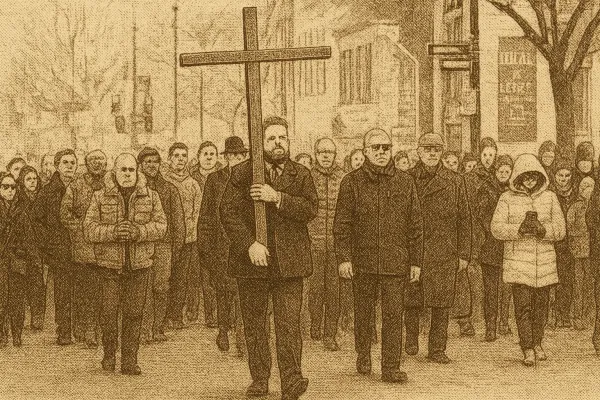
In Montreal, several hundred people are expected to join Archbishop Christian Lépine for a march described as one of “prayer, reflection and silence.” The procession typically winds through downtown streets behind a large crucifix, stopping at historic churches to mark Jesus’s journey to the cross. This year’s event is still going ahead, but religious leaders say future marches could get more complicated after Quebec’s legislature adopted a law that tightens restrictions on public religious expression.
Quebec law bans public prayer without consent
The legislation adopted Thursday does three big things, according to the reports: it extends the ban on wearing religious symbols in public workplaces to daycare workers, it prohibits prayer rooms in public institutions, and it bans public prayer unless there is explicit municipal consent.
The law’s wording is blunt about public space. It says no public road or public park may be used for “collective religious practice” unless a municipality authorizes it “exceptionally and on a case-by-case basis” through a resolution of the municipal council.
For churches and community groups that have treated these processions as a normal part of civic life, the shift is that they may now need a specific green light from city hall, not just the usual coordination around traffic and safety.
Montreal Way of the Cross faces new hurdles
The Montreal event is expected to look familiar to participants: a quiet walk, a cross carried at the front, and stops at churches for readings, songs, and poems.
John Zucchi, national director of Communion and Liberation Canada, one of the organizers, said they always communicate with police about the procession. He also said they have previously been told it was not necessary to inform the city.
Zucchi said last year’s march drew nearly 1,000 people, and that attendance has been growing, roughly doubling since the COVID-19 pandemic. He attributes that to the tone of the event, calling it sober and simple, with “quiet dignity” rather than noise or spectacle.
Even so, he raised a practical question that likely won’t be settled quickly: if a procession is done in silence, what exactly counts as “public prayer”?
Quebec Catholic bishops warn of rights shift
Martin Laliberté, head of the Assembly of Quebec Catholic Bishops, argues the law effectively pushes believers into a lesser category of citizen when it comes to using public space.
He pointed out that street closures and public demonstrations are routine for all sorts of gatherings, including sporting events, protests, and cultural events. His complaint is that religion is being singled out: “If we do it for religious reasons, we don’t have the right,” he said.
Laliberté said organizers have always worked with local officials and followed municipal rules, but that they did not previously need express permission to hold a march. “It was a right, and now it’s not a right any more,” he said, adding that churches may now be relying on the goodwill of municipal councils for approvals.
Charter override powers raise stakes
Laliberté also flagged a bigger concern than permitting: he said the legislation invokes powers that allow Quebec to override some sections of the Canadian Charter and shield the law from certain court challenges.
From the bishops’ perspective, that changes the ground rules around public expressions of faith. Laliberté said the Charter protects public expression of religion, but argued the new law means people no longer have that right in the same way, calling it “a big shift.”
The Catholic bishops took part in consultations and told the government they were particularly concerned about the public prayer ban and the expansion of the religious symbols prohibition. Laliberté said politicians seemed to listen but did not adopt the changes the bishops wanted. He also called the law unnecessary, saying the government already had tools to protect secularism.
What happens next for Quebec municipalities
A key practical impact will land at the municipal level. The law sets up a system where city councils can vote to authorize collective religious practice in public spaces, “exceptionally” and case by case.
Zucchi said he is not yet worried about Montreal’s procession because organizers have experienced goodwill from the city and the police and expect that to continue. The Quebec government did not respond to a request for comment by publication time, leaving some basic questions, like how “public prayer” will be interpreted, to be worked out in the real world by municipalities, organizers, and potentially the courts.
Support Independent Canadian News Analysis
The Canada Report is supported by readers like you. If this article helped you understand what’s happening, you can support our work with a one-time tip.
Support The Canada Report