

Based on coverage from CBC, Global News, Toronto Star, Sudbury.com, and The Peterborough Examiner.
Canada’s military is working hard to draw a bright line between what Canadians are doing in the Middle East and what the U.S. is doing as the Iran war continues.
As tensions escalate in the region, Canada has also secured 325 flight seats for evacuation efforts, underscoring the complexities of its military and diplomatic stance amid the ongoing conflict, as detailed in Canada Secures 325 Flight Seats for Evacuation Amid Iran Conflict Escalation.
The Department of National Defence says Canadian Armed Forces members have not taken part in the current war, and it also moved to correct any impression that Canadians embedded with a U.S. Air Force unit might have deployed into the Persian Gulf.
Canadian Armed Forces role in Iran war
National Defence says the Canadian Armed Forces has had “no involvement at all” in the current war and that no Canadian military members were involved in planning it. The department also says Canada has no involvement in an operation it identifies as Operation Epic Fury.
At the same time, Canada still has personnel in the broader region. National Defence says that, based on numbers from March 5, roughly 200 CAF members are deployed across the Middle East in six separate operations. The department says some personnel have been relocated within the region or redeployed back to Canada, but it will not provide more detailed location-by-location numbers, citing security reasons.
35 Canadian troops not deployed to Gulf
One point National Defence is being especially clear about: the status of Canadians serving on exchange with a U.S. Air Force wing tied to airborne surveillance.
A spokesperson says 35 CAF members are currently serving in some capacity with the 552nd Air Control Wing’s Canadian detachment, based at Tinker Air Force Base in Oklahoma. Those Canadians have not left the U.S. for operations in the Persian Gulf region.
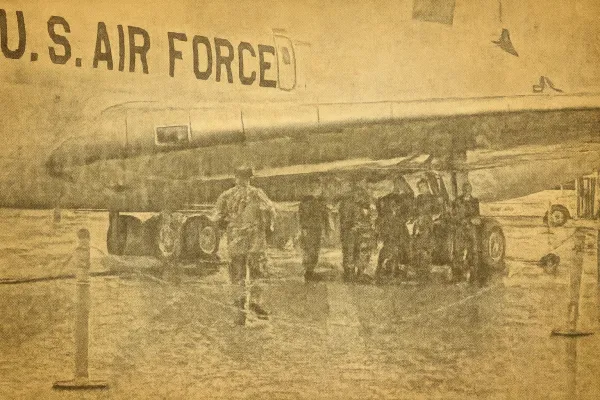
That matters because the U.S. wing has deployed six Boeing E-3G Sentry AWACS surveillance aircraft to an airbase in Saudi Arabia as the war grinds on, raising obvious questions about whether any Canadians attached to the unit might be heading into theatre.
NATO Mission Iraq relocation to Europe
Canada is also involved through NATO, though not in a combat role. NATO’s top commander, Gen. Alexus Grynkewich, confirmed Friday that the alliance has pulled several hundred personnel out of Iraq and relocated them to Europe. They had been part of NATO Mission Iraq, a security advisory operation launched in 2018 to advise Iraqi defence and security officials.
Defence Minister David McGuinty said Canadian Armed Forces personnel and Canadian civilians deployed with NATO Mission Iraq have been relocated to a secure location and are “safe and accounted for.” NATO says the mission will continue its work from Joint Force Command Naples.
The relocation came after Iranian attacks on other troops at British, French and Italian bases in Iraq, according to the reporting here, as Tehran ramps up attacks in the region in retaliation for U.S. and Israeli airstrikes that began three weeks ago.
Strait of Hormuz security and Canada’s stance
The Strait of Hormuz is hovering in the background of all of this, since it is a vital shipping lane and energy choke point. Canada joined the United Kingdom, France, Germany, Italy, the Netherlands and Japan in a statement Thursday saying they were willing to “contribute to appropriate efforts” to ensure safe passage through the strait. The statement did not spell out what those efforts might look like.
McGuinty has left the door open to the Canadian military helping neighbouring countries defend themselves from Iranian attacks, if assistance is sought through NATO. Foreign Affairs Minister Anita Anand’s office said any potential support would be guided by local needs, Canadian laws and policies, and consultations with partners and allies. Her office also said Canada remains focused on diplomacy to lower tensions and to stop attacks by all players on energy infrastructure.
Trump signals mixed direction on Middle East operations
The U.S. messaging is less tidy. Late Friday, U.S. President Donald Trump posted that his administration was considering “winding down” military operations, saying the U.S. was close to meeting objectives including degrading Iran’s military, naval, missile and nuclear capabilities.
But Reuters and The Associated Press also reported Friday that the U.S. was sending 2,500 additional Marines to the Middle East, plus at least one amphibious assault ship, citing U.S. officials speaking anonymously. The reporting notes Global News has not independently verified those additional deployments.
Trump’s posts also took aim at allies over Hormuz, arguing other countries that use the shipping lane should police it, while saying the U.S. would help if asked. For Canadians watching this unfold, Ottawa’s immediate message is straightforward: Canada’s forces in the region are being repositioned for safety where needed, but Canada is not part of the war plan or the fighting.
Support Independent Canadian News Analysis
The Canada Report is supported by readers like you. If this article helped you understand what’s happening, you can support our work with a one-time tip.
Support The Canada Report