

Based on coverage from Global News, CP24, Castanet, The Peterborough Examiner, CKOM, and National Observer.
Alberta Premier Danielle Smith is using the latest jump in global oil prices, tied to the war in Iran, to renew her case for more pipeline capacity to Canada’s West Coast.
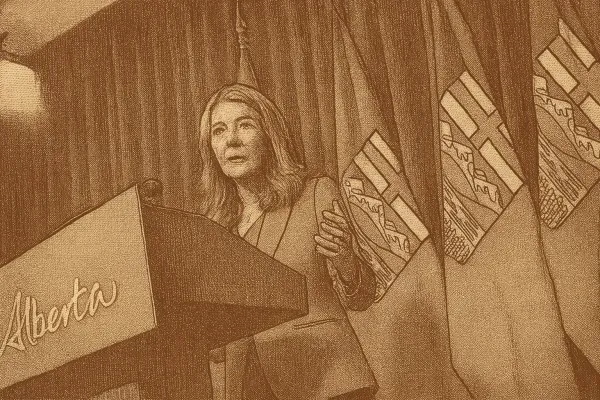
Speaking Monday at a news conference in Lethbridge, Smith argued that fears of shipping disruptions through the Strait of Hormuz show why Alberta needs a more reliable route to get its oil to Pacific markets.
Iran conflict drives oil price spike
Oil prices rose after American-Israeli attacks on Iran over the weekend, with traders reacting to the risk that the Strait of Hormuz could be disrupted. The strait sits at the mouth of the Persian Gulf and is one of the world’s most important choke points for moving oil by tanker.
Alberta Finance Minister Nate Horner said Monday morning the market had moved sharply since it opened, with West Texas Intermediate (WTI) climbing to between about US$70 and US$74 per barrel. Alberta’s latest budget projections, released last week, assumed WTI would average US$60.50 per barrel in the upcoming fiscal year.
Horner said the market is “pricing the risk right now,” and suggested prices could swing back quickly if fears ease, returning to normal supply-and-demand dynamics.
Danielle Smith links Hormuz risk to pipelines
Smith’s message was straightforward: if global shipping lanes look shaky, countries buying oil will want stable suppliers, and Canada should be positioned to meet that demand.
She said any disruption in the Strait of Hormuz strengthens the argument for a new pipeline that connects Alberta’s oil reserves to the West Coast, allowing exports to move through Pacific shipping lanes. She also pointed to the planned expansion of the existing Trans Mountain pipeline, which carries Alberta bitumen to the coast, saying it gives Asian partners a “clear line of sight.”
“We want the conflict to end quickly with minimal loss of life,” Smith said, adding Alberta is watching what Canada’s allies may need. “We’re here to help. But part of the way in which we can help is, of course, with expansions to the West Coast pipelines.”
Alberta budget deficit tied to WTI oil
The politics and the provincial books are never far from the oil price. Smith acknowledged that higher prices could improve Alberta’s near-term fiscal picture.
With one month left in the province’s current fiscal year, Smith said the government’s expected $4.1-billion deficit “might be somewhat less than that,” depending on how much volatility continues.
Looking ahead, the United Conservative government projected a $9.4-billion deficit for the coming year, a forecast driven largely by weaker oil prices. The province also estimates that every US$1 drop in WTI cuts roughly $680 million from Alberta’s bottom line, a reminder of how quickly a budget can swing with the market.
Ottawa-Alberta deal sets pipeline deadlines
Smith’s comments also land in the middle of a broader negotiation with Ottawa.
Late last year, she signed an agreement with Prime Minister Mark Carney that, according to the province, opened the door to a potential Indigenous co-owned pipeline and the rollback of environmental policies seen as barriers to new projects.
That deal sets two key dates: Alberta and the federal government aim to agree on an industrial carbon price by April 1, and there’s a July 1 deadline for a pipeline proposal to be submitted to Ottawa’s major projects office.
Greenpeace warns against fossil fuel dependence
Environmental groups see the moment differently. Keith Stewart of Greenpeace Canada said war could mean windfall profits for oil companies and exporters in the short term, but argued oil-importing countries are also moving faster on wind and solar to avoid being “held hostage” by fossil fuel geopolitics.
For Canadians, the immediate takeaway is that a conflict half a world away is already rippling into Alberta’s budget math and re-energizing the country’s long-running pipeline debate, with federal deadlines now on the calendar.
Support Independent Canadian News Analysis
The Canada Report is supported by readers like you. If this article helped you understand what’s happening, you can support our work with a one-time tip.
Support The Canada ReportSource 1 | Source 2 | Source 3 | Source 4 | Source 5 | Source 6