

Heads up: some of the links in this post are affiliate links. That means if you click and purchase, we may get a commission. It's how we keep this site running without cluttering it with ads.
The best food dehydrator in Canada depends less on a single headline feature than on what lands in your kitchen. A person drying a few trays of apple slices or dog treats has different needs from someone preserving garden tomatoes, making jerky, or processing a fall mushroom haul. Capacity, airflow layout, temperature range, timer length and cleanup all affect whether the machine will earn its counter space.
This is a curated guide based on published specifications, current Canadian listings, and third-party buyer feedback. The six picks range from compact stackable models to larger cabinet-style units with rear fans. A horizontal-flow dehydrator makes the stronger case for frequent, varied batches; a stackable machine can be a sensible choice for modest loads and limited storage. Canadian households should also confirm that a unit uses 120V household power, consider the cost of a long drying cycle, and choose a size that matches the amount of seasonal produce they realistically prepare.
Quick Overview: Our Top Picks
| Product | Best For | Why We Love It | Price |
|---|---|---|---|
| Quieter larger batches | Six stainless steel trays, strong airflow, and quiet operation support convenient overnight drying. | $229.99 CAD | |
| Tight budgets | An affordable five-tray design offers adjustable temperatures and dishwasher-safe cleanup for everyday snacks. | $69.99 CAD | |
| Flexible home use | Adjustable trays, digital controls, and a broad temperature range handle varied ingredients with ease. | $107.95 CAD | |
| Simple everyday drying | Five stackable trays, continuous airflow, and digital temperature adjustment keep operation straightforward and practical. | $99.99 CAD | |
| Large batch drying | Eight trays, horizontal airflow, and an extended timer suit frequent, higher-volume food preservation. | $255.96 CAD | |
| Heavy daily use | Seven stainless steel trays, rear airflow, automatic shutoff, and keep-warm functionality maximize convenience. | $210.95 CAD |
Cosori Food Dehydrator
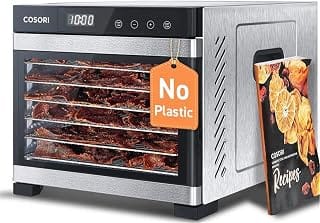
The Cosori is the pick for a household that wants a serious home dehydrator without moving to an eight-tray cabinet. Its six stainless steel trays measure 12 by 13 inches and provide 6.5 square feet of drying area, a useful format for garden produce, jerky, pet treats and several snack trays at once. A 600W rear-mounted fan, digital 35°C–74°C (95°F–165°F) control, 48-hour timer, auto shutoff and overheat protection make it well suited to planned longer batches. It also includes a mesh screen and fruit-roll sheet, so herbs and purées are not an afterthought. Cosori lists noise below 48 dB, and buyers frequently praise its quiet operation, straightforward controls and stainless trays. The trade-off is its 8.21 kg weight and premium-sized footprint; it is best left accessible on a counter or sturdy shelf rather than moved constantly.
Check Cosori Food Dehydrator on Amazon for current availability.
Pros
- Six 12-by-13-inch stainless steel trays provide 6.5 square feet of drying space
- Digital 35°C–74°C (95°F–165°F) control, 48-hour timer, auto shutoff and overheat protection
- Includes a mesh screen and fruit-roll sheet; buyers often mention quiet operation
Cons
- At 8.21 kg, it is less convenient for frequent cupboard storage
- Six trays may not be enough for very large harvest processing
Commercial Chef Dehydrator
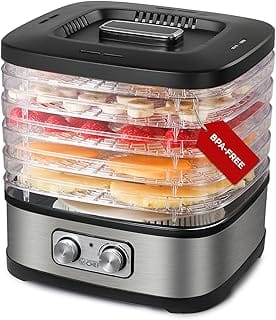
Choose the Commercial Chef for a modest first dehydrator focused on herbs, flowers, fruit and simple dog treats. Its five removable trays sit in a compact 10.2 by 8.26 by 9.8 inch body that weighs 2.27 kg, making it easier to store in a smaller Canadian kitchen. The 35°C–70°C (95°F–158°F) adjustable temperature range and dishwasher-safe trays cover the basics without adding a complicated digital interface. Buyers often describe it as easy to use for herbs, flowers, sweet potatoes and bananas. The honest compromise is a mechanical switch rather than a timer, plus a 240W rating and compact trays that favour smaller loads. One buyer also felt the construction seemed inexpensive. It is a practical budget-minded choice when convenience and capacity matter more than premium materials or advanced controls.
Check Commercial Chef Dehydrator on Amazon for current availability.
Pros
- Compact 2.27 kg design with five removable trays
- Adjustable 35°C–70°C (95°F–158°F) temperature range
- Dishwasher-safe trays and uncomplicated mechanical controls
Cons
- No listed timer or digital control panel
- Small capacity and buyer feedback suggests a basic-feeling build
Magic Mill Food Dehydrator
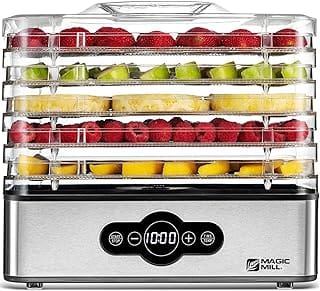
The compact Magic Mill suits a shopper who wants stackable flexibility but still values a digital timer and a broad temperature range. Its five food-grade adjustable trays can be set with 0.6 inches of standard spacing or raised to 1.1 inches for thicker pieces, which gives it an edge for chunky fruit slices and other taller ingredients. The 35°C–75°C (95°F–167°F) digital controls and 48-hour timer support recipes that need more precision than a simple dial. Stainless steel trays, a BPA-free plastic body, and dishwasher-safe removable trays make cleanup relatively straightforward. Buyers generally say it performs the job asked of it. Its limitations are equally clear: 240W power and a five-tray stack are better suited to regular household portions than a large harvest. There is no listed rear-mounted horizontal airflow system, so it is not the first choice for high-volume production.
Check Magic Mill Food Dehydrator on Amazon for current availability.
Pros
- Adjustable tray spacing from 0.6 to 1.1 inches accommodates thicker ingredients
- Digital 35°C–75°C (95°F–167°F) temperature control and 48-hour timer
- Stainless steel trays are removable and listed as dishwasher safe
Cons
- 240W output and five trays limit batch volume
- Stackable design is less suited to large, multi-food loads than cabinet models
Hamilton Beach Dehydrator
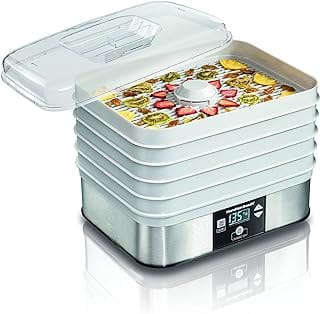
The Hamilton Beach is a sensible middle route for someone who wants a familiar five-tray stackable format with 500W of listed power and a digital thermostat. Continuous airflow and adjustable digital temperature control make it more configurable than a basic dial-operated model, while its 3.63 kg weight is manageable for a household that cannot dedicate permanent counter space. It is best for recurring batches of fruit, vegetables and snacks rather than large-scale preserving. Buyer feedback includes reports of long service life and easy cleaning, alongside a reminder that drying can take longer than a manual may suggest. One buyer also criticized the thin metal around the body. That makes this a practical, feature-focused option, not a premium construction choice. Leave time in your plan, use evenly cut pieces, and do not expect five stackable trays to replace a larger rear-fan cabinet.
Check Hamilton Beach Dehydrator on Amazon for current availability.
Pros
- Five stackable trays with 500W power
- Adjustable digital thermostat and continuous airflow
- Moderate 3.63 kg weight for a countertop appliance
Cons
- No listed timer or accessory sheets
- Some buyer feedback cites thin exterior metal and longer-than-expected drying times
Excalibur Food Dehydrator
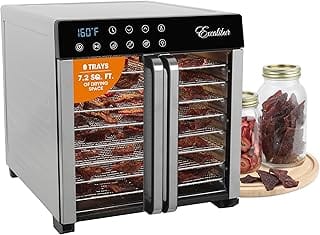
The Excalibur is for frequent preservers who want eight trays, a long timer, and a cabinet design that is easy to monitor. Its horizontal Parallex Air Flow and Hyperwave Pulse Technology are intended to dry evenly without tray rotation, while the 29°C–74°C (85°F–165°F) thermostat and 80-hour timer give it the broadest low-end temperature and longest run time in this group. Clear glass French doors let users check a batch without opening the cabinet. The eight chrome trays offer substantial space in a compact-footprint design, making it a strong choice for vegetables, fruit, mushrooms and jerky. Buyers often mention even drying and straightforward operation. The trade-off is that it is a 7.47 kg premium appliance with chrome trays rather than stainless steel trays. It earns its place for high use, not for a person drying a few herbs once in a while.
Check Excalibur Food Dehydrator on Amazon for current availability.
Pros
- Eight trays, 700W, 29°C–74°C (85°F–165°F) control and an 80-hour timer
- Horizontal airflow system is designed to avoid tray rotation
- Glass French doors make progress easy to view
Cons
- 7.47 kg cabinet format needs dedicated counter or storage space
- Chrome trays may not suit buyers specifically seeking stainless steel
Magic Mill Pro Dehydrator
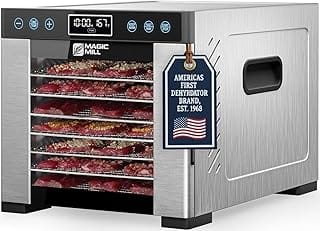
The Magic Mill Pro is the best match for a busy household making jerky, fruit leather, herbs, vegetables and pet treats in regular larger batches. It combines seven stainless steel trays with a 600W rear-mounted fan, digital thermostat, countdown timer, auto shutoff and a transparent door window. The included mesh trays and fruit-leather sheet broaden what it can handle, and the trays and liners are listed as dishwasher safe. A keep-warm function is an unusual extra for buyers who value that option. Published safety features include overheat protection and BPA-free food-grade stainless steel trays. Buyers frequently describe it as user-friendly and report that the shelves do not require rotation. Its 7.26 kg weight and cabinet footprint make it less appealing for infrequent use or very small kitchens. Choose it for capacity and versatility, not minimal storage demands.
Check Magic Mill Pro Dehydrator on Amazon for current availability.
Pros
- Seven stainless steel trays with included mesh and fruit-leather accessories
- 600W rear-mounted fan, digital timer, auto shutoff and transparent door
- Dishwasher-safe trays and liners plus overheat protection
Cons
- At 7.26 kg, it is a substantial appliance to move and store
- Seven-tray cabinet capacity may be unnecessary for occasional small batches
What to Look for in the Best Food Dehydrator in Canada
Start with the food, not the appliance. Fruit leather, herbs and thin apple slices can work well in a small five-tray machine. Jerky, dog treats, garden vegetables and several recipes running at once benefit from wider shelves, more vertical space, and airflow designed to reach every tray.
Temperature control matters because different foods call for different heat. The models here range from 29°C to 75°C (85°F to 167°F), and the broadest ranges give a household more flexibility for herbs, fruit and meat. A timer is similarly useful: it lets the dehydrator switch off after a planned cycle instead of running until someone remembers it. For long batches, a 48-hour or 80-hour setting is more practical than a basic manual control.
Pay attention to the tray system. Stainless steel trays appeal to buyers who prefer less food contact with plastic, while dishwasher-safe removable trays cut down on cleanup. Stackable trays can store compactly and may offer adjustable height for thicker pieces. Cabinet-style horizontal-flow models usually add a front door and a more structured layout, and manufacturers say they don't need tray rotation.
Canadian kitchens also put a premium on sensible footprint and noise. A large dehydrator can preserve a bumper crop, but it has to fit on the counter or in storage for the other eleven months. For apartment living or overnight drying, published noise information and buyer comments are worth reading closely. Finally, buy capacity you will fill. An eight-tray unit is not automatically better than a five-tray unit if most batches are a handful of herbs or treats.
Types of Food Dehydrators (Stackable Trays vs. Horizontal Flow)
Stackable dehydrators place trays one above another, usually around a base that supplies heat and moving air. They tend to be lighter, smaller, and easier to tuck into a cupboard. The Commercial Chef, compact Magic Mill and Hamilton Beach are the natural fits for a first dehydrator or occasional small batches. Adjustable tray height, as on the compact Magic Mill, is particularly handy for thicker-cut produce.
Their compromise is workflow. Tray shape and stacked construction can limit the size of what fits, and drying performance may vary with food thickness, loading pattern and the particular appliance. Buyers should cut pieces consistently and avoid crowding; that helps any dehydrator, but it is especially useful with stacked trays.
Horizontal-flow or cabinet-style dehydrators use a rear-mounted fan to send air across shelves. The Cosori, Excalibur and Magic Mill Pro take this approach. They suit people who want to run several types of food at once, make regular jerky, or dry a harvest without building batches around a narrow tray opening. Their square or rectangular form also makes it easier to lay out slices in an orderly single layer.
The trade-off is size and cost. Cabinet models are substantial countertop appliances, and the larger selections weigh more than compact stackable units. They make sense if you preserve often, less so for the odd batch of banana chips. For a smaller household, a stackable machine can be the more proportionate purchase.
Key Features That Matter for Drying Success
A thermostat and timer are the two controls most likely to affect everyday convenience. Digital controls make it easier to repeat a successful setting, especially when a recipe calls for a specific temperature. The Cosori offers degree-by-degree settings from 35°C to 74°C (95°F to 165°F) with a timer up to 48 hours. The Excalibur extends its timer to 80 hours and starts at 29°C (85°F). The Magic Mill Pro adds a countdown display, auto shutoff, and a keep-warm setting.
Airflow design deserves equal weight. Rear-mounted fans are intended to circulate air across every shelf, and the Cosori, Excalibur and Magic Mill Pro list rear or horizontal airflow systems. These are strong candidates for users who want to fill most trays and would rather not plan around tray rotation. The Excalibur also has glass French doors for checking progress without opening the unit.
Tray material and included accessories shape what you can make. Stainless trays are used by the Cosori and both Magic Mill models. The Cosori includes a mesh screen and fruit-roll sheet, while the Magic Mill Pro includes mesh and fruit-roll trays. Those pieces are useful for small herbs, nuts, sticky purées and drips. Do not assume an accessory is included simply because another dehydrator has one.
Power ratings explain capacity only in part. A 600W or 700W cabinet model may suit larger loads, while the 240W stackable options are aimed at lighter-duty drying. Wattage does not replace good preparation, appropriate settings, or sufficient drying time.
Best Foods to Dehydrate at Home
Fruit is the easy entry point, and Canadian seasons supply plenty of it: Okanagan peaches and apples in late summer, saskatoons on the Prairies and wild blueberries in Nova Scotia and Quebec. Apples, bananas, citrus and berries become snacks or baking ingredients, while dried tomatoes can add concentrated flavour to soups and sauces. Slice pieces to a similar thickness so they dry at roughly the same pace. If a batch includes very ripe and firmer fruit, separate them instead of expecting one finish time.
Herbs and flowers require little space, making them a good job for a smaller dehydrator. Mesh sheets help keep small leaves from falling through wider tray openings. Buyers of the Commercial Chef mention drying herbs and flowers, and the Cosori’s included mesh screen gives it a direct advantage for fine ingredients.
Jerky and meat treats are a common reason to step up to a larger, temperature-controlled machine. Choose a model whose range reaches the recipe’s required temperature, use clean preparation practices, and follow a validated recipe for the specific meat. The Cosori and Excalibur top out at 74°C (165°F) and the compact Magic Mill at 75°C (167°F). The Magic Mill Pro listing doesn't publish a range, so confirm it before buying for jerky. For meat, Health Canada's safe internal cooking temperatures are the Canadian reference: 71°C (160°F) for ground beef and pork, 74°C (165°F) for poultry and game.
Vegetables are a practical Canadian use case during garden season or when a large grocery purchase needs preserving. Peppers, sweet potatoes, tomatoes and mushrooms all appear in buyer feedback for the featured machines. A wide shelf layout makes it easier to process uniform slices in volume. Fruit leather is another worthwhile project, but it needs a dedicated solid sheet rather than an open wire tray.
How to Dehydrate Food Safely (Time, Temperature, and Storage)
Safe dehydration begins before the machine starts. Wash produce, trim away damaged portions, use clean tools and trays, and prepare food in evenly sized pieces. Different foods dry at very different rates, so a chart for apples is not a safe shortcut for meat. Follow a reputable, food-specific recipe for temperature, preparation and drying time, particularly for jerky and other animal products.
Use the dehydrator’s thermostat rather than guessing from the warmth of the air. The published ranges in this guide can help narrow choices, but they do not replace recipe instructions. Digital timers are helpful for managing long cycles, yet food should be checked for the dryness called for by the recipe before storage. Thick pieces, crowded trays and humid weather can lengthen drying time.
Let dried food cool before packing it. Storing warm food can trap moisture in the container. Use clean, dry, airtight containers and keep them in a cool, dark, dry location. Check stored food periodically. If you see moisture, mould, or an off smell, discard it rather than trying to salvage it.
A dehydrator preserves food by removing moisture; it does not make unsafe ingredients safe. Refrigerate or freeze foods when a recipe directs it, and use current Canadian food-safety guidance for home-preserved foods. Careful handling matters as much as a powerful fan or a long timer.
How to Choose the Right Size for Your Household
For one or two people making occasional fruit snacks, herbs, or pet treats, five trays are usually a sensible starting point. The Commercial Chef occupies a compact 10.2 by 8.26 by 9.8 inches and weighs 2.27 kg, while the compact Magic Mill weighs 2.75 kg. Both make more sense than a large cabinet appliance if cupboard storage is a priority.
A five-tray machine can still handle useful batches, but it asks for patience when produce is abundant. The Hamilton Beach adds 500W of power with five stackable trays, making it a reasonable middle ground for someone who expects to use a dehydrator regularly but does not need a large cabinet.
Households that garden, buy fruit by the case, prepare dog treats in bulk, or make jerky often should consider six to eight trays. The Cosori provides 6.5 square feet across six 12-by-13-inch trays. The Magic Mill Pro has seven stainless steel trays, and the Excalibur provides eight chrome trays in a compact cabinet format. More shelves allow ingredients to remain in a single layer instead of being piled up.
Remember that larger capacity brings a larger appliance. The Cosori weighs 8.21 kg, the Excalibur 7.47 kg, and the Magic Mill Pro 7.26 kg. Pick the size you can safely move, comfortably store, and realistically load. A partly filled large unit is fine, but paying for capacity that rarely gets used is not.
Maintenance and Cleaning Tips
Clean trays after every batch, especially after fruit purée, seasoned jerky, or oily foods. Let the appliance cool, remove loose crumbs and residue, then wash trays according to the manufacturer’s care directions. The Cosori, Commercial Chef and both Magic Mill models list dishwasher-safe trays; that can matter for frequent use. A dishwasher-safe claim does not necessarily apply to every accessory or to the appliance body.
Wipe the housing and door with a damp cloth rather than immersing the unit. Keep water away from the fan, heating area and controls. Food residue near air paths can affect odours and makes a kitchen appliance less pleasant to use, so inspect corners, tray supports and door edges after sticky batches.
Avoid abrasive cleaners on stainless steel, plastic and glass surfaces. If food has dried onto a tray, soaking it first is kinder to the finish than aggressive scrubbing. Dry every part fully before reassembling the dehydrator or putting it away.
Store accessories with the unit so the mesh screen or fruit-roll sheet is available when needed. Before a seasonal restart, inspect the cord, trays and housing for damage, then follow the manufacturer’s setup and cleaning instructions. Routine care is simple, but it keeps a dehydrator ready for the next harvest or bulk grocery run.
Where to Buy a Food Dehydrator in Canada (and What to Check)
Buy from a Canadian retailer or marketplace listing that clearly identifies the exact model, included accessories, return policy and warranty support. Product names can be similar across sizes and generations, so verify tray count, tray material and control type rather than relying on a product photo alone. This matters with dehydrators because a fruit-roll sheet, mesh insert or extra tray can change what the machine is useful for.
Amazon.ca isn't the only option. Lee Valley sells its own stacking dehydrator set, and Canadian Tire and Walmart.ca carry a range of models. Compare the exact tray count, controls and included accessories across retailers, since similar-looking units often differ in the details.
Confirm electrical compatibility before ordering. The Cosori, Commercial Chef, Excalibur and Magic Mill Pro list 120V power and the compact Magic Mill lists 110V, both standard for Canadian household outlets. The Hamilton Beach listing doesn't state voltage, so confirm it on the box. Check the plug and the manufacturer’s instructions, and avoid assuming that a unit sold for another market has the same voltage requirements.
Check the warranty, too. Coverage varies widely across these picks: Hamilton Beach lists a five-year limited warranty, Excalibur three years, and Cosori one year with an optional second year. That's worth weighing for an appliance that may run for 48 hours at a stretch.
Read recent buyer feedback for recurring themes, not a single glowing or frustrated comment. Look for comments about ease of use, tray cleanup, noise, delivery condition and whether the machine suits the foods you plan to dry. Ratings can provide useful context, but a high rating should not outweigh a clear mismatch in capacity or controls.
Inspect the appliance when it arrives and keep order records until you have confirmed that all listed parts are present. For larger machines, measure the intended counter and storage space first. A dehydrator is most useful when it is accessible enough to use during the short Canadian harvest season, not buried at the back of a closet.
Frequently Asked Questions About Food Dehydrators in Canada
Which dehydrator size suits a small Canadian household?
A five-tray dehydrator is a sensible fit for a small household making occasional fruit, herbs, vegetable slices or dog treats. The compact Commercial Chef and compact Magic Mill are lighter options, while the five-tray Hamilton Beach offers higher listed wattage. Choose a larger six- to eight-tray cabinet model only if you regularly preserve garden produce, make jerky, or prefer fewer, larger batches.
Is a digital timer worth choosing for overnight drying?
Yes. A digital timer with auto shutoff gives an overnight or workday batch a planned endpoint and makes repeat recipes easier to manage. The Cosori and compact Magic Mill offer timers up to 48 hours, while the Excalibur lists an 80-hour timer. It is still wise to check that food has reached the dryness required by the recipe before storage.
Is stackable or horizontal airflow better for even drying?
Horizontal airflow is the stronger choice for people prioritizing even drying across multiple loaded shelves. The Cosori, Excalibur and Magic Mill Pro use rear-mounted or horizontal airflow designs and state that tray rotation is not needed. Stackable models remain a practical choice for smaller batches, but consistent slicing, uncrowded trays and attention to the recipe help produce more even results.
Will a 120V dehydrator work with Canadian household power?
Yes. The Cosori, Commercial Chef, Excalibur and Magic Mill Pro list 120V power and the compact Magic Mill lists 110V, both standard for Canadian household outlets. The Hamilton Beach listing doesn't state voltage. Confirm the voltage and plug details on the exact listing you are purchasing, then follow the manufacturer’s electrical and placement instructions.
Are dishwasher-safe trays important for easier maintenance?
They are not required, but they are useful for frequent dehydrating and sticky foods such as fruit leather or seasoned meat. The Cosori, Commercial Chef and Magic Mill models list dishwasher-safe trays. Check the care instructions for each accessory, since a dishwasher-safe tray claim may not apply to every sheet, liner or part of the housing.